VIII Rally Ruta de la Sal
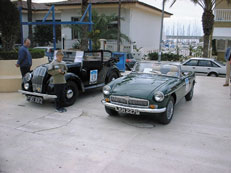
The area around Torrevieja and La Mata in southern Spain has been synonymous with the production of salt since Roman times and the town of Torrevieja even boasts a museum dedicated to salt production from the evaporation of sea water in its Salinas. Therefore it is no surprise that the Rotary Club of Torrevieja names its annual car rally for classic cars after the town’s ancient heritage. This year’s event took place over the weekend 29/30 March 2003. The rally is open to any classic car and this year attracted a mixed selection of traditional British marques, Rolls Royce, Jaguar, Triumph TRs, Morgan, TVR, a Morris 8 Tourer, an MGA and a couple of MGBs. Continental European cars were heavily represented with Mercedes saloons and roadsters, the ubiquitous Citroen Traction Avants, Alfa Romeo and a tiny Fiat Topolino. Finally a couple of huge American monsters from the 1960s made up the numbers to the 45 car limit. Competitors were mainly from Spain and the Balearic Islands, as well Switzerland and Scandinavia. Our MGB Roadster and the Morris 8 of our friends John and Sarah Straight represented the Brits. As the cars assembled on the Plaza alongside the harbour, we signed on at the Royal Sailing Club, a private members club normally off limits, but with our Competitors badges pinned proudly on our chests we were now allowed access to all areas and felt very important!
Morris Garages represented by Morris Eight Tourer and MGB
It is very difficult to organise any form of motor sport of the highways of Spain. In a country that is frequently drowning in a quagmire of legislation and administration the successful running of this event is a pure miracle, given the red tape involved. Throughout the rally we were under the constant supervision of the Guadia Civil Trafico who marshalled the event with a fleet of motorcyclists, in a manner befitting either a Royal Procession or the movement of top security prisoners. Nothing was left to chance by the organisers who had even arranged a breakdown recovery vehicle and mechanic as part of our convoy. By now you may have realised that the event is not the usual competitive driving event, more a leisurely procession of cars making their way around 260 kms of scenic Spain with frequent stops to take on refreshment and show off the cars. Nonetheless there were simple driving tests of skill and judgement, of a gymkhana style, in order to add competition and amusement for drivers and spectators alike.
After signing on and receiving our route book, competition numbers and a wealth of literature the rally finally started only 45 minutes later than planned, which by local standards was punctual. With the sirens of our motorcycle escort wailing we set off from the Real Club Nautico and drove along the packed promenade. At every corner children shouted and waved frantically, youths whistled and adults smiled broadly, the Spanish need little encouragement to enjoy themselves and the more noise they make, the better they like it.
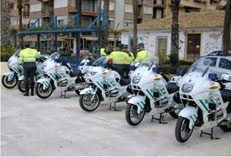
Constant supervision from the Guadia Civil Trafico who marshalled the event with a fleet of motorcyclists
Our route took us south along the coast to San Pedro del Pinatar, before turning inland through San Javier and to the first special driving test. On a private car park the cars were lined up in two parallel columns with a series of cones placed in a slalom course ahead of each car. The purpose of the test was not to score the fastest time through the course, but to follow exactly the actions of the other car alongside, thus aiming to cross the finish line together. Our MGB turned much tighter than the Traction Avant with its long wheelbase that was being driven by my partner in the other lane, but by mirroring his progress we managed to cross the finish line simultaneously. We congratulated each other on our success. The nimble Fiat was drawn against a Mercedes saloon in a meeting that left the driver of the Mercedes sweating and panting for breath as he finally wrestled the vast bulk of his machine across the finish line.
From here we travelled to the small town of Torre Pacheco where the cars were lined up for display in the town centre pedestrian area whilst the crews had lunch. This was no rushed affair as waiters served plates of cheese and cerano ham, then cal mares and savoury tortilla appetisers before the 4-course lunch of banquet proportions. An abundance of wine and beer flowed throughout the meal with the Guadia Civil Trafico joining in the party. Lunch took almost 3 hours and was probably rather rushed by local standards. The Town Mayor presented each of us with a canvas document case containing a brochure and guide to the area as we left the restaurant.
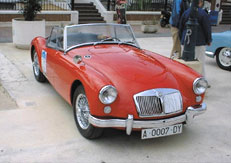
MGA De España
It was late afternoon when we set off towards the town of Orihuela, so our arrival at 5pm coincided with the town’s reawakening after the afternoon siesta. Here the sound of the motorcycle escort sirens was intense as the sound bounced between the tall ancient buildings that lined the narrow streets. Imagine being sealed in a 50-gallon metal drum and only accompanied by a trumpet that someone had connected to a garage air line……. On top of this the locals turned out to add their share of background carnival. As we left Orihuela and made the steady climb to the Sierra de Escalona the sirens thankfully fell silent and the peace and beauty of the countryside could be enjoyed again. This is an arid and barren area with stunning views across a wilderness similar to Arizona. It therefore came as a surprise to suddenly find the Embalsa le Pedrera, a vast water reservoir with a perimeter roadway winding 14 kms around its shores. It was here, as night was beginning to fall, that the next driving test was to take place. This consisted of driving around the Embalsa in our usual convoy whilst each individual car’s lap time was secretly recorded. Without knowing the time they had recorded the drivers had then to drive the route in the opposite direction and match their original time exactly. Penalty points for those who could not! Here we were at a greater disadvantage than most, only knowing the distance to be 14 kms. And we had originally travelled between 35 and 40 mph. So not only did this Driver and Navigator struggle with mental maths to convert kms to miles for the benefit of our MG’s speedo, we only had the digital clock function of the car radio as a timepiece, so our accuracy was haphazard at best. We finished the course and parked to await the others. Some had taken this really seriously and our friends with the Morris 8 managed his second lap within 6 seconds of his original time. And then only came third! We battled for last place and found it was denied us by an elderly Citroen that limped in very late with a flat battery.
In absolute darkness we made our way to Campoamor and our hotel set in the centre of the fine Campoamor Golf Course. On arrival in our suite we found a personal note of welcome from the President of the Rotary Club together with a bottle of Rioja wine in a presentation case. By now it was after 9pm but there was time for a leisurely bath and a short rest before the cocktail reception and dinner that was served at 10.30pm. Nothing unusual about the hour, remember that lunch did not finish until almost 5pm. The food was exceptional and we chatted to our new friends seated with us at the dinner table. They had travelled from Ibiza with their Citroen. Our conversation was probably more animated than even that of the native Spaniards around us, as we discovered the Ibicencos have their own language, not unlike Valenciana. As I am fluent in neither, and vaguely incompetent in Castilian Spanish, which is the official language hereabouts. I drew on all the tricks learned from the TV game show “Give us a clue”. The Spanish recognise at least 5 different languages which goes some way to explain why their conversations are always so animated.
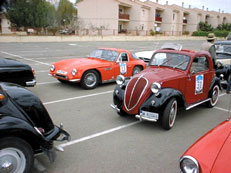
Entries of all types from TVR to Fiat Topolino
And so the next 3 hours passed by all too quickly. It was 1am when the band struck up for the dancing that was to follow dinner. After such a huge meal and awash with wine I waited for things to settle before venturing onto the dance floor, but by a cruel coincidence I had hardly begun to shake my body when all the clocks throughout Europe suddenly sprang forward by one hour to 3am to celebrate the arrival of summer time. The band celebrated by leaving. And so to bed where the next 5 hours passed more quickly than I would have liked and I was awoken by the clatter of buckets and the squeak of wringing wash-leathers as the front of the hotel was transformed into a giant car wash and valeting station. Six officers of the Guadia Civil with bloodshot eyes and unsteady hands silently leathered down their BMW motorcycles. They too had attended last night’s Dinner and Dance, although I had not recognised them without their green uniforms, crash helmets and sporting automatic pistols on their hips.
Sunday morning was bright and sunny as our cavalcade of cars set off again. Like a lazy ribbon we threaded our way through sleepy towns and villages like Jacarilla and Almoradi where the motorcycle escorts seemed to take a perverse pleasure in combining all 6 sirens, as if a wake up call to those who had celebrated last night as hard as we had but had not been obliged to put their clocks forward. We swept through stop signs, red traffic lights and were given priority at every junction as we made our way to the morning break at Catral, some 50kms from Campoamor. Once again we were greeted with unlimited beer and wine to accompany a tasty buffet. As coffee was not an option we stuck to water. Once again the cars were parked in the town centre and attracted a large crowd. The Spanish are a hands on nation and the cars were soon decorated with hand and fingerprints of all sizes. If you are concerned about scuffs and scratches then this is not a good place to be. You have only to look at the state of the average Spaniard’s car to realise their indifference to screen wash and car wax.
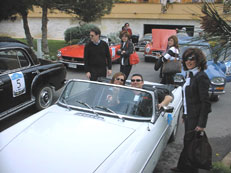
Spanish friends Gabi and Abril in their MGB
By now we were already running late, even by local standards it was agreed we were late, so a decision was made to use the new Alicante to Cartagena motorway to facilitate a quick return to Torrevieja. This was the first opportunity since the rally began to flick the overdrive switch on as we cruised at 50 mph. And it felt like 100mph as the Guadia Civil Trafico banished all other traffic to the rear so as not to interrupt the convoy. These officers were enjoying every minute of this jaunt that must have been a welcome change from their routine duties.
We returned to yesterday’s starting point and parked in front of the Real Club Nautico where a large crowd now gathered around the cars. This is an attractive area known as the Vista Alegre and consists of a marble surfaced plaza with fountains and statues. The final driving test took place here and required the driver to set off from a standing start and cover a distance of 10 metres as quickly as possible. However all had to be under control as the driver must finally stop as close as possible to a garden cane resting horizontally between two traffic cones. This provided plenty of entertainment for the spectators as cars clattered through the cane or stopped well short of it. My own efforts had me within 4cm of the bar, but I was easily beaten. The finalists both managed to stop whist touching the cane, yet not dislodging it from the cones; the result was only decided on the fastest time. I now realised why my fellow drivers had spent so much time getting as close as possible to the bar over the past two days…
The rally finally closed with lunch and presentations at the Town Hall Assembly Rooms. The Mayor thanked the organisers and everyone who took part and following complicated calculations was able to announce the winner. Amid good-natured heckling a Catalan from Barcelona took first prize and the Captain of the Guadia Civil was presented with a Plaque to ensure the event will take place again next year. All competitors received a Rally Plaque and an inscribed memento. I am sure an event of this nature would be greeted with horror in Britain yet it still brought out the warmth and friendliness seen amongst car enthusiasts the world over. In Barcelona they speak Catalan, in San Sebastian they speak Basque, in Madrid they speak Castilian, our new friends from Ibiza speak Ibithenco, we Brits speak English, but put a bunch of old car enthusiasts together in Spain and wherever they are from, they will soon be speaking the same language.
Bruce Rowbotham