Playing the Right Tune
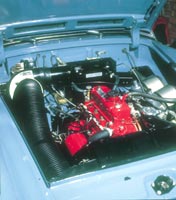
Roger Parker looks at some of the improvements that can be made to the popular A series engine
After a couple of months absence I am able to return to this series with a more detailed look at the various common MG models and how I consider is the best options for tuning for increased power for normal road use. It is clear that most owners are happy with their cars but would often like a ‘little extra pep’, just to sharpen things up during normal driving. They clearly do not want to go down the road of having to update all the running gear to suit a seriously uprated engine. I also specifically exclude any form of competition preparation as this is adequately covered in the individual regulations for the specific competition discipline.
As ‘A’ is the first letter of the alphabet it seems logical to start there, so let’s begin with the A series engine…
The A series has been seen in two basic forms, the in-line and the transverse. There are significant differences between the two and so in simplistic terms these should be regarded as different engines when comparing anything below the head gasket line.
Under the bonnets of various models of MG Midget the A series has appeared with 948, 1098 and 1275cc capacities with power outputs ranging from 46.5 to 65bhp. The A series is also of course so very familiar in a variety of other BMC and BL cars and has been one of the world’s most tuned engines. That statement makes two points, first that the engine is responsive to tuning and second, that it must be in a pretty low state of tune to start with. This is confirmed by the bhp per litre produced by these engines, which start with 49 for the 948, rising to 50 for the initial 1098, then to 53 for the later 1098 and dropping back to 50 once more for the 1275. Even the renowned Cooper S only manages just under 59bhp per litre, a figure usually beaten by current entry level city runabout engines, and put into perspective by many competition A series engine pushing 100bhp per litre without a turbo or supercharger in sight.
With this in mind remember it will be easy to raise power beyond the capability of the rest of the car and so what may seem to be a small increase of 11.5 bhp is a whopping 25% to the 948cc engine. It’s important to keep a sense of perspective.
948cc
The 948cc cars have much in common with the Frogeye Sprite from which it and the Mk 2 Sprite were derived. Unfortunately carry over running gear was weak, namely barely adequate drum brakes and weakness in the transmission. Now whilst it is possible to look at removing these weaknesses I would suggest that original Mk1 cars are better served by being retained in their original format, or as near to that as possible.
This leaves some scope for minor improvements with attention on the head, specifically through careful attention to the ports and chambers, being top of the list. Add a slightly raised compression ratio to between 9 and 9.5 to 1, an increase of approximately 1 ratio, and then to fit less restrictive air filters and a modest, but large in percentage terms increase will be seen. Even this level of change will demand a rolling road set up to optimise fuel and ignition settings.
1098cc
1098cc was created from 948cc with a big bore and longer throw crank. The capacity increase raised power to 55 bhp (20% increase) with extra torque but it also came with bottom end reliability issues from the crank and small 1.75″ main bearings. This engine was to see service in the MG 1100 and other BMC badge engineered 1100 cars, and whilst it was made in huge numbers, it was not an engine receptive to serious tuning.
Like the 948 there is scope to look into the same type of head modifications and in fact during 1963 BMC actually did just that and created a head that was to become a tuners delight, the 12G295 casting. This featured increased inlet valve size, 30.9mm from 29.2mm, with the exhaust remaining at 25.4mm. Porting was altered and fitting to other 948 or 1098cc engines would show a power increase, yet BMC claimed no power increase until November of ’64 when they announced the Mk3 Midget. This featured an improved 1098 with 2″ main bearings and a stronger crank, following the example of the recently announced Cooper S. BMC power figures showed an 8% power increase.
It is worth noting that arriving with the 1098 engined cars was a stronger gearbox and front disc brakes, giving more scope for tuning. However, if you have a 1098 car with a 10CG engine then it is a weak one, but if you have a 10CC then it can be regarded in the same strength category as the 1275.
For modifications to the early 1098, I suggest no more than I suggested for the 948. In fact fitting a cleaned up 12G295 head is often a way to arriving at a 10 to 12% increase. Cleaned up meaning that all the rough casting is smoothed in the ports and around the valve seats, with the same done in the chambers and the valves sit on three angle seats and a light skimming to raise compression ratio to around 9.5 to 1. Professionally, this sort of work is usually accompanied as standard now with unleaded conversion work, home tuners should keep this in mind.
With the 10CC engine there is much more scope and here the skilled handiwork of an expert can go to town on the head. I suggest the base line would normally have been a 12G295 casting as there is less work for a head tuner to do. However, in the absence of good second hand stocks, and I have only seen two in the last few years, the same work can be applied to the original head, but expect it to cost more. Valve sizes are something that many owners seem transfixed on increasing yet the need for increased valve size has to be confirmed or it may actually become counter productive. In the context of this area I suggest 30.9mm inlet and 25.4mm exhaust.
In effect, a larger port area accompanies a larger valve. A side effect of this is to lower the air speed at lower engine rpms, which with a carburettor engine that airflow has greater difficulty holding fuel in the airflow. Fuel dropout is a term that can apply and the result is poor engine running, less power than standard in this rpm area and poorer fuel consumption. Larger valve sizes have their place, but many of the best road engines often have the least attractive on paper specs. The truth though is that getting the best out of what BMC gives in standard form is often better.
It should also be said that mixing parts from different tuners often doesn’t work. Remember that specialists have spent considerable amounts of time and money creating their engine specifications. Whilst there is a degree of commercial interest in any advice they give, satisfied customers tend to come back and spend more.
The principle for all A series is that detail headwork provides the biggest gains so the suggestions for the weaker 1098 applies for the stronger 1098. Add the same suggested air filters and bell mouths, plus a tubular long centre branch (LCB) exhaust and matching free flow system and the recipe will push the power to beyond that of a 1275 engine with around 70bhp. At this point it has to be said that you can also use a 1275cc head onto the smaller A series. This is subject to ensuring clearance for exhaust valves in the block and calculating the correct compression ratio, plus using an alternative cam profile and different carburettors and see another significant power increase. However, I consider it more prudent to fit the whole 1275cc engine and achieve more power and torque at a stroke, with its untapped tuning potential.
A series engine of 1098 cc but with smaller 1.75″ main bearings not ideal for major tuning
1275cc
The 1275 engine was always regarded as a detuned Cooper S engine, one of the reasons it was a detuned version was for reliability, specifically in respect to cracking of the head between the inlet and exhaust valves. Today cracked heads are not uncommon due to age and modern petrols, fortunately the 1275 engine has been in volume production until a couple of years ago so there is a ready supply or newer replacement heads that can be used.
Before tuning this engine remember there is plenty of scope to raise power very significantly and reliably, but that reliability will not extend to the car’s transmission. Its gearbox and axle limitations are well known and so significant power gains demand significant improvements in the transmission and brakes. Here axles can be uprated, but gearboxes were really at the end of their design torque capacity for the standard 1275. This is one reason that the 5 speed Toyota gearbox has been so effective, but parts are not in good supply today, and it has been more recently superceeded by the 5 speed Ford conversion. This also overcomes the standard car’s overly short gearing which with standard gearbox and a tuned engine will make the car accelerate like a scalded cat on steroids, but the noise levels will also resemble those same felines ‘singing’ at 3am outside the bedroom window.
The 1275 was been subject to quite a degree of factory tuning seen clearly between the Midget and the MG Metro specs. Nominally, there is just 7 bhp difference between a Midget and MG Metro, but this more like 15 bhp advantage to the Metro, due to the different methods of power measurement. The obvious question is can the Metro supply its parts to boost the standard 1275 Midget engine?
In some respects, the answer is yes, plus there is further room for detailed modification to the Metro head to raise the power by another 12 to 15%, subject to ancillary changes to match. On a well set up Midget this would push power up by around 40 to 45%, yet be a tractable and road friendly engine.
In more detail the cylinder head is still the area where the best return for investment can be made in tuning terms. Valve sizes are larger than other A series with 33.2mm inlets and 29.2mm exhausts. The valve size may be larger but the ratio between engine capacity and valve size shows that BMC were being conservative in keeping the ratios similar to the other A series. A variation is seen in the MG 1300Mk 2 with a new head specification that featured even larger inlet valves, 35.5mm and modified ports.
14 years later the MG Metro mimicked this big valve head, with the base 1300 Metro using the Midget 1275 valve sizes. Consequently, it is a very good move to look at the MG Metro cylinder head as the basis for any modification and these are not difficult to find in good condition. (Note Metro heads, being A+, don’t use the bypass hose between the water pump and the underside of the thermostat housing.)
Mods are going to be seen in smoothing port shape and detail work on the area around the port split and the valve seats, using 3 angles of course. Chambers will have a degree of detail work with a chamber capacity matched to ensure a compression of around 9.7 to 1, even though the MG Metro runs a very high 10.5 to 1. Whilst the engines can take higher compression today, tomorrow is another unknown story. This route provides a degree of future proofing where changes in fuel make up and octane rating can be accommodated comfortably. This work is described in a number of books, but there is no substitute for the practised hand of a professional expert.
In an MG Midget the standard SU HS2 carburettors are far better than most people give them credit for, with good low speed response and fuel economy. They can more than adequately cope with a 25 to 30% increase in power and this will be seen in the normal road driving rev range. Conversely, standard air filters will be restricting the upper third of the power band so need to be changed for those suggested for other Midgets, with the bell mounts. An LCB manifold and performance exhaust system will finish this specification. (Note that the fitting angles of the very efficient MG Metro 1.75 HIF44 and water heated inlet will not fit under the Midget bonnet line.)
The standard distributor will be perfectly adequate if in good condition and the vacuum advance should be retained to help economy and will not hurt power. For engines where more than 30% power increase is being reached then replacing the HS2s with HS4s can be done with a small lower rpm loss of torque and power. (See later for more on carburettors.)
Cams
The standard Midget cam is the same and is a common cam used in a huge number of different cars with inlet timing of 5 degrees Before Top Dead Centre (BTDC) to 45 degrees After Bottom Dead Centre (ABDC) to give 230 degrees duration. Exhaust opens 51 degrees Before Bottom Dead Centre (BBDC) to 21 degrees After Top Dead Centre (ATDC) and 252 degrees duration.
Many people have difficulty with understanding the term ‘Duration’. Quite simply it is the time that the valve is held open. It is calculated by transposing the timing onto a circle (360 degrees) and noting Top dead Centre (TDC) at 12 o’clock and Bottom Dead Centre (BDC) at 6 o’clock. So 5 degrees before TDC is just before 12 o’clock and 45 degrees after BDC is just after the 6 o’clock position. Since the valve is open between 12 o’clock and 6 o’clock that period accounts for half the circle, or 180 degrees. The total open period is 180 degrees plus that which the valve is opened before TDC and after TDC. Thus the duration is 5 + 180 + 45 = 230 degrees. Exhaust duration is calculated using the same principles but here the other side of the circle is used, the effect is the same though.
Overlap is another term that many don’t understand and here it is the period when the inlet and exhaust valves are both open to whatever degree. This occurs at the end of the exhaust stroke when the exhaust valve is closing and at the start of the inlet stroke when the inlet valve starts to open and is expressed in degrees. So with the Midget’s inlet starting to open at 5 degrees BTDC and the exhaust remaining open until 21 degrees ATDC, there is a period of 26 degrees of crank rotation where both valves are open. Overlap is needed as there is insufficient time for the cylinder to either fill or empty if the valves were to open and close at TDC.
This condition becomes more apparent with highly tuned engines where with higher revs there is a greater need for bigger overlap periods and this reflects on poor running at lower engine speeds due to the negative effects of both valves being open at the same time. Essentially exhaust can pass into the inlet and inlet air and fuel can pass straight through into the exhaust. These effects are negated at higher engine speeds and are why many engines with non-standard cams have a dead period at lower rpm then the engine starts to work at a certain RPM. This is often described as ‘coming on the cam’.
The Metro range and the A+ engine changes saw only tinkering with the standard cam profile with the 1300 Metro engine sharing the same 230 and 252 degree duration as the Midgets and all 1300 cams having the same valve lift of a 8mm. The MG Metro though featured a different profile and had inlet timing of 16 degrees BTDC to 56 degrees ABDC giving 252 degrees, and the exhaust opening at 59 degrees BBDC to 29 degrees ATDC giving 268 degrees. Overlap jumps from 26 to 45 degrees and this is reflected in a less smooth idle and often problems in getting under the current UK annual test exhaust emission check leading to the use of the standard 1300 cam in later engines, not something that affects UK A series Midgets. The effect on the engine is certainly positive and I suggest that this profile is a good one to use on a road going Midget 1275 where no loss of driveability is wanted.
Away from standard camshafts there are many manufacturers and re-grinders who offer a very wide range of alternative cam profiles and lifts for the A series engine range, and the sales information is often quite attractive. However, the reality is that these claimed gains, although genuine, are not always going to be seen in your application as the ‘test’ engine may have been set up very carefully having all possible tolerance adjustments done matched to the ideal ignition and carburettor changes. This attention to minute detail is not usually possible or practical for our engines. Therefore, do take claims with a pinch of reality and look at the cam specs and for a road engine I suggest keeping to a sub 270 degree duration, with overlap no more than the MG Metro.
Engine capacity and cam profiles have a very sensitive and directly related relationship. Essentially short durations such as the 230 degrees seen on the Midget inlet provide a very smooth idle and strong torque in the low to mid rpm range. Extending that duration has a progressive effect in moving the power and torque delivery further up the engine rev range, leaving idle less smooth and low engine speed torque weaker, but higher engine rpm power and torque stronger.
You can’t beat capacity is a common cry and this is usually true. With cams a useful effect of enlarging the engine capacity is that the larger capacity dampens the effect of the cam profile, so a Midget that runs very smoothly and well on a 230 degree duration cam would cough and splutter on a 285 degrees at lower revs. The 3.5 litre Rover V8 though is as smooth and creamy as they come and pulls top gear smoothly from 400rpm yet has a 285 degree duration cam.
That is an extreme example, but the principle can be used effectively when considering rebuilding your 1275 engine. Standard rebores are usually seen in 20, 40 and 60 thou over sizes, giving 1293, 1312 and 1330cc respectively. The MG Metro cam often makes the engine a little lumpy at idle and difficult to set emissions with the 1275cc capacity, but at 1330cc it is usually much smoother and similar to a 1275 with a normal cam. These conditions give additional benefits for considering taking the engine to a larger capacity. If your engine needs rebuilding then the additional cost of going out to plus 60 rather than plus 20 is small and worth the extra.
An engine with a 45% power increase in a Midget should now reach a theoretical 108mph, based on the standard car’s road test maximum quoted at 96mph (Autocar 4th Feb 1971). At this speed the engine would have to be turning at over 6400rpm with standard gearing that will be above the power peak rpm point. The significance of this is that beyond peak power the engine’s power delivery drops and so there is less power to increase speed. In a nutshell, there are four elements to consider, engine power, engine rpm, power required for speed and gearing. The ideally geared car for performance has the power peak and peak rpm point matched to the calculated maximum speed that power can achieve in that car, then the gearing is matched.
Using the standard 1275 Midget as an example sees the engine rated at 64bhp net at 5800rpm and the gearing of 16.5mph per 1000rpm in top gear. Maximum power for this gearing equates to a speed of 95.7mph, which compared to the actual achieved speed of 96mph shows that the factory gearing is just about spot on for performance. Raising the power of the engine will see the peak power point rise slightly to 6000rpm or just under. 6000rpm would equate to 99mph and to achieve this the engine needs to produce just 10% more power. As this tuned engine would be producing much more power at this point the power drop after peak power will still allow a greater speed looking at a reasonable rate of drop off. I suggest that on a graph the power required line and the power produced lines would cross at around 104mph and 6300rpm.
The above is mainly theoretical as most will agree that the standard gearing on any Midget is too low in standard form. Consequently, a tuned version will exaggerate these negative aspects and whilst it is often a sweeter and smoother runner it can’t hide the low gearing. The post August 1977 Midget 1500 benefited from a 3.7 final drive that raised the mph per 1000rpm in top gear to 17.9, 1.4mph better than the earlier cars. This is a useful 8.5% rise that would be well suited to provide as good a matched gearing for our tuned Midget engine as you’re likely to get. Although it would still be a buzz box as it ideally needs the overdriven 5th gear to provide more comfortable cruising in modern open road conditions.
Optional ancillaries
First let’s look at bigger carburettors. The standard SU HS2 1.25″ carburettors are very effective in providing the ideal in a road car environment and moving to larger 1.5 SUs will see some loss of low speed torque and driveability. However, once you move the power band over 30% there is a good case to change to the 1.5″ SUs. Cost is always a significant influence and here I would balance that against the condition of the original carburettors. Put simply if the HS2s are in good condition there is a weaker case for a change, but if they are worn then there is a very strong case as you must at least be into refurbishment costs of the originals. Also try and plan for future intentions, even if you’re not going straight to that specification now. Only a mug spends money on expensive tuning gear then fits worn carburettors, or a worn distributor.
I will give a mention to the Weber DCOE and similar fixed jet and say that whilst these carburettors are very effective and have a slight advantage over the SUs in terms of outright power they are not quite as good at lower rpms and part throttle. As a result, they are less fuel efficient and generate considerably greater induction noise. For this level of tuning they are best left to the competition spec engines.
Perhaps the most overlooked area of any engine is the distributor, which if working, however badly, is asked to soldier on and on until it collapses in a proverbial heap of lost HT sparks. It’s a relatively low cost but high return item, simply from the aspect of removing wear and poor timing. Some wear can be eliminated by adding electronic ignition, which does make sense on a tuned engine where constant precision in ignition switching is needed. This is especially so for many distributors where there is uneven wear on the points cam. All owners still on points may like to measure the points gap on each of the cam lobes and many will be surprised at the variation. On a dwell meter this shows up as a variable reading.
The standard specification Midget distributor will be fine in most applications. Alternative distributor specifications are available but before buying take the trouble to put the car on a rolling road and then plot the best ignition timing is for your engine at various rpms. This then allows any changed distributor advance curve can be set to as close to the optimum as possible. Buying a performance distributor because it has a ‘performance’ label is totally the wrong approach!
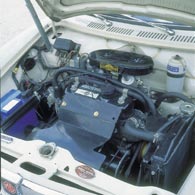
Transverse A series 1275cc
FWD A series
My final area of recommendation has to cover the FWD cars and this starts with the MG 1100. The engine delivered 55bhp as supplied on a pair of Twin SU HS2s and featured the 12G295 head. It also featured the weak 1098 10CG engine and so the same tuning limitations apply as the early Midget. The cars are rare now so I doubt owners would want to do more than a few careful tweaks to sharpen the performance while retaining the original look.
The MG 1300 first appeared as the MG 1100 with a chrome 1275 badge on the boot indicating that this engine option had been fitted. In this form it had the base Austin 1300 tune with a single HS4 SU and 58 torquey BHP. Soon after the Mk2 1100 and 1300 ranges appeared and the car was badged MG 1300 and gained twin HS2s and a power hike to 65bhp. This specification is essentially the same as the Midget 1275 and can be dealt with in the same manner. Unlike the Midget though there was a further step up in performance with the MG 1300 Mk2. This had larger valves and higher compression mentioned before together with a Cooper S cloning of an extra head stud and bolt to help contain the higher cylinder pressures from the 9.75 to 1 compression, up nearly 1 ratio. There was also a three branch tubular steel exhaust manifold, not an LCB type, that was hardly more effective than the original cast item and it regularly split.
The same tuning methods can be applied to the FWD cars as applies to their like age Midgets. Even potential weaknesses in the transmission are also applicable, although these earlier transverse gearboxes had stronger steel caged bearings rather than the Metro move to nylon cages in the search for refinement. The main problem coming from the original cross type of driveshaft couplings connecting the driveshafts to the gearbox, which would rot quickly when contaminated with oil and break up under torque application. A quite regular problem on these cars. Uprated non original parts were readily available in their day but now these may not be so easy to find.
Steady bars to stop engine rock should be considered, even on standard cars to reduce exhaust failures. A long centre branch manifold and performance exhaust system shows worthwhile gains and both should be fitted. I have fond memories of using mother’s MG 1300 Mk2 between 1970 and 1973, which I treated to a well modded head that resulted in a very marked improvement in performance but me becoming expert in welding up the exhaust manifold!
The MG Metro provides the pinnacle of the performance A series in standard factory specification and there is plenty of scope for improving that further. One downside though is that with these cars coming from a period where MoT exhaust emission requirements had started to become tight, there is a need to consider the annual test. I mentioned earlier the difficulty that could be seen with getting an MG Metro to pass the emission tests, so there is little point in fitting an alternative performance cam if this is going to make it even more difficult to pass the annual test. Better to look at increasing the engine capacity and sticking with the standard cam. The head may be one of the best performance heads to come from the factory, but there remains plenty of scope to improve it through careful attention to the same areas as with other A series heads.
It already operates with a super efficient large single carburettor and inlet manifold, itself a reflection of the effective tuning done in the 1960’s and ’70’s on the A series. This also applied to the exhaust where the cast iron manifold and the exhaust downpipes adopted the LCB design to great effect. Even the MG air filter was developed to produce more power than standard so the scope for increases through further change is much more limited. However a good exhaust system attached to the cast manifold and a carefully designed high flow air filter system with ducted air from a cooler part of the engine bay will add around another 8% to the 15 to 20% an expertly modified head can give. Be aware though that the standard air filter uses a cast adapter that does the same air flowing job that the bell mouths do for the twinned SUs and that many ‘performance’ air filters simply bolt to the back of the carburettor without. Therefore adding a bell mouth (stub stack) will ensure that you don’t look to gain 5 bhp and then lose 3 bhp by introducing turbulence!
As always the running gear in terms of brakes and suspension need to be looked at to ensure any modifications can be safely contained. Fortunately, there is a good selection of options and in fact the basic car is well equipped to start with.
I will end by mentioning the pinnacle of A series factory performance which was the Metro Turbo. Restricted to just 93 bhp on 7psi of boost from the Garrett T3 turbo this was a perfect example of how easily the A series engine could overpower the chassis it was fitted to. The main problem was the gearbox and its limited torque handling capacity, and torque is the main result from turbo charging. This meant that had the Metro been given the same turbo specification as the Maestro and Montego Turbo models, with 10psi and an air to air intercooler it would certainly have produced very close to 100 bhp per litre, but it would have broken a gearbox every other lamp post! This didn’t stop further development that saw some competition cars producing close to 200bhp through a combination of traditional tuning plus the inevitable raising of boost.
The standard turbo is restricted to 4psi boost until 4000rpm is reached and only then is the full 7psi allowed. Many people feel the need to mechanically over ride the boost control and select higher pressures by adjusting the wastegate actuating arm length. A simple process for immediate results, but I can’t recommend any changes without some suitable reworking of the gearbox. The Mini roots of the 4 speed box also restricts the potential with the gearing as the gears were spaced wider than is desirable to achieve an acceptable top gear ratio. The Metro Turbo is already rare even though it is a relatively recent model. It is so easy to tweak the boost and then go and break the engine that many examples have been lost to breaking and also for supplying parts for tuned Minis. It is perhaps best to start viewing this model as endangered and keeping it close to standard spec.
Finally I will remind you that all my suggestions are for mild road use. There remains a place for the super tuned variations but not in the context of this feature. Owners wishing to look for such exotic conversions have to gather much more information than can be written in the whole of this feature and I can speak to owners individually if they wish to contact me at the Club office.
Next time we will look at the B series engine.
Roger Parker