Trials and Tribulations with an MGA
Trials and Tribulations
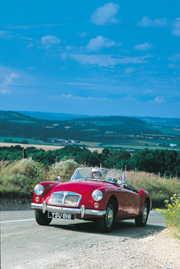
It was a hot afternoon and the evening forecast was good. We decided that it would be a wonderful idea to use the MGA for the dinner date we had with our in-laws. They were staying in a hotel about three-quarters of an hour away and we had a table booked for 7.30pm. Leaving with plenty of time to spare to enjoy the car and the fine weather, we had not a care in the world.
Ten minutes into the journey the car coughed as we came out of the first village en route. Nothing to worry about I thought until at the end of the next village, the car started to miss and as we tried to coax it up a hill, it petered out to a final stop. Trying the starter saw the engine spin over but with no signs of life.
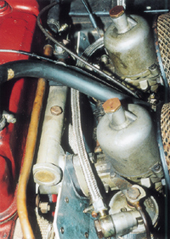 Up came the bonnet and boot, out with the tools and I inspected the engine bay, checking for fuel supply and a spark. All were present and correct but still no life as the starter turned. With my thinking cap on, I went through all of the possibilities that could be causing the problem. After three-quarters of an hour it was obvious that we were not going to get to the hotel. A frantic phone call sorted out the arrangements and another call to a friendly neighbour secured a lift back home to collect the workhorse car and a car-trailer.
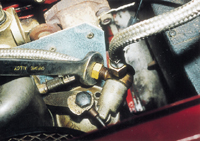
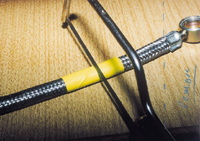
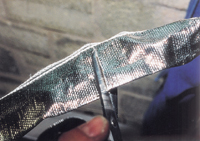
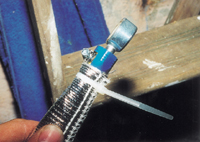
However on the return trip to the stricken car I passed a familiar looking red MGA with my other half driving it. So I turned round and returned home only to find one red MG complete with grinning driver who, having managed to start the ‘A’ had then driven home without a problem. All of the symptoms pointed to fuel evaporation. Looking at the way the fuel pipes were routed over the top of the engine, my mind immediately ran away with the thought that this must be the case. This view was further enforced by the fact that it was the first time we had run the car on unleaded petrol. Unleaded is more volatile than Four Star and therefore should have a lower evaporation point, thus raising the under-bonnet temperature with the extra heat making the problem worse. The cure was to order up a braided fuel pipe, pipe finishers and some heat shielding lagging. This should insulate the fuel pipe from heat sources and deliver the fuel to the float chambers at as cool a temperature as possible. The following weekend this was all successfully installed, as can be seen by the photographs. However due to the ‘British Summer’ it was several weeks before we were able to test out my handy work.
At last the sun was shinning and it was time to test the remedy. After 15 minutes of driving there was not a sign of the original fault. Great, we thought, now we could enjoy the car again. Then, just as we were starting to relax, the car one more spluttered and the engine petered out in the exact way as before. Again all the checks were carried out and confirmed that there was fuel and a spark. However this time I was looking for any other clues for the cause of the failure. I was sure that I could not get the fuel to the carburettors any cooler, so the problem must lie elsewhere.
Another critical look had me checking the colour of the spark. It was not a white or bright blue spark but more a weak yellow. Could this be a clue? It was then that I decided to replace parts on the ignition side of the car.
Talking to my local MG Owners’ Club Recommended Supplier he recounted a problem he had experienced with several customers’ cars with a similar fault. The remedy – a simple rotor arm change. Too good to be true, I thought. However, prepared with a replacement rotor arm in my pocket; I drove the car up the road until it failed again. This time I pulled over and changed the rotor arm. After fitting the new arm the engine then started, to my astonishment, first time. This trial with the MGA just goes to show that whatever symptoms the car shows, even if it seems to obviously indicate one fault, do not go down that single route loosing sight of what other areas may cause a similar problem. All the indications pointed to a fuel problem but in fact, after having spent over £80 to overcome the excess heat; it only needed £2 spending on a replacement rotor arm to remedy the fault. Oh well, that’s life.
 |
 |
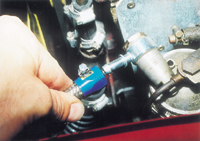 |
| Removing the original fuel lines | The easiest way to cut braided pipe is to tape up the cutting area first to stop the braiding splitting everywhere | With the pipe neatly cut the end clip finisher can be put on and the whole pipe pushed on to the union |
 |
 |
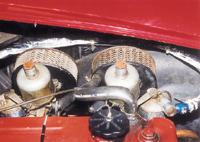 |
| Cutting the heat reflector and insulator material to size | Securely fixing the insulating material | The re-routed line now away from heat source and protected from heat, hopefully stopping the majority of evaporation occurring |