MG TF Assembly Final Part
| Last month saw the completed assembly of the car ready for dispatch to the dealer. Whilst this process is visually the most interesting aspect of a car’s build there is a huge amount of work done away from the assembly line, hardly surprising with the thousands of parts used in each car. | |
|
This month we take a glimpse at the build of two of the major parts of the car, the body and the engine, which shows the complexity and commitment, needed to complete each aspect. Considering how much else has to be made and put together the whole process of car assembly is seen to be a massive and widely spread operation. |
 |
 |
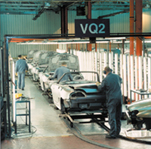 |
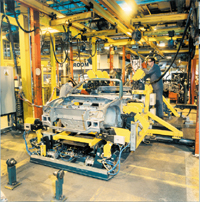
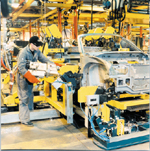
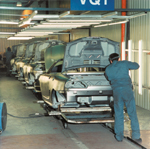
| The TF body undergoing welding | Welded bodies on individual dollies receiving bolted on panels | Bodies in final inspection area before being dispatched as ‘body in white’ form, from Coventry to Longbridge |
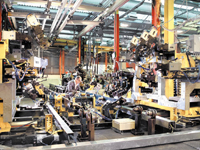 |
Firstly we visit the body assembly facility at Mayflower Vehicle Systems Coventry. Mayflower it should be remembered stepped well beyond the normal position of a supplier with the MGF and became a partner with Rover in the development and production of that car. This exposed Mayflower to a different and greater risk, but enabled the development cost of the MGF to be spread and in doing so enabled the car to be produced. With the development of the MGF body shell into the new and revised MG TF shell Mayflower remain close partners with MG Rover.
Turning sheet steel into a car body is a very complex process involving machinery of very considerable size and enormous power. It also requires a wide range of tools to form the specific shapes of all the panels large and small, which are subsequently assembled on jigs to ensure correct positioning before they are welded together. The complexity of these jigs and the depth of welding required is hinted at in a couple of the images.
Once the main substructure is welded it becomes rigid enough to be placed on special dollies and the bolt on external panels can be fitted. The quality of the fit of these panel is vital, as the bodies have to be ready to enter the paint process immediately they arrive at Longbridge. There is no time to follow the normal body shop techniques of a skim of filler, followed by a ‘guide’ coat before any top coats are applied, with this process it has to be right first time. Quality checks and final adjustments can be see in the photographs. Once the bodies have passed through the final checks the ‘bodies in white’, as they are termed, are transported from Coventry to Birmingham, painted and drop down onto the production line at the appointed time, as we saw in the first instalment. |
 |
When MG Rover was formed in 2000 one major element was initially missing. This was the Powertrain division, where the K series engine range, PG1 and R65 gearboxes are made. Clearly with the vast majority of Powertrain’s production going into what were now MG Rover products the situation whereby Powertrain was an outside (BMW owned) supplier was far from ideal. Fortunately, at least from an external viewpoint, Powertrain became part of MG Rover Group some 12 months later. |
 |
The heart of any car with character has to be the engine and the K series is a very willing and strong heart for the MG Rover ranges. With Powertrain being under the MG Rover umbrella the door opens to much greater development. The first avenue being the 160PS version of the VVC engine that appeared in the Trophy 160 SE MGF and which has been refined further for the ZR 160 and TF 160. |
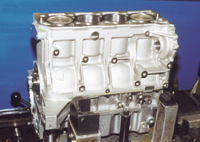 |
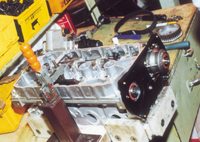
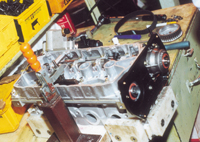
Powertrain is located at Cofton Hackett, which sounds a very quaint countryside hamlet, but in reality is a few hundred yards down from the main entrance of MG Rover’s Longbridge plant. Viewed from the front with a good selection of trees fails to give appreciation of what occurs behind the gates. Inside the assembly area a steady stream of engines were undergoing construction. Whilst I have a very high regard for the K series and its potential, I am also aware that in the MGF especially there were (in the early days) a higher than desirable rate of head gasket failures. It was therefore interesting to see the bin of steel dowels that are now used to locate the head onto the block. |
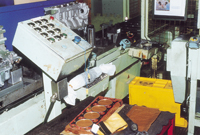 |
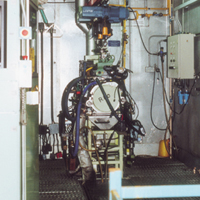
VVC engines are essentially the same as other 1.8’s below the head gasket line but above there are massive differences. The VVC heads on the day I visited were being assembled by Mike Williams whose skill and deftness in putting these together was a pleasure to watch. Mike would be the ideal chap to have on hand if you wanted to do any work on your own VVC head! VVC engine build accounts to about 250 per week, with each undergoing hot test before dispatch. For interest Powertrain are producing over 200,000 engines and over 70,000 gearboxes per year. |
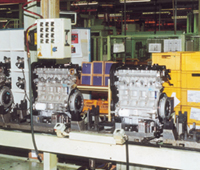 |
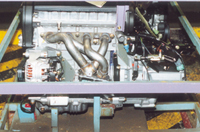
Once the engine has passed tests then depending on its destination and use will either be crated for dispatch, or fitted to its PG1 series gearbox pending transportation those few hundred yards up Lowhill Lane and providing the dynamic heart to another MG or Rover. |
 |
The facility of following the build of a single car is, to someone outside the industry, a fascinating and illuminating experience. It highlights the complexity of building a modern motor car and the efforts that MG Rover is making to produce a quality product. I hope that this series has been of interest, even to those whose affiliation is towards the older MGs, remembering that every MG will be old one day. |
 |
Thanks have to be extended to Kevin Jones and all the people of MG Rover who I had the pleasure of meeting and talking with. They exuded a clear sense of pride and enthusiasm in what they were doing and give confidence for me to fully support their products. |