Which Engine!
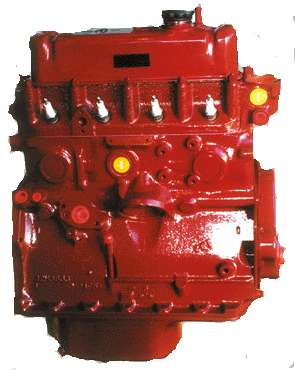
Which Engine!
When the inevitable happens to your engine at the end of a high mileage and high revving life, the popular misconception is that there are only two choices of replacement – standard or performance. To tell you that for an MG B there are between fifteen and twenty different alternatives may sound daunting, but by deciding exactly what you ideally expect to suit your style of driving and the road traffic conditions you normally encounter, the decision is radically simplified.
In last month’s edition we looked at the re-manufacturing processes, which go into producing the high quality replacement engines that are now readily available. By understanding how each of the main engine components contribute to running characteristics of a specified engine, it becomes easily possible to arrive at an individual specification which can then be closely matched to the right performance engine for you.
First consider your own driving preferences and driving style, analyse the way you drive and the kind of traffic conditions you regularly encounter. Ask yourself whether you find yourself on motorways or on A or B roads, is the MG regular everyday transport or weekend fun only? Do you drive enthusiastically and change gears in the higher rev range or does quiet smooth cruising appeal to you most? Is volume of traffic a problem where you drive, with queues and jams being a regular occurrence or is the open road the norm? Budget is inevitably a consideration, but it would be best to determine your ideal specification regardless of cost in the first instance, and then moderate that specification by omission of the least valued features until specification and budget match.
If you are using your MG for week-end pleasure trips and are happy with performance which by modern standards equates to a small family saloon, then there is no need to change from the standard specification. A degree of extra smoothness and quiet running can be achieved by ordering one balanced throughout including the flywheel and clutch.
For cars fitted with overdrive, a comfortable high speed motorway cruising speed is achieved at 3,200 RPM and acceleration whilst not being dynamic by todayís standards, is well capable of keeping up with all traffic conditions. All engines should now be supplied with hardened exhaust valve seats to run on Lead Free fuel.
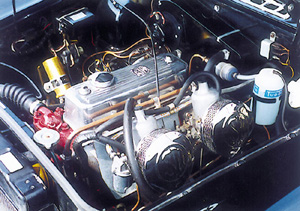
Any modifications to an engine which create extra power earns the description Performance Engine, but in practice the standards and specifications vary enormously, and knowing what each contributes is essential to making the right choice for you.
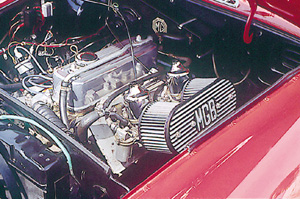
One sure way of improving overall power of the engine in terms of both brake horse power and torque is to increase the size of the cubic capacity of the engine. The options of sizes for MGB that are available in addition to the standard 1798 cc are 1840cc, 1950cc, 2100cc and to order 2200cc. Larger capacity engines are available for Midget 1500 models and the V8 is also available in 3,900cc and 4,600cc. The logic is obviously bigger engine more power. It is worth noting at this stage that the brake horse power of the engine is not the biggest gain through increasing engine size, it is the torque. Furthermore it is the torque of the larger capacity engine from the mid range of revs which gives dynamic acceleration, which then moves into higher brake horse power as revs increase. Increasing the cubic capacity is therefore considered a sound basis for any performance enhanced engine, as improved power is delivered smoothly without affecting any of the normal engine
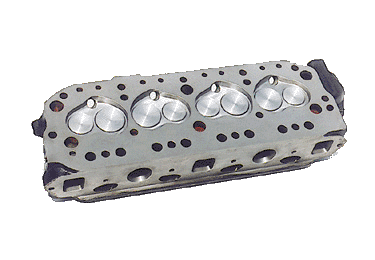
The cylinder head can be modified in six principal ways to improve power and performance.
1. By increasing the valve sizes.
2. By increasing the volume of the air induction and exhaust chambers.
3. By smoothing out the surfaces of the air induction and exhaust chambers to accelerate the flow of fuel/air.
4. By smoothing and shaping the curvature of the same to increase air flow.
5. By shaping and smoothing the crowns of the cylinder head, (ie the area in which the combustion takes place) to again improve gas flow.
6. By equalising the volume of each crown and then skimming the head to provide an exact specification of compression ratio. This ensures even power and running on each cylinder
All these effectively improve the efficiency of flowing fuel /air mixture into, and exhaust gases out of the engine and it is not surprising that this component takes the greatest skill and time to prepare. This list is not exhaustive and the science of power tuning cylinder heads is seemingly endless. However, the principal of improving what for the MG models was a very unrefined casting into a more efficient version makes it a worthwhile inclusion in any performance engine where improvements in both torque and brake horse power will be gained. Carrying out this work requires skill and is very time consuming. The wasteage rate is also high and therefore the additional cost of including a Stage 2 head will about £200.00
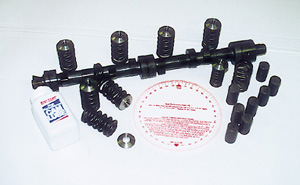
No other engine component will affect the running of the engine or determine at what revs the power will be delivered as much as the camshaft. It is basically a series of eccentric lobes along the length of a driven shaft, which is used to open and close the inlet and exhaust valves at specific timing and to a specific height. This simple principle gives rise to endless variations in the shape, size and timing position of each of the lobes and each configuration produces a different effect on the engine running. To simplify matters it is best to understand that the standard camshaft is ideal for providing a smooth tick over and good torque response but does not allow a performance engine to achieve maximum brake horse power which is normally delivered at around 5,000 RPM. A mild camshaft starts to deliver more power at the high end together with increased torque, and still allows the low end running to be virtually unaffected. Fast road camshafts deliver more BHP and torque at the high revs and have a distinctive power cut in and cut out range. This is known as the power band and for MGB engines starts around 2800RPM and ends at varying points up to 6000 RPM. The tick over and low rev response will be affected although the extent of this can be compensated for to a large extent by matching the ignition timing to optimum. With the standard Lucas distributor this cannot be easily adjusted as the advance curve is pre determined by the springs and bob weights mechanism, but with the Lumenition Ignition Management System the settings can be programmed precisely to any individual engine and best results achieved. When choosing your engine consider your own driving style and decide whether you drive enthusiastically, changing gear at higher revs (4000 to 5000 RPM) and drive predominantly on open roads. If so then a faster cam is fine and you will get the best from it. If your style is more leisurely and gear changes come in at 2500 to 3500 RPM, you regularly encounter queues of traffic, or if you want more torque to give you plenty of power for lower rev overtaking and acceleration, then a standard or mild camshaft is best used with the larger cubic capacity engines. The cost of the camshaft does not vary greatly although the performance options are inevitably more, but choosing the right camshaft for you will make sure you get the best performance and most enjoyment from your new engine.
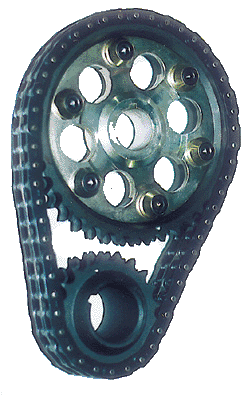
These gears drive the camshaft from the crankshaft and the term Duplex refers to twinning of two gears and two chains running parallel to give greater strength and accuracy. The Vernier is the adjustment mechanism incorporated into the larger camshaft cogged gear, and this allows adjustment of the outer cogged gear relative to the centre keyway. This means that instead of the relatively coarse adjustment in one tooth sections of the original equipment, the camshaft can now be adjusted to the exact degree desired for smoother running and more power, with no adverse effects.
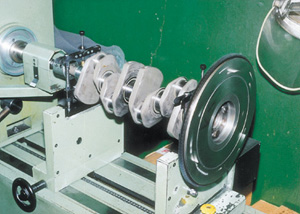
With any degree of power improvement the stresses placed on the components are increased and need to be compensated for if the engine is to last. One effective way to accomplish this is to balance the drive assembly of the crankshaft, flywheel and clutch. This is done dynamically, (with the assembly rotating) and excess metal causing the assembly to run eccentrically is removed from the outer castings until vibration is eliminated. The principle is similar to balancing road wheels. The con rods are also balanced in weight and centre point, and the overall effect is to quieten the engine by removing vibration from these components which in turn reduces engine wear and prolongs engine life. This is also a low cost option, which is well worth including on any engine specification including standard.
To get the best from your choice of engine, (and particularly performance engine), the fitment of ancillary bolt on tuning equipment will make a real difference. The following are suggested in order of benefit relative to cost.
1. Three-branch tubular manifold replaces the original cast iron manifold and works by smoothing out the severe curvature of the bends to allow the exhaust gases to escape more quickly. As far as practical the lengths of manifold tube and cubic capacity of those manifold lengths are equalised to create even pressure in every part of the manifold, thereby smoothing the running of the engine. May be bought as part of a complete exhaust system, or by itself to be sleeve fitted to the original front pipe, and is considered to contribute from 3 BHP upwards to performance.
2. K&N Air Filters and Stub Stacks, give efficient induction of air supply into the engine. The filters are very low maintenance, high efficiency units, which offer very low resistance to the passage of air through them, unlike the original equipment paper filters. With a more abundant supply of air at inner chamber of the air filter, the bolt on stub stacks flows the air efficiently into the neck of the carburettor to optimise performance. With an increased supply of air the fuel supply may also need to be increased to match by fitting richer needles. Again the power increase is from a further 3 BHP upwards, depending on engine/ancillary equipment and set up.
3. Performance Distributor and Lumention. The first accurately times the ignition spark more accurately by doing away with the vacuum advance mechanism, and with a different advance curve provides a more reliable spark timing in the higher rev range. The cost of this distributor is often cheaper than standard, and fitting a new distributor with a new engine is worthwhile. The contribution in terms of BHP is not practical to gauge. Fitting Lumenition electronic ignition at the same time further improves accuracy and reliability and is available in a range starting with Magnetronic through to a full performance Ignition Management System.
4. Larger Carbs and Weber Carbs. For the larger capacity engine or where there is a very high state of tuning it is practical to increase the carburettor size from say HS4 to HS6 and jet and needle to the new application. The most popular example is AUD505M – the Abingdon specification MGB HS6 Carb and inlet manifold assembly. Weber also do a twin choke DCOE 45 and for V8 models Weber do a 4 barrel down draft with Offenhauser manifold. This list is by no means exhaustive but gives the well proven parts to consider when fitting your new engine.
Help is at hand if you have difficulty in making up your mind or need further information, but if you have decided on more power it would be wise to include greater engine cubic capacity together with engine balancing as a good starting point. The Stage 2 cylinder heads give extra power and donít need to be matched to fast cams so it is practical to order say a 1950cc Stage 2 engine with standard cam if you prefer lower rev gear changes. It is also practical to request an engine specification not already offered and an individual quotation can be prepared in every case. Although most of the examples given have been MGB, the same principles apply equally to Midget, A, C and V8 models. Enjoy choosing and enjoy your new engine!
A complete range of performance and standard engines for all MG models is available from MGOC Spares Tel. (01954) 230928 and MGOC Accessories Tel. (01954) 231318.Any variation to the engines listed below can be supplied to order.
| G500 | 1840cc stage 2 MGB | £1250.00 |
| G505 | 1798cc Balanced Eng. MGB | £799.95 |
| G510 | 1950cc MGB engine | £899.95 |
| G510BE 1950cc | MGB Balanced Eng | £949.95 |
| G520 | 1950cc stage 2 MGB | £1450.00 |
| G524 | 2100 High Torque MGB | £1875.00 |
| G525 | 2,100cc stage 2 MGB | £2579.00 |
| G526 | 1798cc 3 bearing stage 2 MGB | £1720.00 |
| G528 | 1098cc Midget stage 2 | £1150.00 |
| G530 | 1275cc Midget stage 2 | £1150.00 |
| G535 | 1500cc Midget stage 2 | £1150.00 |
| G536 | 1600cc Midget High-Torque | £1099.95 |
| G545 | 1489cc MGA stage 2 | £1472.95 |
| G546 | 1588cc MGA stage 2 | £1472.95 |
| G547 | 1622cc MGA stage 2 | £1472.95 |
| G548 | 1950cc MGA stage 2 | £1550.00 |
| G549 | 2100cc MGA stage 2 | £2700.00 |
| G552 | 3000cc MGC stage 2 | £2682.50 |
| G555 | 3500cc V8 standard L/F | £1915.00 |
| G556 | 3500cc V8 stage 2 | £3029.00 |
| G557 | 3900cc V8 standard L/F | £2695.00 |
| G558 | 3900cc V8 stage 2 | £4117.00 |
| G559 | 4600cc V8 standard L/F | £3900.00 |
| G559A | 4600cc V8 stage 2 | £4350.00 |
(engine collection or delivery from £19.95)
| Midget 1275 | £697.50 |
| Midget 1500 | £727.50 |
| MGB models | £769.95 |
| MGB 1950cc | £899.95 |
| Delivery or collection | £19.95 |
| (Surcharge on Exchange unit) Castrol lube packs | |
| Running-in Lube Packs from | £34.44 |