 |
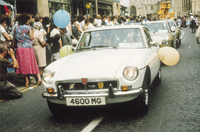
What a difference a day makes. On the 8th and 9th September 1979 great celebrations were held in Abingdon to mark MG’s fifty year association with the town. The culmination of the special event was a carnival parade through the streets with a least one model of each of the MGs made at Abingdon. I took part in my 1974 MGB GT V8 and it was a really joyous occasion. However with monumental bad timing this festive atmosphere was destroyed when 24 hours later the news was announced that the Abingdon factory would close down and that MG production would cease in July 1980. As you can imagine there was an immediate outcry not from just the workforce at Abingdon, dealers and MG enthusiasts throughout the UK but also from around the world including a group of American dealers who offered to place huge orders for new MGBs. The BL management and chairman Sir Michael Edwardes in particular were adamant however and a press statement said “The proposal to terminate the production of current MG models was based on the inescapable facts of economic life. The MG is no longer a sports car in our opinion, its handling and performance are inferior compared with most saloon cars.” |
 |
There were of course talks of buyouts and take-overs with the most serious being led by Aston Martin-Lagonda’s chairman Alan Curtis. However discussions did not run smoothly and the reluctance of BL to let the MG name go together with problems of raising the required capital led to the collapse of the negotiations in summer 1980. The last of the MGBs built at Abingdon rolled out of the Pavola works on 23rd October 1980. After a production run of over half a million cars the MGB was dead and at the time it seemed so was MG. |
 |
MG Metros, Maestros and Montegos were built during the 1980s but to many people the thought of a new 2 seater MG sports car was just a pipe dream. This may have been the case except for the forethought of one man. David Bishop had joined British Motor Industry Heritage Trust in 1983 to run its then small museum at Syon Park in London. A Triumph sports car enthusiast at heart he was shocked to hear that all the tooling for the Triumph TR7 had been destroyed and on learning of the same possible fate for the MGB tooling he decided to take action. With a relatively small investment he collected over 800 press tools and set up at a small industrial unit at Faringdon between Swindon and Cowley. This facility was fitted out with equipment largely salvaged from Cowley and only four lost dies had to be remade. On 13th April 1988 the new manufactured MGB bodyshell was launched at Rover Group’s headquarters in London, just two weeks after Rover’s dramatic acquisition by British Aerospace. The Classic Car Show was held in Birmingham at the end of that month and visitors were treated to the sight of a team of MG specialist transferring the components of a rusty old MGB roadster, registration number TAX 192G, into a spanking new Heritage bodyshell painted in Tartan Red. It was a promising day for MG enthusiasts who wanted to rebuild their ailing MGBs but it did no harm at all to the subtle campaign for a new MG sports car. |
 |
A number of enthusiasts built up “new” cars with Heritage shells, fuel injected Rover V8 engines and other Rover Group parts. This came to the attention of Rover’s senior management and in July 1989 MGOC’s own Roger Parker was invited to Canley along with his 1968 MGB V8 roadster. A TVR 280i was there for comparison and by the end of the day it was clear that the management team were very impressed with Roger’s car especially as it had been built by an individual in a single car garage using Rover Group Parts. The possibilities using the resources of the whole Group did not go unnoticed. By June of 1990 BMH had built up 2 prototypes. DEV1, registered LFC 436S, was a left hand drive US car and fitted with a 3.5 litre Land Rover engine. DEV2, registered YWU 486S, was based on a brand new rubber bumper bodyshell with a 3.9 litre Rover V8 engine with major changes to the suspension set-up. After much soul searching however Heritage decided that the manufacture of a new car would be better left to Rover and that BMH should stick to its core business of providing replacement bodyshells. |
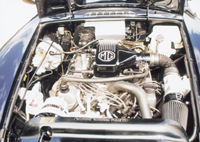 |
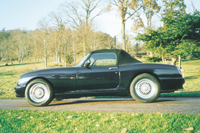
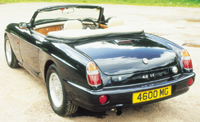
Fortunately Rover Special Products (RSP) had been set up as a new division within Rover Group to develop low volume niche products and in April 1991 began researching the project albeit with a very tight budget of £5m. By the autumn of that year a development car had been built under the banner of Project Adder (Britain’s answer to the AC Cobra?). The car was to be powered by a 3.9 litre fuel injected engine and use as much MGB hardware as possible although many new or adapted parts were to be used including the engine, drivetrain, suspension, much of the electrics and interior trim. Although the MGB bodyshell was to be the basis for the new car, externally it would be totally unique with new front and rear wings, bonnet, bumpers, lights and windscreen surround etc. Many of the panels were hand produced by Abbey Panels who had also supplied Rolls Royce for the Corniche and Jaguar for the XJ220. The rear light cluster was made especially for the RV8, at no little cost, and the front lights were based on the latest Porsche 911. By March 1992 a completed car was ready for viewing by top management and a one page press released was issued on 13th March announcing “A special edition MG to mark the MGB thirtieth anniversary.” The car was finally unveiled at the London Motor Show on 20th October 1992 and took centre stage on the Rover stand. With a price tag of £26,000 and other V8 cars on the market, such as the TVR, the initial response in terms of firm orders however was not as had been hoped. |
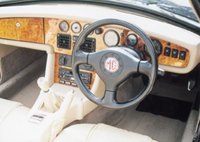 |
Seventeen pre-production cars were built as dealer demonstrators and press cars but the first production car, in metallic British Racing Green, was completed on 31st March 1993. This car was given the Vehicle Identification Number SARRAWBMBMG000251 reviving a long tradition as Abingdon MGs from 1930 to 1953 were started at 0251 (works phone number Abingdon 251). Throughout the production run there were minor changes and improvements but the major change came at chassis no: 644 when the LT77 gearbox (Leyland Transmissions 77mm shaft) was replaced by the Rover R380 item. On the later gearbox reverse is in the more conventional position of across and back (opposite 5th) whereas on the LT77 reverse was a push away from the driver and forward up next to 1st gear. |
 |
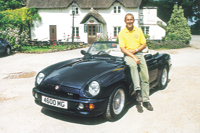
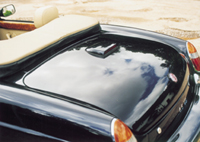
Japan has had a long love affair with British cars, particularly the Mini, and as they also drive on the left (all RV8s were right hand drive) it was decided to market the RV8 in Japan. In October 1993 a Woodcote Green Japanese specification RV8 was unveiled at The Tokyo Motor Show. The main difference to the UK car was air conditioning being fitted as standard although this meant the replacement of the front fog lights with air intake grilles and the positioning of the air conditioning unit in the passengers footwell taking up a lot of the available legroom. Small Rover badges on the lower front wings also identified the Japanese car. Orders flooded in immediately and 13th January 1994 was a red letter day for MG as the first batch of 46 RV8s were loaded aboard the car carrier “Don Carlos” at Southampton Docks. After a break of almost 14 years MGs were once again being exported and earning foreign currency for Great Britain. Although only 500 cars were originally allocated to Japan 1,568 of the 1,983 production cars were eventually exported there. Only 324 cars stayed in Britain with a handful of cars being exported to Germany, Holland, Belgium, France and Australia. Co-incidentally RV8s are now being “re-imported” back from Japan. These cars typically have a low mileage as they have been used as second or third cars but a full service history is not always forthcoming. Currently prices for a Japanese spec car are on average about £1,000 lower than for a similar British car. Australia and New Zealand also drive on the left and a number of ex Japan cars have also found their way there. My own car is chassis no: 1133, a British specification pearlescent Oxford Blue car which was first registered on 14th November 1994 as M504 UBL. It now carries my personal number 4600 MG which has been with me on various MG models since 1973. |
 |
The RV8 was always going to be a limited edition of 2,000 models and on 22nd November 1995 the last RV8, a Woodcote Green Japanese specification car, with VIN SARRAWBMBMG002233 was manufactured. By that time of course the MGF had been launched, but that as they say is another story. |