Is it too late for the ‘O’ series MGB?
Too Late for the
‘O’ Series MGB?
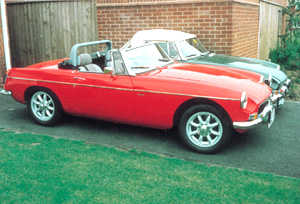
Finished example which from external view retains original classic lines of the MGB but twice the power of the standard MGB and an ability to return 50mpg depending on driver demands. You can call ëheadsí and win with “tails”
Fashion is said to follow cycles and sooner or later something you have stuffed in a dark corner for years will become all the rage and occasionally worth lots of money. Cars donít often follow this ebb and flow except in adopting styling features of cars from bye gone eras that many view with rose tinted spectacles. Occasionally though you find exceptions to the rule such as the VW Beetle and MGs.
I am sure that those of you who have been around for more than the last 9 years will remember a little red number I created with John Hills Ltd, using a Heritage Body and a 16 valve M16 twin cam engine from a Rover 820. The concept went down very well with very many members at various shows, passing on some very pleasing comments. Later I actually drove the car for a feature on Top Gear and it appeared in a number of national motoring publications. Some actually made comments about Rover doing something like it and I had to say tongue in cheek, ìYes thatís a good ideaî, knowing full well for nearly 2 years that Rover were into the ëAdderí project that became the RV8.
The red car was built to attract attention for the company, and this it certainly did. It was a project to tickle the taste buds of the MG world with no direct intentions that the conversion would be made
 Back in the turbulent BL days of the 1970s the B series and MGB were soldiering along with little real investment or change, other than to comply with changing legislation in various markets mainly the US. The two main influences were seen in the adoption of the Rubber Bumpers and the slow strangling of the engine power and general efficiency by emission requirements. It was 1972 that the needs to address the power and emission battle led to the start of the ëOí Series engine development.
Even though this was going to be an engine that replaced all the B series engined models, not just MGs, it was clear that cost limitations were the order of the day. This led to original ideas of creating the new engine so it could be made using existing B series engine production equipment, and so initial designs were not much more that a modified B series with an overhead cam cylinder head. In fact there was a Datsun (Nissan) engine that had clear B series BMC roots of just such a configuration. I havenít delved into the history books deeply but there was a tie up between Datsun and BMC after the Second World War and this is where the roots of the similarities arise.
Whatever the early restrictions to this engine project the result became the ‘O’ series with a cast iron block, topped by an alloy cylinder head equipped with a single overhead cam and a separate port for each valve. The crank for the 2-litre version sported the same throw as the B series engine but with a larger bore to achieve 1994cc. There was also a smaller 1.7 litre (1695cc) version of the ëOí series that used a short throw crank.
 The first application for the ‘O’ Series was in the Princess range of saloons where both engine capacities were used giving 78 and 91bhp. Soon after the 78bhp 1.7 engine was slotted into the Marina which replaced the 1.8 single carb B series, but the twin carb MGB spec engine continued for a while. Later still the 2.0 litre engine was used in the Marina, but attached to an auto gearbox. Next to receive the ëOí Series was the Sherpa Van, again with both capacities being used.
The irony of the period was that the car that originally provided the justification for the new engines development, was the last in the list to actually receive it. As we all know the MGB version of the engine was never allowed to reach production, but the actual specification for that engine was developed ready for production. This meant the only MGBs ever to officially receive the ‘O’ series engine were factory development cars, an number of which found their way into private hands, but without the ‘O’ Series engines.
There were to be two different specs for the MGB, both 2-litre, one with a classic twin SU carb set up and the other with multi point fuel injection where emission regulation was stricter. The actual carb specification engine was to be the more powerful with 105bhp against the injected versions 100bhp, if documentation I have seen is correct. It certainly would appear to be realistic estimates.
Clearly the adoption of either of these specification would show a very significant boost to performance, especially for the North American market which since 1975 had suffered with the single Zenith Stromberg carburettor and a paltry 65bhp. Even the UK spec would have shown quite a performance boost with the extra 21 bhp over the 84 bhp spec B series engine of late UK MGBs. I canít accurately assess what the acceleration would have been, but the top speed can be calculated to 112mph, plus or minus 2mph.
 History tells the story of how MG was to be no more, let alone seeing an ëOí series engined MGB. In the first two years of the 1980s the twin carb spec of ëOí Series was to find a home in both the Rover SD1 2000, and the revamped Princess range called Ambassador. Ironically the TR7, which was the ëfavouredí sports car of the period, was also to have received the ëOí Series engine!
By 1982 I was into the ninth year of ownership of my MGB and I had built and fitted a 1950cc engine with very many modifications. The effect of all these modifications was significant but perhaps a touch crude. As a result I actually started to look into fitting the 2-litre ëOí series engine, as it could be lifted straight out of the Sherpa van where it was attached to a version of the MGB gearbox. Sourcing a pair of SUs and manifold would not have been difficult and ëhey prestoí I would have created a replica of what might have been.
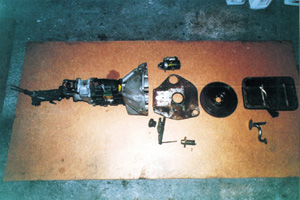
At the same time as I was looking into the ëOí Series options some V8 fuel injection parts came along and provided a more tempting prospect! I have no regrets whatsoever in following the V8 route. However, the seeds of the ëOí series MGB were planted in fertile ground! The only restriction to them germinating into a healthy project was the stony subject of finance – lack of it of course! This problem was to exist for another 8 years – but then… In the middle of 1990 a chance conversation at John Hills dropped onto the subject of a new company demo car that could have a more modern mechanical base. In that 8 years my often overactive mind had been following the mechanical developments of the ëOí series engine, and the offshoot twin cam M16, 16 valve, version used in the Rover 820. I also saw the Sherpa continue to use whatever was the current ëOí series specification engine along with the trusty standard LT77 5 speed gearbox. (Commonly called the SD1 box.) The connections here were simple, in that the latest ëOí series would still attach to the SD1 pattern gearbox and that the 16 valve variants used the same basic cylinder block. This meant that the 16-valve engine could be simply attached to the SD1 gearbox to open up an even wider range of possibilities. The use of this gearbox has a well established base with V8 engined MGBs, so the idea of using the same gearbox with a Rover 820 16 valve engine, instead of the V8 was a logical and very appealing prospect. Remember that at this time 16 valve engines were still very much a sporting sales plus point, rather than the norm for a basic engine as it is today. Consequently the ëKudosí of an MGB with an up to date 16 valve engine and full engine management system was well worth the risk of trying.
 Over a 6-month period together with Dave Cartwright from John Hills the Twin Cam 16 Valve MGB was created. I am to this day still surprised as to how well the car performed ëstraight out of the boxí. Sure there were some teething problems, but there was no multi vehicle development fleet, so what people saw was exactly how it was built first time. Knowing the initial restrictions I still wonder what could have been achieved with a real budget to iron out the many smaller problems that existed.
Notwithstanding these negative points (a builder/re-builder always sees his errors as much larger issues) the car was very well received wherever it went. I well remember the first showing, which was the MGOC national event of 1991 at Knebworth. The first drive of more than ten minutes was to be done from Redditch to Knebworth with no support vehicle and ëmugginsí was to drive it. It went remarkably well until just about 4 miles from the Park when the oil sensor line to the gauge fractured and left me with the need to do a little roadside first aid!
Subsequent demand for the car meant no further development was done. Power was not a problem as a run on Peter Burgessís rolling road gave a reading of 128bhp at the wheels, only some 6 bhp less than my MG Maestro of that time which used the same engine. The engine management system fitted was in fact a mix of bits and pieces from Rover and Montego and whilst power was good the economy was only average. Since my like engined MG Maestro was returning 25% better figures I felt that this was an area where big improvements could be made.
I was able to address some of these issues a few years later when a friend finally coaxed me into fitting his GT with the same engine and gearbox. Once again there were considerable restrictions on the budget. Differences lay in the fact that this was a rubber bumper car against the chrome bumper spec used before. In many respects this was like a new conversion, although the main aspects from the original were carried through. The main advantage with this second car was the use of a complete engine of known history AND the complete standard engine management system.
Performance of this second car was certainly on a par with the first, however the smoothness of the engine and crispness to throttle was much better. I was also very satisfied to receive information that on several very long cruising runs of over a hundred miles that the calculated mpg had just exceeded 50mpg – on cheapest unleaded! The first time scepticism said that a mistake had been made in filling or calculating the returns, especially so since the average speed was around 60mph. However the return journey and a number of subsequent similar runs proved this was not a fluke. Even accounting for some error in recording the distance it is quite clear that the fuel economy of this conversion is tremendous. (Incidentally there are many more MG Maestroís now with this 16-valve conversion and they all report mid 40ís on a run – unless they use the later MEMS engine management when there is a 5 to 10% drop.)
When I did the first 16 valve MGB there were many who expressed an interest in doing their own, however the costs were (are) not that different to the cost of a V8 conversion due to the very ëone off natureí. As the Country was entering a recession and the bubble was just bursting in the classic car market it is not surprising that only a handful of conversions were done. Todayís conditions are much better and the number of people seeking details on such a conversion reflects this. What follows is a framework onto which anyone wanting to do a similar conversion (8 or 16 valve) may start to build.
Before jumping in at the deep end a little detail will help identification of parts needed. The engine used for versions 1 and 2 is the original spec ‘O’ series engine that was fitted to Princess, Ambassador, Marina and Ital cars 1978 to 1984. The same engine was also used in the Sherpa, but for a couple of years longer, to 1986.
The best method of identifying this engine is to note that it has a separate distributor mounted half way along the overhead camshaft and coming off the engine at 90 degrees and hanging over the spark plugs. The porting of the cylinder head means that when installed in the MGB it will be on the same side as the B series. The inlet and exhaust port layout is also individual to this series with the ‘in,ex,in,ex,in,ex,in,ex’ configuration.
In 1984 the Montego arrived with a heavily revised ëOí series now referred to as ëO2í, in 2-litre form only. The head has the most obvious changes with the ports being moved to the other side of the head. The port configuration changed to ëex,in,in,ex,ex,in,in,exí and the distributor was replaced by just a cap that mounts on the flywheel end of the camshaft.
In 1986 the Sherpa range caught up by changing to the ëO2í series with both 1.7-litre and 2-litre form. To this day the Sherpa application is the only use of a 1700cc ‘O2’ engine. The real bonus of the Sherpa using the ‘O2’ is the fact that at a stroke all the post 1984 ‘O2’ series, and subsequent related engines, (M and T series 16 valves units) can be simply converted to an ‘in line’ configuration.
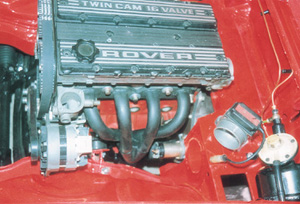
The M16, twin cam 16 valve engine was the mainstay engine for the Rover 820 from 1986 to 1991, with a few 220 and 420 models in 1991/2 using a version also. It is identified from its classic twin cam design and the cast alloy ribbed cam covers. These have ëRoverí cast into the inlet cam cover and ë16 Valveí cast into the exhaust cam cover. It has a cast iron block painted red, and an unpainted alloy head. It comes with either a single point injection unit that delivered 120bhp or a multi point injection that delivers 140bhp.
The T16 is a clear development of the M16 and shares many parts. The main differences are centred on the head, which now has a clearly visible angled line to the plastic cam covers, and the adoption of a combined water and PAS pump in an assembly, with alternator and air con compressor, hung off the side of the block.
These conversion notes are based on the conversion of a post 1968 MGB or MGBGT. Earlier cars will require some extra work in the transmission tunnel area The routes that I follow are done specifically to take a standard engine and transmission and with use of only standard production parts to create an assembly that could be placed in another (MG) chassis. This retains the original standard reliability factors of the production units, and more importantly in any future maintenance or repairs, should allow easy purchase of standard spare parts. All options are really aimed at the UK market where the donor vehicles were common.