Transcontinental Midget
Transcontinental Midget
The Development of LOR999F to Transcontinental Tourer
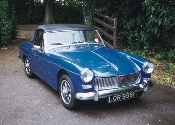
| I have owned LOR for about ten years, using it intermittently, a euphemism for only on fine summer days. Hence for many years it never got much use at all. However my MG saga started in earnest when I bought a sad-looking MGB GT that had been languishing on a local forecourt for months. I made a silly offer for it and my bluff was called. This was really the re-birth of my love affair with these cars. | LOR 999F all cleaned up and ready to go |
When I first qualified from University more years ago than I care to remember, I bought a red 1098 Midget. It was the apple of my rather impecunious eye, and I used it for club rallies, autocross events (old enough to remember those?) and sprints and hill climbs. I added a Downton Stage 1 head and larger jets to the carburettors and had a lot of fun and a little success.
It is strange how ones memory plays tricks after the passage of years. When I bought LOR, I was really disappointed at how slow it was and how much it rattled. It was supposed to have been restored, but there have been many articles in ‘Enjoying MG’ about the disasters of purchasing so called restorations. Suffice it to say that I first had to have the rear wings and both sills done. This was followed by an engine rebuild and soon after this was refitted, the gearbox decided on early retirement. It all helped to keep up the costs. My son and I used the car for Norwich Union Classic events. But it was boringly slow; the drive home from Silverstone on potentially fast dual carriageways was a nightmare.
| The MGB GT I rebuilt from scratch, well, the front wings were leaking, and it was black, so what else could I do? In the motoring press I saw advertised an event to Russia and back. I entered the car and the basis of the re-build was this event. It of course necessitated changing the colour to Old English White, fitted an Oselli ‘fast road’ two litre engine, with uprated brakes and suspension. The event was cancelled the day before departure, and we lost most of our considerable entry fee. Hitchcock’s first rule: stick only to events organised by the RAC or equivalent organisations. The car was later used, on my first (1995) Euroclassic. But this brings me back to the Midget, which should have been, but wasn’t, ready for said event. And so the chapter of disaster begins. | 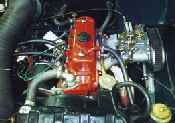 The completed engine bay The completed engine bay |
It was decided by someone, probably my oldest son, that we should try and do something with the Midget. By this it was implied that if I could do up the B then maybe I could achieve a lot more with the Midget. This became a rebuild to sprint and hill climb standard. Personally I am not too keen on these events. As far as I can remember from all those years ago, it meant getting up about five o’clock on a Sunday morning, driving for hours through weekend traffic, all for just minutes or even seconds (if good enough) on the track. I preferred the long distance events. And some comfort.
The first thing was to strip to a bare shell my supposedly sound car. By the time I had removed the front wings, engine and gearbox, front suspension and all the pipes and wires, I discovered the first problem. I couldn’t unbolt the springs (which I planned to change) because someone had welded them in place. With no suspension at the front it was going to be a rather difficult and an expensive task to move the car to a repairer. Nothing for it but to do it myself. I brought a Mig welder and practised. To be honest, I have had more fun from my welder than almost any other piece of equipment I own. It took a week before I dared attack the bodywork. Then I found it necessary to remove a lot of car before all the rust was gone. Still, I ended up with a fairly rough (my welding looked rather like a row of mouse droppings), but strong repair, and it was all out of sight anyway.
With the body sound, it was time to attack the under bonnet area. This I cleaned back to bare metal and re-sprayed. There were a few corrections to make, such as the slam panel where I managed to drop the engine, as one does.
It was time to consider the specification. I approached Tim Fenna at Frontline Spridget for advice and parts. The first thing I needed was a better gearbox. So I bought the Frontline Five-Speed Gearbox conversion (ex Toyota, but then nothing is perfect) with copious instructions and Tim’s mobile phone number (essential). I had to cut a lot of bodywork away underneath the transmission tunnel and it was on Saturday afternoon (isn’t it always?) that I was trying unsuccessfully to get the new gearbox to fit. A call to Tim who happened to be on a bus going shopping with his wife sorted things out.
The engine was subbed out to a local expert who elected to build me a 1300 full race engine, using the stronger Marina block and inch and three quarter SU carburettors. This would be another disaster. I had everything finished just a week before the 1995 Euroclassic. Starting the engine for the first time precipitated the entire sump-full of engine oil all over the garage floor. So, engine out and back to the builder for an explanation and repair. This is why I used the MGB GT for that event. The explanation given for the oil loss was that Marina blocks have no rear main bearing, and the oil pressure reduced to only 40 psi, which I was assured was alright. I managed the Haynes Two-Day classic, with diminishing power as the event progressed and returned the car for better tuning, prior to the Norwich Union Classic which was about a month later. On this event I got ten minutes from home before the engine seized solid. Suffice it to say that I had been given the cheapest lash-up possible for £2000!
| Hitchcock’s second rule is NEVER get anything done by amateurs. Stick to the professionals, who have a track record and a reputation to maintain. I went to MED in Leicester, who not only helped me sue to get my money back, but built me a superb engine, to state of the art specification. I had everything from nitrided crank, 1380 re-bore, omega pistons, scatter cam, full race head with roller rocker bearings (significant, see later), and a 45 DCOE Weber carb. I now have about 100 BHP at the rear wheels. | 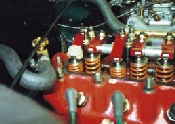 The repaired rocker arm after 700 miles The repaired rocker arm after 700 miles |
The next part was stopping the beast. M&G International supplied drilled front disks and competition pads. I used competition rear brake shoes also supplied by them.
Then came the suspension. I added anti-tramp bars from Frontline, and a limited slip differential to the rear axle. The front suspension was straight Frontline, with Avo adjustable shock absorbers and negative camber.
The seats I fitted were Corbeau classic from Demon Tweeks. When I asked them what competition seats they could suggest for an MG Midget, their initial response was to recommend changing the car for an MGB.
The car had splined hubs and standard halfshafts. These would not have been strong enough, so I had special ones made by Brown and Gammons, after trying for ages to find a firm that would make these for wire wheels. The wheels I chose were alloys with Goodyear NCT 175 tyres.
The next problem was that we found that the clutch was not strong enough. Out with the engine again, and a stronger clutch from Frontline. Except that (1) I was sent a Ford clutch plate by mistake and then (2) on replacing the engine, I found that I could not get the starter pinion to engage. The clutch cover was too big so out with the engine again. I am really good at removing Midget engines now. Flywheel and correct clutch cover were obtained with profuse apologies and again sent back to MED for balancing. Finally I managed to get it all together and working.
However the next problem reared its ugly head:- I found the rear tyres were rubbing on the bodywork on enthusiastic cornering. Back to Tim Fenna for advice.
“What you need is a Watts Linkage” he explained. “I haven’t got a clue what such a thing is”, I wailed back over the phone. “I will fax you a diagram”. Tim replied. And he did. At least I now understood the principle. Two weekends later it was finished. It comprised a triangle mounted centrally point downwards just in front of the petrol tank, braced against the floor and front wall of the boot, carrying a pivot with two rose-jointed bars to each end of the rear axle. The effect was dramatic. The rear of the car felt very taut and road holding was hugely improved.
We did the 1996 Euroclassic with a car that had become quite spectacular. I now had the ability to cruise at ninety plus, all day. Acceleration was awesome and so was the road holding. I could pass cars on corners on the track on either side with no problems. But the next disaster had already arrived. At the foot of a hill climb somewhere near the German border, I found that I was running on only three cylinders. Removal of the rocker cover revealed a broken roller on No 4 exhaust valve rocker. The RAC mechanics mended it with liquid metal, and I successfully drove the remaining seven hundred miles, VERY carefully. It was mentioned in an article published in ‘Enjoying MG’ a year or so ago.
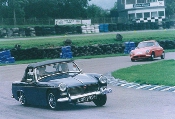 Lyddon Circuit at the start of the ’96 Euroclassic |
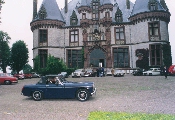 Some of the chateaux were spectacular – one of the checkpoints on the Euroclassic ’96 |
On the 1997 Euroclassic the brakes were a disaster. On Hochenheim circuit I set the front pads on fire. The engine also tended to over-heat when using revs about six thousand, maximum power is around six thousand five hundred, when the car really flies! At this stage the car was well run in and had just been on a rolling road for tuning. Anyway, back to the brakes and of course Tim Fenna, at Frontline.
“I have just the thing”, he replied. “Nine inch front disks and better callipers and pads.” Another problem was solved. Another expense incurred. The over-heating at high revs is still with us, a new radiator was considered, but not followed up. The trouble is infrequent, only occurring in really hot weather on race circuits. There is no thermostat fitted, which does help. The rear lever-arm shock absorbers have been changed for Avo adjustable ones to match the front, which did not make a big difference for road-use, but a least I can change the setting easily.
| So, what is left. There was a vibration from the prop-shaft, which was unbearable until this item was balanced. I now have to align the rear suspension components better to reduce this further. The development of the car has taken over two years, and the only things remaining that are original are the body and the wheel bearings. Departing from standard means difficulties in sourcing parts, ages waiting for them, or having to make them yourself, and it never seems to stop. There is always something to improve or needing changing. But then, I have had no precedent to follow. LOR is quite unique, but still looks standard. | 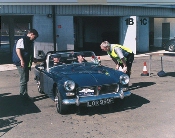 We like Norwich Union events -the end of ’97 event at Silverstone We like Norwich Union events -the end of ’97 event at Silverstone |
I have been asked why I chose a full-race spec for the engine, and wasn’t it intractable? Well the answer is in the result. I have used the car for work. Driving through towns is no problem at all. The MED engine is excellent and the tuning by Tom Airey on his rolling road in Hampshire had given me even more power at low revs that the standard engine. I am sure that the scatter cam manufactured to MED specification with different timing for inner and outer pairs of cylinders has a lot to do with the flexibility. This car is a genuine Grand Tourer, capable of high speed travel across Europe in safety and comfort. We drove over five hundred miles from Monza in Italy across Switzerland and France last September, in beautiful weather with the roof down, and I got out with no stiffness or tiredness. It was a wonderful experience. It makes the trials and considerable expense worth the trouble.
My next project, my idea of the ultimate V8 Roadster is just completed. Watch this space.
Bob Hitchcock