Unleaded – part 2
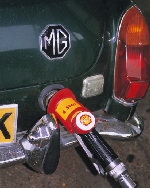
Unleaded Uncovered part II
Roger Parker completes his overview of the great petrol debate about the use of unleaded fuel in MG engines
The ‘O’ Series Engines
This series of engine was designed and intended to replace all of the ‘B’ series applications in order that the ever increasing emission requirements could be met, the export markets of the MGB driving the programme. The fact is that it did replace all the ‘B’ series applications with the one very notable exception – the MGB, the one that had the most need! (Perhaps BL stood for Boardroom Lunacy!)
Politics aside it should be noted that the ‘O’ series was developed to production specification for the MGB and only the last minute decision to axe the car prevented it appearing under production bonnets. Part of this process involved the development of the engine to run unleaded and my information indicates that in 1979 engineering approval was given to the ‘O’ series engines to run unleaded. This has a significant bearing for later cars that were to use the ‘O’ series.
The next time that the ‘O’ series was to affect MG was with the introduction of the MG Montego EFi in April 1984, followed shortly after by the identical engine being used in the MG Maestro EFi. These engines carried over quite a number of parts from the earlier ‘O’ series engines, including the same valves, guides and seats. The seats and inlet valve changed in 1986 when the 20HD series engines appeared, but other items such as guides and exhaust valves continued to the end of production.
The official approval for these engines to run unleaded did not appear until 1990. Interestingly there were no engineering changes listed, only a new ignition ECU for the MG Maestro, which continued with the Lucas engine management and a new Rover developed engine management system (MEMS) for the MG Montego. It is also worth pointing out that the later catalyst version of the engine used the Lucas system and whilst MG Maestro/Montego was not listed as being available with them, if the engine code is 20HF51 then this would be a catalyst spec.
Just like the Metro there were cars sold in Switzerland and Germany well before the UK approval of unleaded appeared. My recollection of data read over 10 years ago indicated that these were expected to run unleaded and I note that there is a specific separate ignition ECU listed for the ‘Swiss’ market cars. (The ‘Swiss’ specification is the only alternative listed in this field)
The detail of this data clearly shows any injection MG engine 20HD05 107298 on, matches the specification of the cars running unleaded so can be regarded as fully engineered with no need for any engineering changes whatsoever.
The implications of the data also points towards the fact that the earlier engines have also been engineered to run unleaded. My experience with many, many thousands of miles with a tuned early ‘O’ series and many hours run flat out on a dyno with no power losses or any form of internal damage, tends to help support this view.
The MG Maestro/Montego Turbo have two distinct engine specs, the earlier 20HC41, 20HC85 and 20HE15 versions which do not have approval, and the later 20HF50 which does. The factory conversion follows a slightly different path to that used for the injection engines, as the engineering route taken to unleaded by Rover involves a new piston. This reduces compression by half a ratio, 8 to 1 against 8.5 to 1 of the leaded engines, with other parts including piston rings being carried over.
At the start of the 1989 model year the Montego Turbo also gained from a new combined engine management system called ERIC. This was with engines coded 20HE15. This engine can be associated with the later unleaded versions by virtue of the ERIC system, but reference should be made to the engine codes to confirm which spec the engine is.
Earlier Turbo engines have almost all that is needed to be unleaded compatible and certainly there is no need for any changes above the head gasket line. This leaves just the lower part of the engine and the fact that the new pistons only drop the compression ratio. My observations of many high boost turbo engines indicate no damage due to the use of unleaded. Too much boost and power lifting heads and blowing gaskets is another matter though!
One very specific aspect found when comparing unleaded to leaded with the Turbo engine is fuel efficiency. The economy with 95 RON unleaded is very significantly reduced under similar driving conditions, read that being around 15%! Use of 98 RON super unleaded reduces that deficit, but it is still short of the leaded results. The reasons almost certainly are the need to re-tune the engine to take into account the different combustion characteristics, which with this engine management system is not possible, except with the early ERIC engines that can have the later unleaded ECU fitted.
These engines were used in the MG Maestro 1600 from introduction in spring 1983 to the arrival of the 2 litre ‘O’ series version in October 1984. The ‘R’ series is by far the most common, but with a common base design both can be treated the same as far as the engineering is concerned. With both having cast iron cylinder heads they have the same limitations as do ‘A’ and ‘B’ series engines. This means that the same procedure for converting is also applicable, with the addition that a replacement ‘S’ series cylinder head, prepared for unleaded use, is available from Rover as a replacement part – at a price well above the usual engineering conversion though! This doesn’t list the use of any valve seat inserts, so may well involve some form of induction hardening process to the casting, in much the same way as was done to late MGB heads for North America.
The rubber bumper MG Midget uses the Triumph 1500 4 cylinder engine that has its roots as deep and distant as the ‘A’ series, so not surprisingly the same period engineering design and materials were used. This means that the 1500 is not engineered to run with unleaded fuels, although the North American market created a similar situation as found with ‘B’ series engines. My understanding is that pre 1976 engines were leaded and that after 1976 some were unleaded (California) and others weren’t. Whether that meant that all post 1976 cars were engineered for unleaded, but only Californian cars with a cat were required to run just unleaded, I do not know.
Conversion to run with unleaded follows exactly the same route as with the previously listed ‘A’ and ‘B’ series engines.
The Rover V8 engine was fitted to the MGBGT V8 and more recently the MGRV8, and has been a very popular choice for conversions. All of the Rover V8 engines have been made by Land Rover whether the engine was to be fitted to a Land Rover product, a Rover saloon or a Sherpa van. Land Rover has also been responsible for the engineering of the engine. Bearing in mind the fact that BL never gave any of the V8 cars unleaded approval it often surprises people to learn some facts gleaned direct from Land Rover Engineering.
Since October 1970, yes nearly 28 years ago, all V8s were engineered to run with unleaded fuels. This was a couple of months after the announcement of the Range Rover and no doubt was connected to the projected markets for that car. This makes it the simplest of all the older engines to deal with and remember this isn’t titbits of information or deep investigation, this is the answer given by Land Rover to the simple question, “Can the V8 run unleaded?” There is no qualification to that statement, it means that all original MGBGTV8s and all the SD1 and later engines used for conversions are already engineered to run unleaded. This leaves the first couple of years production from Rover P5B (the 3-litre body) and the P6B (the 2000 shape), which do not have approval.
The only other point to mention is that the MGRV8 being produced after 1992 means that not only is it unleaded compatible, but it has to operate with a catalyst. In the RV8s case there are two cats, one for each bank of cylinders. The emission levels that this car has to meet dictates that the cats are fitted at all times, otherwise it would fail at MOT time and at any roadside spot check.
I’m sure that most will be more than aware that the ‘K’ series engine is found in 1.8 litre form in the MGF. The car has been in production since 1995 which means that the engine is both engineered to run unleaded, and has to run with a catalyst. In fact all ‘K’ series, from whatever Rover, are unleaded compatible. It is worth mentioning that the required emission levels that have to be met at all times, dictate that the cat has to be fitted and operating at all times. Removal of the cat would not only mean that the car fails to meet the required level at MOT time but also at any roadside emission test.
| It is one thing for an engine to be ‘engineered’ to run on unleaded, it is altogether another matter to expect it to run as well on unleaded without some changes. The MGRV8 and the MGF are obviously tuned to run on 95 RON unleaded, but how many know that the MGBGTV8 was also tuned to run on 94 RON fuel. So not only did it come with the engineered capability, it also operates with normal UK 95 RON unleaded with absolutely no modifications whatsoever.
The earlier four cylinder engines, the ‘A’, ‘B’, ‘C’, ‘R’ and 1500, can all adopt the same basic advice when converting to 95RON unleaded, which is to retard the ignition timing by 3 degrees from whatever the base settings are for that specific engine. This takes into account the fact that without the flame-retardant effects of tetra ethyl lead in the fuel, it actually burns faster and reaches higher peak temperatures. Even when using 98 RON Super unleaded the fuel will burn faster and a slight reduction of base setting may be beneficial. With these engines simple adjustment is possible as they all operate with conventional distributors. |
|
The ‘O’ and ‘S’ series engines operate with varying forms of engine management which doesn’t allow any easy alteration of the ignition settings. However, in the case of the ‘O’ series injections with the Lucas engine management (two separate ECUs) there is an alternative ignition ECU, (NNN 10005) which is specifically set up for the engine to run with unleaded. The fuel ECU remains the same. There is also the full catalyst spec for this engine that is not a listed option for the MGs. This uses a completely different Lucas fuel ECU, but the ignition ECU (NNN 10016) is the same fitting as earlier models.
As there wasn’t a 1600 MG spec engine available into the unleaded period there is no direct alternative but the later ‘S’ series had unleaded applications where the ECU was (NNN 10009). There was also the 103-bhp EFi version with (NNN 10004).
Both the ‘O’ and ‘S’ engines have one advantage in that they operate with knock sensors as part of the management, which automatically detects detonation and reduces the timing to the cylinder(s) affected. In practice the standard timing settings often work very well and provide better response than with the ‘unleaded’ ECU’s, leaving the very rare situations of detonation to be dealt with by the knock sensor circuit.
The compression ratio will also have a controlling influence on which octane the engine should run with, but quoted static ratios are misleading since volumetric efficiency (the breathing efficiency) of the engine will dictate what the effective compression ration will be. It is quite possible to find a modified engine with a lower static compression ratio than an otherwise similar standard spec engine actually returning higher effective cylinder pressures, due to it’s greater efficiency. Other factors too will influence the speed and effectiveness of combustion, and then there is the factor of heat transfer away from the combustion chamber, where alloy has a significant advantage.
Having just lost some of you ‘over the side’, here is a rescue line. As a basic guide a standard, or near standard engine with a static compression ratio of below around 9.75 to 1 should operate with 95 RON unleaded without problem. Above this and the use of 98 RON should be considered. In the cases where the engine is modified then discussion with the engine builder/supplier should provide some base advice.
It is also possible to extend the use of the lower octane fuel by a greater reduction in base timing. For example my 3.5 litre V8 EFi engine runs a heavy breathing 200 bhp at the wheels with a 10.25 to 1 static compression ratio, 95 RON unleaded with timing set at 2 degrees BTDC.
It has always been said that every engine is an individual and so individual setting up almost always achieves better results than by just using the base recommended settings. When changing to unleaded you are upsetting the status quo for the engine, and it is always advisable to have a session on a rolling road to identify any variation in the original settings. Once noted these can be used for all subsequent tune ups to maintain performance.
The MGF, MGRV8, MGBGTV8 and approved MG Metro, MG Maestro2.0i, and MG Montego2.0i/Turbo need no comments as they are unleaded approved. MG Maestro 2.0i and MG Montego 2.0i from engine 20HD15 need just the ignition ECU listed to clone the factory specs complete. Effectively any V8 can run unleaded with just a timing change, dependent on compression ratio.
The next batch are those engines that have implied engineering changes done by the factory, and these include all other MG Maestro EFi, MG Montego EFi, MG Maestro Turbo and MG Montego Turbo. Every practical indication here is that they contain all that is needed to be unleaded approved, with some versions so equipped already operating in unleaded markets. It is pointless to advise any engineering changes, and experience indicates that the original engine management works perfectly well and allows long periods of normal operation. For the EFi versions the change to the later unleaded ECU would bring it closer to the exact factory unleaded spec, but note that this often reduces the performance too.
The remaining engines found in MGA, MGB, MGC, Midget, MG 1100, MG 1300, MG Magnettes, MG Maestro 1600 and early MG Metro all fall into the category of needing engineering changes to mimic the factory unleaded route and the general advice is to plan to follow such a route.
With the experience of many others in markets that have only had unleaded for many years there is a very high incidence of engines running for huge distances and many, many years on unleaded without any changes being effected. These engines having maintained their normal performance and economy. This may reflect the general change to an easier use that the older MGs now seem to be subject too. Clearly whilst there is some implied pressure with the removal of leaded fuel from general sale by 2000, there is also a clear path that says that engines will not fall to pieces overnight. Even if an engine is subject to accelerated valve seat recession or other related damage, the progress will be steady and such that there will be both plenty of advance warning and time to plan and execute any remedial work.
On that basis I do not recommend that owners rush out and have an unleaded head and other work done for the sake of it. I suggest that they continue to use their cars in the normal way but use unleaded when leaded is unavailable, or so expensive it becomes uneconomic. Eventually some work will inevitably be needed, unleaded or not and at that point have the engineering changes done to maximise cost effectiveness. I know that many will worry about this and not feel happy until they have some built in insurance. To those owners I say do what you feel will ease your mind. Remember that converted engines run perfectly on leaded should you want to continue until leaded vanishes.
Playing the waiting game may also see accredited viable alternative options, such as additives, appearing on the market for just these types of car. It also puts off expending money, which we can all appreciate, to a time when you can achieve more for that expenditure. This is especially true for the owners whose engines have not had much use following very extensive rebuilds. Another consideration if not already included, is to include some form of power tuning to accompany the unleaded work to be done to the cylinder head.
The biggest area of gain for these older design engines is with cylinder head modification. Combining modifications with unleaded work is a very effective way of combining two very worthwhile improvements into one labour charge, which provides significant savings over the same work done in two stages. With moderate levels of tune, improved engine efficiency will not only provide a smoother, more responsive and powerful engine, but provide savings with better fuel consumption on top using cheaper unleaded.
I hope that this feature has provided some clarity to the whole issue and illustrated that there is no need to rush out and do anything. Take things slowly and a step at a time and remember to enjoy your MG(s) all of the time.
Roger Parker