MGA 1600 MkII
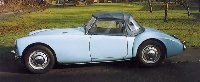
With declining sales on the American market Abingdon introduced the final version of MGA with the 1600 MKII model in 1961. The MKII was very little changed in comparison to the previous model MGA 1600. Obvious visual changes are the revised chrome grille with inset slats and the repositioned rear light assemblies. The interior featured extra trim on the facia and a chrome bezel for the loudspeaker grille. In addition, the MK II roadster also had extra Vynide covering on the scuttle top.
MGA MK II finished in iris blue.
Engine modifications
| Under the bonnet the engine was increased in size by 34cc in cylinder capacity taking it from 1588 to 1622 c.c. This extra volume along with various other engine changes gave an improvement in maximum power output, up from 83 b.h.p. to 90 b.h.p. at 5,600 rpm. At the same time the crankshaft and connecting rod sections were also improved to ensure that this now quite highly developed four-cylinder engine would continue to be reliable in service. |  |
Larger cylinder capacity was achieved by increasing bore diameter from 75.4mm to 76.2mm while the stroke remained the same at 88.9mm. The cylinder head was also considerably improved with larger inlet valves while at the same time the profiles of the inlet and exhaust tracts were modified to improve air flow. The compression ratio was raised from 8.3 to 1 to 8.9 to 1. A higher compression ratio in combination with the larger combustion chamber was also made possible by replacing the former design of piston with the slightly concave crowns with new flat top pistons. These were solid skirt with three compression rings; the upper one chrome plated and one oil control ring – all located above the gudgeon pin. To match the increased output from the engine, the final drive gearing was increased from 4.3 to 4.1 to 1.
Better performance
The increases in engine power gave small improvements in the car’s acceleration. The time taken to get from 0 to 70 dropping by 0.5 seconds, while the 0 to 80 time was cut by 2 seconds. The rise in axle ratio enabled the MK II to comfortably maintain a higher cruising speed. It went up by around 10 mph so that the little MG which previously cruised around the mid seventies was able to cruise in the mid eighties. There was also a fuel consumption benefit and if driven prudently, it was found that the MK II showed a small but definite improvement.
Behind the wheel
| The engines fires readily when the separate starter button is pulled and warms up quite quickly. Driving this MK II you are made aware of its ancestry by its traditional feel but competent road holding and responsive handling set it apart from its contemporary rivals. Although the design of the car still features a separate chassis, there is no detectable flexing and the little MG feels to be tight and very solidly built. The way the car behaves on the road is distinctly MG as it combines a very firm ride with safe predictable handling. Steering is high geared and responsive, yet another traditional MG trait. The engine is also very flexible, pulling quite strongly from quite low speeds. Although it has plenty of torque the engine cannot be described as smooth. There is a certain harshness and a fair amount of thrashing mechanical noise, yet it remains a willing and responsive unit. | 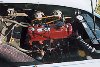 BMC B series engine in improved form for the MGA MK II. 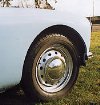 Ventilated steel disc wheels are much easier to look after than the optional spoked wires. |
| Clutch and gearbox The clutch is light and gives smooth easy take-off, working very well in combination with the excellent gearbox. Each movement of the lever is very short and precise, making the whole gear changing process a pleasure. There is no synchromesh on first gear which means that you need to remember not to attempt to select it whilst on the move. When Autocar road tested the MK II in 1961 they complained that the box was rather tight and notchy but I found the gearbox on this MGA to be extremely slick and easy to use. |
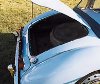 Boot lid is released from inside the cockpit. |
Brakes
Sure footed handling and very good progressive braking makes the MK II a very safe and predictable car to drive. The disc front and drum rear set-up behaves impeccably and was well regarded when the car was new. Autocar described the brakes as engendering “complete confidence” with no “falling-off in efficiency” and with “no fade” after repeated use from high speed. The fly-off handbrake is also effective and great fun to use once you have got the hang of it and gives the car yet another link with the earlier T- series MGs. To release the handbrake, for a quick getaway, it is only necessary pull slightly upwards on the lever and then just let it go. The handbrake lever falls easily to hand being well positioned between the transmission tunnel and the driver’s left leg.
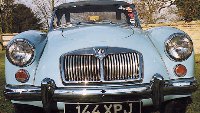
The distinctive chrome grille has recessed slats.
Interior
The cockpit area is quite small and storage is limited although there is a some space on the shelf behind the seats when the hood is raised. Each door has a generous storage pocket for smaller items. There is always the boot but much of its capacity is taken up by the spare wheel; although squashy bags can be still be stowed away in the remaining space.
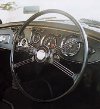
Functional and well trimmed the interior features individual bucket seats that are competently designed, giving good support and a comfortable driving position. The distinctive four spoke steering wheel dominates the dashboard but does not restrict the view of the main instruments. The flat dashboard is well equipped with speedometer, rev-counter, fuel gauge and the combined oil/water gauge, all laid out in similar fashion to the later MGB or Midget. A large horn button is centrally located on the dashboard while the direction indicator switch is positioned on the extreme right hand side. This switch is very period with tell-tale illumination but the warning light can be obscured by your hand and it is easy to forget to switch it off. The optional heater/demister functions well enough providing everything is working correctly and when the hood is up, the small cockpit quickly becomes quite snug inside.
Security
| To get into the car can prove to be a puzzle because there are no exterior handles or locks on the doors. The omission of handles and locks is a reminder that this car was built in an bygone age when security was not an issue. To gain entry to the car with the hood up and side screens in place you have to slide back one of the perspex screens by pressing on the outside of the sliding screen, then slipping your hand through the open window to press down on the cable door release on the inside of the door. Similarly there is no exterior locking handle on the boot. The boot can only be opened from inside the car by pulling a looped wire release handle located in the hood stowage compartment behind the passenger seat. Once opened, the boot has to be supported with a prop which is clipped to the underside of the lid. More conventionally the bonnet is also released from inside the car but the pull handle is located under the dashboard on the passenger side. | 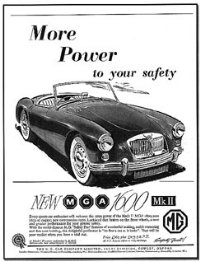 |
Weather equipment
| The hood has a fully folding frame. After releasing the frame fastenings at the screen top and the hood fastenings at the rear of the cockpit, the folded hood assembly can be retracted into the compartment behind the seats. The sidescreens are located by a peg at the rear and a cranked bracket at the front which is fixed to the door by a knurled nut. It is a very simple task to undo the nut and slip the sidescreen off each door and store them behind the seats in front of the folded hood. The sidescreens on the MK II are particularly well designed being very solid in construction with sliding perspex windows that provide good visibility, ventilation and also enable you to make hand signals or operate car park machines. | 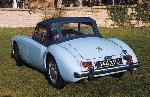 Repositioned stop and indicator lamps give a clean look to the rear end of the MGA MKII. |
| Gilding the lily Some enthusiasts complained about the changes made to the MGA when the MKII was introduced and it was the new inset chrome slatted grill that attracted the most criticism. It must have been a great problem for BMC to give a face-lift to such a well balanced design without spoiling the integrity of the car. However, few would argue with the improvements to the specification of the engine and the extra performance. The MGA broke new ground in sports car design and proved to be so successful that in 1962 the 100,000th MGA rolled off the production line. This MGA was a 1600 MKII roadster and was specially finished in metallic gold paint. |
 |
Richard Ladds
Specification
| Engine: | Four cylinder overhead-valve |
| Capacity: | 1622cc |
| Bore and stroke: | 76.2 mm(3.000in.) x 88.9 (3.5in.) |
| Valve gear: | o.h.v. pushrods and rockers |
| Compression ratio: | high 8.9 to 1 low 8.3 to 1 |
| Maximum power output: | 90bhp at 5,600rpm |
| Performance: | 0 to 60 mph 13.7 |
| Max Speed: | 102.3 |
| Transmission: | 4 speed manual |
| Suspension front: | Wishbones and coil springs |
| Suspension rear: | semi-elliptic leaf springs |
| Steering: | back and pinion, 2.6 turns lock to lock |
| Brakes: | Lockheed 11in. diameter discs at front, 10in. diameter drums at rear. |
| Wheels: | Steel disc wheels or wire wheels |
| Tyres: | 5.60 – 15, 5.90 – 15 |
| Fuel capacity: | 10 gal |
| Unladen weight: | (ready for the road) 18cwt (914kg.) |
| Dimensions Wheelbase: | 7ft 10in (2.388m.) |
| Overall length: | 13ft 0 in (3.96m.) |
| Overall width: | 4ft 10in (1.473m.) |
| Track Front: | disc wheels 3ft 11.5in.(1.206m) wire wheels 3ft 11 7/8th (1,216m) |
| Track Rear: | disc wheels 4ft 0.3/4in (1.238m) wire wheels 4ft 0.3/4in (1.238m) |
| Overall height: | 4ft 2in. (1.27m) |
| Overall width: | 4ft 10in. (1.473m) |