MGC Buying Guide
Buying an MGC
History
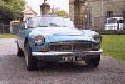
The MGC is one of the most maligned and misunderstood products of the Abingdon factory. A car that is difficult to assess fairly because it occupies a unique position among MG sports cars. When it was launched in 1967 the MGC was available in roadster or GT form and bore a very close resemblance to the MGB and was therefore judged as a variant of the B rather than a separate model. The two cars are indeed very similar in appearance, viewed from the front the MGC is instantly distinguishable by its bonnet bulges and bigger 15 inch wheels. From the rear the only external sign apart from the taller stance, is that the chrome lettering states MGC instead of a MGB. However, despite the visual similarity there are many important differences between the cars. Many of the key components in front of the windscreen had to be altered. To accommodate the larger engine the inner wings, front cross-member and front suspension all had to be redesigned. This involved changing from lever arm dampers with coil springs to telescopic dampers and torsion bars.
Distinctive bonnet bulges are necessary to cover the tall C-series engine.
Engine
The big six cylinder seven main bearing engine is the key to the personality of the MGC. This is not the same engine as used in the Austin Healey 3000 as some misinformed vendors have claimed, but a new unit developed as a replacement. The engine had a bore and stroke of 83.36mm and 89.9mm, producing a capacity of 2912 cc. This engine was also to be used in the Austin Three Litre saloon (ADO61). It was unfortunate for the designers of the MGC that the engine turned out to be 70lbs heavier than originally anticipated and despite its promised 145 bhp, the combination of extra weight and lack of low speed torque meant that the performance of the car was not as impressive as expected. Despite this, the MGC did accelerate from 0 to 60 in 10 seconds, had a top speed in excess of 120 mph and possessed an impressive high speed cruising ability.
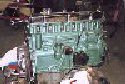
The seven main bearing, six cylinder, 2912cc C-series engine is the heart of the MGC.
Handling
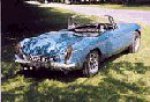 When it comes to handling the C is again unfavourably compared to the B, many of the journalists who first tested the MGC expected the same driving experience. The C weighs a full 350lbs more than the MGB, with the engine weight exceeding the B unit by 210 lbs and this extra mass at the front alters the balance of the car. The result is very different handling with much of the Bs agility sacrificed to accommodate the extra power. However, it was found that increasing the pressures of the front tyres by 4 psi helped to counteract the extra weight and improved the handling. Although a lower geared rack was fitted, the steering feels heavy at low speeds but as velocity increases the C steers straight and true. The suspension feels softer with the C giving a more comfortable ride than the B and despite the extra weight there is little roll. Generally the MGC tends to understeer, the road testers from Autocar reported that when pushed hard the tail could break away in the wet and when it did was difficult to catch,but provided corners were approached with a slow in, fast out technique the car behaved predictably. The C is much better when driven in a smooth progressive style and is happiest on the open road where the extra power of the six cylinder engine can be used to the best advantage.
Living with an MGC
The MGC is every bit as practical and easy to live with as the MGB roadster or GT, as the cockpit, boot or rear deck areas are the same. But the C is a very different car to drive, especially on long journeys, it has power in abundance and is very smooth and tractable, it is an ideal motorway car and will cruise happily at speeds well above the legal limit. The downside of this extra power is an increase in fuel consumption but the m.p.g. is more acceptable on long journeys rather than with stop and start town driving. The MGC makes greater demands on its owner than the B and requires careful maintenance and a higher level of involvement and enthusiasm .
Buying an MGC
There are not many MGCs on the market and the opportunity to purchase a good car does not often arise, as a consequence they are advertised at very high prices. The roadster is invariably most expensive but the value of any MG should be determined by its condition. Although originality is important good quality period modifications such as Downton engine tuning parts are quite acceptable. Prices will depend on condition but currently MGCs are on the market for between £5,550 to £8,000 for GTs with roadsters starting at £7,500 and going up to £10,500.
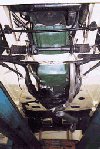
A smaller cross-member and torsion bar front suspension was designed to allow more room for the big six cylinder engine.
What to look out for
As most of the shell and exterior body panels are the same as the MGB they share the same weaknesses, MGCs can suffer just as badly from corrosion particularly in the sills, floor-pan and suspension mountings. Repair panels that are shared with the MGB are readily available but those panels particular to the C such as the stronger floorpans, inner wings and transmission tunnel are more difficult to find or may have to be specially made up.
The MGC went through a period of being undervalued and some cars fell into the hands of those who did not maintain or service the cars adequately. Always look for a car with a full history, old MoTs and repair bills can support mileage claims and demonstrate the level of care that the car has received.
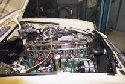
There is little room to spare under the bonnet
Possible problems
The big six cylinder engine is generally unstressed and will last well if properly serviced. The oil pressure should be around 15 – 20 psi at tickover and about 50 psi at 2500 rpm. Piston rings can wear, so once the engine has thoroughly warmed up check for blue smoke in the exhaust. There is usually some tappet noise but excessive clatter from the top end may indicate a worn rocker shaft. Listen for any noises from the back axle which may indicate wear arising from the extra torque of the big engine. King pin wear is common especially when greasing has been overlooked, it is a good idea to grease them very regularly. Replacement king pins are available but quite expensive. Most other mechanical components can be found, but certain parts are no longer available, for example the heater valve on the cylinder head is no longer listed but a Mini heater valve can be adapted and substituted.
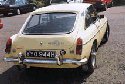
Only the tailgate badge identifies this late model MGC GT.
Conclusion
If you fancy an MGC ignore all the contemporary road test reports with their negative comments and drive one for yourself. It is important to remember that the car is not just an MGB with a big engine and try to judge the car objectively on its own merits. Open up an MGC on a suitable stretch of motorway and you will appreciate how well it sits on the road and delivers unstressed high speed cruising.
Richard Ladds
Owner’s View
The MGC roadster featured is chassis no. GCN1/5758 one of the 1,403 roadsters built for the home market between October 1967 and September 1969. Fitted with standard steel wheels and a non-overdrive gearbox, the car was finished in Primrose Yellow and supplied to one of the main Worcestershire dealerships during 1996. Registered HXC 200H on 1st August 1969 in order to take full advantage of the new letter, the car waited a further seven weeks before the first owner drove it away from the forecourt.
The delay was due to the fact that the purchaser had preferred to take delivery of an example finished in the one metallic colour listed exclusively for the MGC roadster, Riviera Silver Blue. The sales manager approached the parent company for such a car, preferably as a swap for their own. When it had been ascertained that one could neither be located nor indeed built (as production had already ceased), the sales manager was so keen to clinch a deal on one of the most un-popular sports-cars on their books, he booked the brand new yellow car into his spray shop!
Eighteen months later, the blue roadster passed into the hands of a certain John Priddey of Tamworth. Restricting his driving to the summer period only, he laid the MGC up as usual at the end of 1976, as he had for the previous six year. Domestic changes in 1977 demanded the car temporarily remain on blocks; indeed the wheels did not move again until the mid – 1980s when it was billeted to his sister’s garage in Birmingham. By 1991, she rather selfishly decided there was a limit to brotherly love and after six years, asked that she might park her own car under cover. Reluctantly, the MG was advertised for sale, which is when the current owner enters the story. 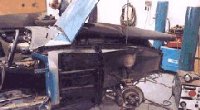
The MGC undergoing restoration in 1994.
I had been looking for an MGB roadster some little time, having previously ‘lost’ my MGC GT during a divorce settlement. With limited funds available and aware that over half of the entire roadster production had been shipped across the Atlantic ocean. I had thought my best option was to acquire a tatty but sound ex-Californian import which could then be cosmetically restored. Considering this second option had distinct advantages, I spoke to John Priddey and closing my mind to the fact the car had been driven for thirteen years, made 150-mile journey to Redditch a toute vitesse. Eventually we found a wooden garage and under several boxes and various items of gardening memorabilia, was a very dry but complete MGC. Assuring me that it would have started if only he had remebered to charge the batteries, John proudly explained that he had done the respray in Ford’s Electric Blue, fitted the 12″ steering wheel and given the bonnet its go-faster stripe! These aside, I liked what I could see of my sleeping beauty and made my opening offer well below the asking price. To my surprise and delight, this was immediately accepted – the figure still being over three times what he paid for the car with only 12,000 miles on the clock some twenty years earlier. Once collected and returned to my home in Cambridge, the car was taken immediately to the local M.O.T. station where it failed the test……..the seized hand-brake cable had recently been severed, presumably to effect a hasty released from its Birmingham prison! 13128 miles were completed before the next year’s MOT, with just the absolute minimum of maintenance required or given.
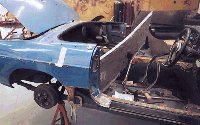
New sills being fitted to 7678 MG.
During my six-year ownership, 44,000 miles has been added to the odometer with no work being done whatsoever on the bottom of the engine, and a small number of subtle modifications carried out elsewhere. These include an overdrive gear-box, a set of Mk. I leather seat covers made for Mk. II (reclining frames), an unleaded cylinder head and a substituted Motolita steering wheel, once the property of MGB racer Gerry Brown. The rather unusual mag-alloy wheels, so often mistaken for the ‘J.A.Pearce’ wheels found on several University Motors Specials, are nevertheless genuine after-market accessories from the late 1960s, named GEMINI and produced by Dunlop. A full restoration was carried out on the bodywork by the MGOC workshop at Swavesey during the early part of 1994,culiminating with a full respray in the original shade of Silver Blue Metallic. As so often with a car of this age, before this could be done, almost every internal panel (and several external ones too) were replaced although appropriately, traces of primrose yellow paint remains clearly visible within the engine bay. The seats, cylinder head, steering wheel have all been retained, enabling a very straight-forward exercise should I wish at some stage to return the car to how it appeared thirty years ago.
The MGC remains my sole form of transport, one that feels equally at home in an urban or motorway situation. It is as safe in the wet as in the dark and as economical as almost any of the eleven MGBs I have owned during the past twenty years and an absolute joy to drive.
Geoff Shirt