2008 MG TF LE 50 – ‘The Comeback Kid’
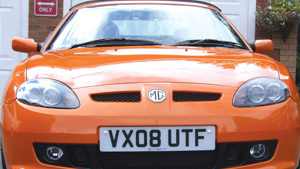
We have covered the progress made by NAC MG since they acquired MG Rover back in July 2005. Three years on and the fruits of their labour were released onto the UK market in early September 2008, our first drive of a production car was approached with a great deal of expectation. Writing about a launch that’s a re-launch of a model that went out of production some years before appears to be becoming an MG trait, and could label MG as ‘the comeback kid’. The limited run RV8 was in effect an MGB re-launched 12 years after it ceased production. As most readers will be familiar with the older TFs, I’ll be looking at a more detailed breakdown in order to highlight the changes.
The end to the millstone of Head Gasket Failures?
First let me clarify the changes made to address that Achilles Heel – head gasket failures. Almost every potential buyer will be aware of this reputation, but probably not the full facts. Head gasket failure was not a major concern when applied to the TF, especially in its last two years of production. However, with the early MGF the reputation was largely justified, although by the time the first TF arrived in January 2002 the problem had been much reduced, plus in 2003 there were further significant enhancements to the cooling system that further lowered the failure rate. Before MG Rover collapsed they were about to introduce the EU4 spec of engines which carried a number of modifications that would significantly impact on the potential for head gasket failure. NAC MG finalised this development with the new TF LE500 engine, known as the N series. The N series has a stiffer lower engine rail and uses a multi-layer steel shim cylinder head gasket, which simply can’t suffer from the original design’s common type of failure.
Wine improves with age and so does the TF
The new TF reveals with only slight front end re-styling to signify it’s a product of the new MG car company. Detractors may complain that it’s an old design and cite the Mazda MX5 as a newer model. Few realise, that the MX5 carried on for 16 years, 1989 to 2005, before a major redesign, and with a facelift in 1998.
A two seat open sports car does not follow the same rules of production life as a mainstream product, age is not so important, what the car offers and delivers is the point. The TF arrived in 2002 and was a quite deeply changed development of the MGF, which in turn arrived in 1995. In every full year of both model’s production they topped the UK sales charts. Even accounting for the three years the car has not been produced, the model is just 13 years old, so not that different to the MX5, currently the world’s best selling two seat open sports car. The MG TF LE500 is a limited edition model with a run of just 500 cars, all very high specification compared to any previous TF, and better than any competitor product. The MX5 is the mainstream competition and when the OTR (on the road) prices are compared they are very close, but the LE500’s high standard equipment list is not comparable. The slight price advantage of the base Mazda is more than offset by the LE500’s impressive list of standard equipment.
Mechanical Specification
LE500 comes in only one mechanical specification with a 135bhp EU4 compliant 1800cc engine mated to a five-speed PG1 gearbox. There is also only one specification for the suspension and brakes, with the former being a development of the 2005 model year’s softer and significantly more comfortable standard suspension, and the latter being the highly regarded 304mm diameter big brake spec with the visibly striking AP Racing four pot (piston) calipers up front. Wheels and tyres are also a carry over of the 16” 11 spoke alloys with the same 195/45×16 front and 215/40×16 Goodyear Eagle F1 tyres.
That markedly more compliant and comfortable suspension compared with any pre 2005 model MG TF is obvious to anyone with experience of the earlier TF. As a result of MG Rover’s collapse only a few hundred owners were able to enjoy the significant benefits of those 2005 models. The ride of those models with revised standard suspension was much more comfortable, with little detriment to the car’s excellent handling. I can confirm the ride of the new LE500 is just as good as the 2005 model cars I have driven.
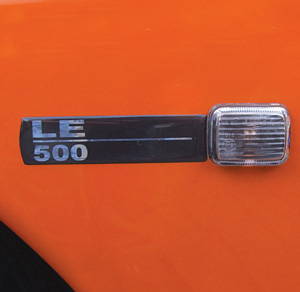
LE500 badges on front wings
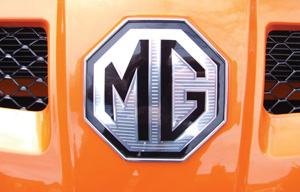
New style MG badge
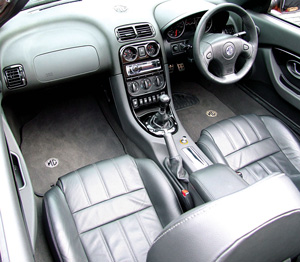
Interior
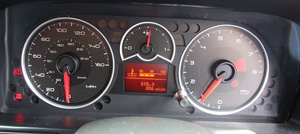
New instruments
There’s one area where the LE500 appeared different, a solid feeling that came from what to me was additional body stiffness, enough to give the LE500 an edge over the earlier cars, although I’m not aware of any difference in the bodyshell construction, perhaps there are more welds; the added solidity reminded me of the seam welded MGF and TF Cup cars.
The departure of Stadco, the former body supplier of TF bodies for MG Rover, was wrongly interpreted by elements of the UK press as a sign that the TF would not reappear. Having a revised lower volume expectation no longer justified the need for two body production lines, also the line in China was new and would obviously be able to offer more consistent quality and cost savings. It made sense to make all TF bodies in China and then ship what was needed for UK production. Several UK built TFs with Chinese bodies have already been crash tested to certify they meet all the required standards.
New tooling should mean a more consistent panel fit and generally on the cars I have seen the fit is perfectly acceptable, but not yet up to Audi or Mercedes levels. Painting of the bodies is more comprehensive than in the MG Rover days and the paint depth and quality is very good on the cars seen.
Visual differences are the frontal changes to the bumper panel. The lower blacked out section has a deeper curved lower edge section and sides, making more of a mouth look below the number plate line, whilst above the previous double slat has given way to a single wider slat either side of the larger MG badge. The rear is little different with just the addition of rear parking sensors. One area of the original TF bumpers that was poor was the blacked out sections, often poorly masked and painted. The LE500 carries on from the late model TF with very neat black plastic mouldings, a significant quality improvement.
High Levels of Safety and Security
One of the most important carry over features is a very good Euro NCAP four star adult occupant and three star pedestrian safety ratings, both still very competitive. Interestingly the four star rating was achieved when the passenger airbag was still an option whereas today it is now standard! Let me put this is some perspective. Many cars now receive 5 Star adult occupant safety awards but in the whole of 2007 NO car received four stars for pedestrian safety, and over 2/3rds of cars tested only achieved two stars, so the TF remains a true leader in this area.
Driving safety has always depended on safe and secure handling and ultimate high levels of grip. The standardization of the previous superb AP Racing 4 pot calipers clamping massive 304mm discs, with ABS and EBD means all cars now have the same superb braking system. Whilst there are no other electronic safety aids such as stability control, the relatively low power levels and high competence of the overall chassis means this is not a failing. The previous Thatcham category 2 level security has been improved to Thatcham Category 1 through various areas having better shielding; although one change sure to catch out those familiar with previous TF or MGF models will be the way the alarm and boot are connected, with Thatcham Cat 1 security any opening of the boot when the alarm is active will set the alarm off. Whilst this is a step forward it’s a shame not to see the fitting of an electronic boot release, especially as the key fob is of the same series as all the late MG ZR and ZS models. These models had a third button position on the same round fobs to provide the convenience of remote boot opening, yet retained their Thatcham 1 security level. Insurance grouping incidentally is Group 14 for the LE500 and will be Group 13 for the follow on TF 135.
Small but significant improvements
Getting in is as simple as ever, although now there’s a very satisfying ‘thunk’ when the door closes, rather than the previous ‘clang’ of earlier models.
The general ambience of the interior feels good and appears to be of a better quality from the detail changes, which includes down lighting from the interior mirror being changed to two sets of four white LEDs.
One very visible failing of earlier cars was the cut of the rubber cheater (door mirror mount) these would usually display a ragged lower cut line where it sits above the trim. I was happy to note that the LE500 had a very straight cut line with the cheater butting neatly against the door trim.
Another improved area was the floor carpet fit, many owners would testify that the carpet would pull away from the sills near the front lower corner of the door apertures and leave an unsightly gap. Boot carpet would also distort and pull away, probably due to heat from the engine bay, it’s good to see extra fixing to deter this, plus better quality carpet.
The hood also exuded an impression of higher quality than I recall on 2005 model year cars. It features the same distinctively shaped glass rear window with a standard HRW and a heavily curved bottom line, which allows the window to sit flat on top of the engine cover carpet when it’s lowered.
Hood operation was smooth and easy, although I noted a need for just a slightly greater effort to close the hood. The impression that the hood material was better quality may be related to this, but operation was very easy and simple compared too many soft top cars.
Not so good on the new car is the now standard supplied hood cover, as the material used looks cheaper. Design is a carry over and so there’s an extended tailpiece that sits in the body channel under the leading edge of the closed boot lid. To ensure that the material didn’t pull out, the edge of the old cover had a sewn-in piece of tubular foam that was soft enough to crush if caught in the wrong place when closing the boot lid. The LE500 has a similar arrangement, but in place of the sewn-in foam tubes are a pair of plastic pipes. Whilst relatively soft these will not crush as easily, and I foresee that careless fitting of the hood cover and closing the boot lid onto these, may promote possible damage.
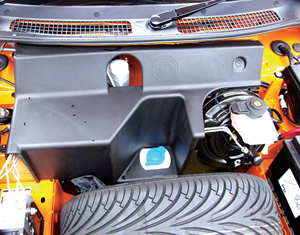
Better quality and monogrammed plastic cover
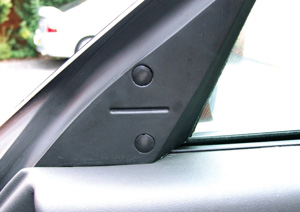
Detail quality improved such as the rubber cheater cut line to trim panel
That niggle aside the list of small but significant improvements carries on. One area that really illustrates the drive for better quality that NAC MG has made throughout the car is under the bonnet. Most MGF and earlier TF owners will recall the cheap and nasty, flimsy black plastic cover behind the spare wheel (which incidentally is now a full sized alloy) and covering part of the bulkhead area below the windscreen panel. In the LE500 it’s a thicker much better self-supporting plastic moulding with a proper shape and very smart. The icing on the cake though is the neat MG motif moulded into the front centre.
Back inside the car you’re faced with a familiar basic layout, but immediately you are drawn to the new instrument cluster equipped with normal analogue speedo and rev counter, separated by analogue fuel gauge. Under the fuel gauge is a digital display that provides the odometer and trip distance functions and also the engine coolant temperature reading via a bar graph. During the first few seconds following ‘ignition on’ there is also a service interval counter displaying mileage to the next service, then around the main gauges are an enhanced range of warning lamps including a petrol low level warning and gearchange light.
I felt that reading the new instruments was not quite as easy as the previous set up.
The centre console retains the same layout including the analogue clock and oil temperature gauge. It is pleasing to note that the calibrations of these actually match the main instruments.
Below the gauges is a Pioneer (1 DIN sized) radio/CD head unit supplied with a remote control and a flying lead for the IPOD laid in the glove box.
Below the radio is a carry over of the 2005 model heater controls, here the same criticism of the 2005 model remains true as the controls and face look and feel a little tacky.
At the base of the centre console the same bank of switches is present but in the LE500 all slots are used which gives a better overall look. These switches control windows, front and rear fog lamps, heated rear window, air con master on/off and recirculation functions. Below the switches remains the small but useful oddments pocket.
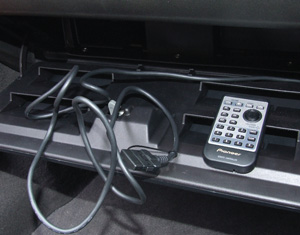
IPOD connection and ICE remote control in glovebox
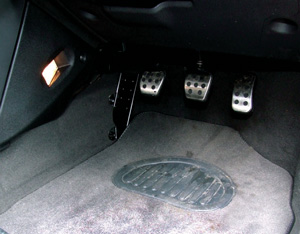
New pedals
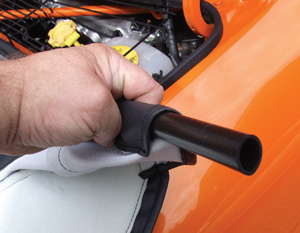
New hood cover has less than ideal plastic tube fill ins
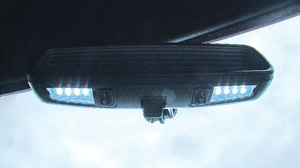
Effective LED interior illumination
Other controls are exactly as before but remain perfectly functional. One set of controls that have changed are the pedals, now all featuring bright sporty finish metal faces with the rubber type moulded ‘buttons’ projecting to provide anti slip for wet shoes.
Driving the LE500
Driving the car is probably the most important aspect and the good news here is that I feel that this is the best TF I have driven so far.
The LE500 drives like other TF 135 models, which should come as no surprise. The engine spec of the LE500 is, in simple terms, a EU4 compliant version of the previous EU3 engine with the same peak power. Acceleration and throttle response were good and pretty much as I recall for previous TF 135 models. It has been said that reaching EU4 compliance has cost a little low rpm torque and perhaps the below 2500rpm band was slightly less responsive than before, but it would also be the case that the mileage of well under 1000 miles even when I handed the car back will have had more influence. The change to EU4 compliance sees the CO2 emission rise by just 1 gram per Km to 185. The test period was too short to measure fuel consumption accurately, it would seem that the official overall average of just over 35mpg will be bettered by most owners, aside from those who permanently drive in restricted urban conditions, certainly over 40mpg should be available on any longer sensibly driven runs.
I was able to include almost every type of road for the test from empty country roads through towns, to busy motorways, and the weather dished up showers to provide wet and dry surfaces. The car was a pleasure to use and all the time there was a feeling of solidity and the complete lack of rattles, squeaks and extraneous noises from the body. The full leather seats were comfortable and were surprisingly free of that typical slip you find, this enhanced the driving pleasure, plus added to passenger security and comfort.
Ride and handling was pretty much the same as those few 2005 TF models, and so for the usual UK road surfaces this means that the car was much better and easier to drive by far than the majority of TF models. Steering was light at parking speeds yet precise and communicative at high speed, with enough feedback to be aware of what was happening under the two front tyre contact patches, so vital for good control.
The effects of the smaller glass area is less than you would imagine, the benefit of clear glass and demist functions at all times, means that rear vision is improved.
Having air conditioning was not a new experience for me in an MGF or TF and the efficiency of this in the LE500 was as good as I have experienced in any of these cars before, being more than enough to cool the interior quickly and effectively. Heating was always effective and this remains the case.
Dribble Wipe
The TF, and MGF before it, was notable for being the odd model out in the MG range through the lack of synchronised control of the wipers and washers. While other MG models provided synchronised operation of the wipers with usually two or three sweeps, TF and MGF did not have this facility, leaving the driver to operate the washers and wiper controls separately.
The differences widened with the 2004 model year ZR and ZS’s facelift introduction of a novel feature called ‘Dribble Wipe’. This is nothing more than an additional single wipe by the wipers some seconds after the wash and wipe cycle has finished. When you have used the washers on the screen there will be a dribble of water that always manages to find its way right in front of your vision a few seconds after the wipers have stopped. ‘Dribble Wipe’ is simply a pre programmed additional wipe to help cater for this automatically.
Rear parking sensors are standard on the LE500 and whilst not an option that perhaps appears on the desire list, many owners become firm supporters when they have lived with a car fitted with them. The system on the LE500 demo car showed that the range was not quite as good as other MG saloons so the beeping warnings didn’t start until somewhat closer to the test wall, nevertheless the warnings were otherwise accurate.
Conclusion
The LE500 is a car to put MG back in the new car lists in just the same way the MG RV8 did in 1992 when it was launched with the knowledge that a new modern (the MGF) was just three years away. Today we have almost the same scenario with the TF holding station until the new and fully up to date MG Sports car arrives, unlike the 1990s these MG sports cars will be supported by three new MG saloons and being driven by a company that has the will and resources of making the MG future the brightest it has been for a very long time.
In conclusion the LE500 has moved itself above the level of the previous 2005 model year TF. With little difference within the major aspects of the car it can’t be expected to be hugely different. However it has improved in the areas where it must; quality and refinement, and the LE500 adds a great deal of extra value in the high level of standard equipment that would have added around seven thousand pounds to a previous models new cost, making £16,399 on the road price very attractive. As a result the MG TF LE500 stays true to the MG roots of being an affordable and economic sports car that still offers Terrific Fun.
Roger Parker