B’s on the Beat
| B’s on the Beat | Part Two |
| Last month Hazel Lane and Joy Smith revealed some of the ups and downs of Policing the roads of Sussex in an MGB GT, to MGOC member Stuart Disbrey. Now, in the concluding part of the interview, they discuss training to drive at speed, a new car and ‘going for a spin’.
With six months of hands-on experience under their belts the ‘traffic dollies’, as Hazel Lane and Joy Smith, the first all female Traffic Police crew in Sussex Constabulary had become known, went back to Kent Police Driving School to take their three week Advanced Course. “When we went back to Maidstone for ‘Advanced’ there were plenty of familiar faces, people who we had done the ‘Standard’ driving course with, and we really felt welcome. One sign of that was that we were housed at the top of the men’s accommodation block, rather than having a separate building all to ourselves!” says Hazel. |
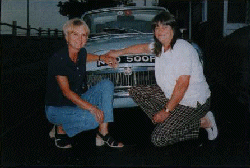
The ‘Sussex dollies’ today; Joy, left and Hazel 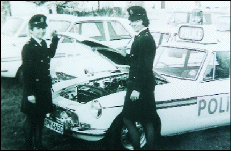 Joy, left, and Hazel take a look under the bonnet of SPM, 1969 |
Constabulary had become known as the ‘traffic dollies’. |
This time around, the duo found themselves being literally pushed to the limit and beyond it.
“You were expected to drive on the open road beyond the speed limit all the time, basically to achieve the highest speed that you could,” explains Joy. “We had the order ‘make progress, make progress’ from our instructors ringing in our ears. You were really pushed – and there are some pretty hairy country lanes in the Maidstone area! We both passed at Class 1 – the first female Class 1 qualified Police drivers in England. The only drawback was that we had left our MGB GT patrol car at Lewes – and we missed it!”
On their return to Lewes Traffic with their Advanced Course safely passed, Hazel and Joy enjoyed some new found confidence.
“With ‘Advanced’ qualifications we really felt that we were driving to the conditions and not merely to the capabilities of the car,” says Hazel. “With the MGB being capable of reaching above the 100 mph mark it presented speeders with no chance. However, if we booked someone for speeding we had to collect a stop watch and then take corroboration that the MGB’s speedometer was correct on a measured mile. That had to be done every time we gave a speeding ticket. We were also in the force during nation-wide Government trials of a 50 mph maximum speed limit for single carriageway roads in 1968-69. We had a terribly antiquated radar machine, just a black box which sat on the side of the road running off a 12 volt battery, which we sometimes used to catch speeders.”
Despite the MGB’s relative smallness in size, and lightness of construction, no concessions were made when it came to the allocation of tasks.
“We were expected to go anywhere,” says Hazel. “But with all the weight in the back we used to damage the exhaust quite often on speed bumps or country tracks.”
And Hazel discovered from personal experience that you couldn’t take an MGB golfing!
the open road beyond the speed limit all the time, basically to achieve the highest speed that you could,” |
“I was chasing a stolen car with a male colleague. We lost them briefly, but we knew they’d gone on to a local golf course, dumped the car and run. The MGB was not designed for golf course driving – as we soon found out as the car and its exhaust parted company!”
At that point, as Hazel explains, one form of horse power was abandoned in favour of another: “No vehicle could make headway on that ground, so we left the MG behind. I had done a bit of horse riding in the area and, as luck would have it, some people who I knew were riding by. The two of us borrowed their horses and gave chase!”
So startled were the car thieves to find themselves being pursued by an impromptu mounted section that they gave themselves up – arrests for which both officers received congratulations.
For all the affection the pair felt towards their BGT, it had other limitations. Joy recalls ‘losing’ the back of the car on an icy road one frosty morning, while Hazel pointedly comments: “The MG didn’t handle well in the snow – I remember nearly getting stuck on Ditchling Beacon, a local landmark, when the snow was higher than the car!”
But if the MGB GT was not the perfect Police car, Hazel had a mishap in 1969 which at least illustrates its ruggedness.
“I was on my way to a fatal accident,” she explains, “I pulled out to overtake a slower vehicle and had to take immediate evasive action to avoid a head-on collision with an oncoming car masked by a dip in the road. I clipped the bank and rolled the MG, which ended up on its roof. I have to admit that I totally misjudged the manoeuvre – even Police drivers can make mistakes – but the damage was repaired, the car was soon back on the road and I was totally unhurt. We wore our seatbelts all the time, you see, even though it was not the law then.”
| In 1968 Hazel and Joy were assigned a brand new car as their much loved HPM was retired in favour of a model straight from the production line – SPM 465 G.
“The two cars were quite similar,” says Joy. “The only real difference we noticed was that SPM had coloured piping on the seats, rather than the plain upholstery of HPM. We had SPM from new and we used to have to take it out and drive it for miles and miles to run it in. Little did we realise in those days that we were driving around in collector’s items!” The two friends soon got used to their new ‘mount’, but, in an amazing coincidence, they were destined to see their old faithful HPM one more time. “In 1970 we went on a refresher driving course,” says Joy. “We were driving past a garage forecourt in Tonbridge and there stood HPM, stripped of all its Police paraphernalia and up for sale. It must have totted up more than 85,000 miles in its three years with the Sussex Constabulary. We often wonder who bought the car and what became of it. Who knows – one or two of our old MGs might still be on the road today.” |
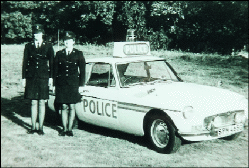 A 1969 publicity shot features SPM with Hazel, left, and Joy – differences from HPM include twin spotlights, two square wing mirrors and ‘Police’ badging on the door
|
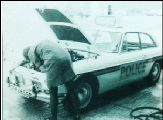
on Ditchling Beacon, a local landmark, when the snow was higher than the car!” |
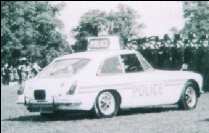
| Hazel and Joy finally went their separate ways in July 1970. Hazel was posted to Brighton to be issued with a new MGB GT – BAP 885 K, one of the first Leyland MGs – while Joy stayed with SPM at Lewes. In March of that year Joy had been bridesmaid at Hazel’s wedding – “Traffic Division virtually closed down for a couple of hours that day,” laughs Hazel – now both were assigned new female crew partners.
By that time the novelty value of female Traffic officers had begun to disappear. There were women crews in each Sussex Traffic Area, female officers having been gradually phased in over the previous few years. “There must have been eight or ten girls in Sussex traffic by 1971,” says Hazel, “Though Joy and I were the ‘old hands’ I suppose.” “It was a wrench to split,” adds Joy. “We knew how each other worked, how we would react to certain situations. We would get a call and not even have to speak – we were absolutely certain of what each other would do. At an accident one of us would go to the injured, the other would start to make the area safe. We would take it in turns as to which of us would be the officer ‘responsible’ for dealing with a certain call. We knew we could always rely on each other. Our separation was a new beginning, we took on the responsibility of bringing someone else up to standard.” Part of Hazel’s new ‘patch’ was the A23, a busy road where fatal accidents were not uncommon. “Both of us attended some horrible accidents during our time,” says Hazel. “I can vividly recall one on the A23 where seven people lost their lives. Even now Joy and I go along certain roads and can remember an accident on almost every junction and bend.” For both women the high notes of their careers relate to their own professional skills. Joy remembers being commended on the standard of her evidence in court after an accident, while Hazel recalls a commendation for apprehending two car thieves when off duty. |
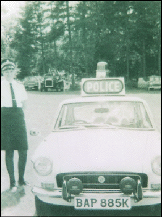 Hazel pictured with BAP – the car’s recessed grille, spotlights and twin square wing mirrors in evidence
|
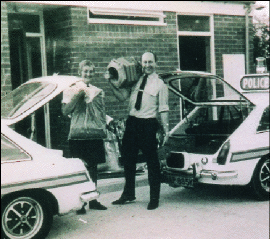
“I spotted this stolen car out of the window of Joy’s flat – it was one we had been told to keep an eye out for during our shift,” she explains. “The pair of us were still in uniform, so I just jumped into my civilian VW Beetle and went after them while Joy phoned into the Station for some support. Somehow I managed to stop them and I shall never forget the look on their faces!”
There were low points too.
“For me the worst thing was attending accidents involving children,” says Hazel, “I remember going to an accident where two small kids had been killed and lifting one of the bodies out of a ditch. That experience stays with me to this day.”
“Our responsibilities did not just extend to Traffic duties, we often got caught up in other things,” explains Joy. “We were once called to a house in the middle of nowhere where a man had committed suicide with a shotgun. We arrived to find his body upstairs, and his wife and child sitting downstairs waiting for us. One of us had to take statements and comfort them, while the other started clearing up the mess.”
“And there was a time when we spent part of our shift driving up and down Eastbourne sea front using a loud hailer to tell people to stay indoors because a ship out to sea was leaking fumes,” recalls Hazel.
Joy finally left the Sussex Police in 1972, to get married, and Hazel left to have children in August the following year. More than 25 years later the intensive training and experience which the two gained stays with them – both are active in their local Neighbourhood Watch.
“You still get a surge of adrenaline when you hear sirens,” says Hazel, “You think – ‘Hey, they’re playing our tune!’ You find yourself able to memorise registration numbers with ease and you’re still good at descriptions – at seeing the things that other people miss. We still recognise the distinctive sound of an MGB too. That throaty roar always brings back memories.”
“In the days when we were in uniform the Police were able to use their initiative a lot,” says Joy, “It was good old-fashioned policing I suppose – we used what we called ‘the Ways and Means Act’ to get the job done.
“I remember a head on collision which I attended. It was pouring with rain, dark and I was on my own. There were a few bystanders and I got the often-heard comment ‘Oh bloody hell, it’s a woman’ from them. The driver was trapped and I found several guns in the boot of the car. So I had to secure those as well as dealing with the accident – though it turned out that all the guns were legal. That incident shows how the world has changed – Police reaction to a find like that wouldn’t be so nonchalant now, but then there was no pressure to justify our job and little emphasis on performance figures. Since then times have changed, not necessarily for the better.
“Of course today female Traffic Police officers are commonplace, but even civilian women drivers were rare then. We both have a real sense of pride that we blazed that trail.”
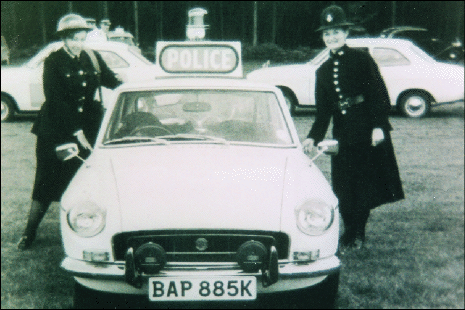
Period Police costumes with BAP at Bramshill
Stuart Disbrey