Buying & Running an MG RV8
Buying & Running an MG RV8
“But why buy an RV8?”Asked my wife, “especially as you love your MGB. And you’ve only just had a new engine fitted. It’s true; I did love my British Racing Green 1969 MGB GT (that’s it on page 70 of ‘Enjoying MG’ December 1998). And I had had a fully balanced 1950cc engine fitted last year by Russell at LMG in Bexleyheath. Not to mention the suspension overhaul and telescopic shock absorbers. The BGT drove like a dream. But its very attraction had wetted my appetite for something a little different and even faster. I had always wanted a roadster. With the children grown and gone the opportunity was there.
It had to be an MG. Not only had I fallen into the trap of becoming an MG enthusiast, but Anne and I had also made some very good friends at the Dartford Area MGOC. I had to preserve our eligibility for those long weekend runs to France and Belgium. And we hadn’t worn out our T-shirts.
The new roadster had to be significantly better than my BGT which was quite difficult. I needed a car that was completely reliable and rust free. The list of possibles included an MGB roadster with a Heritage shell and a 1950 stage 2 engine, an MGC which had benefitted from a bare metal rebuild, an RV8 or possibly an MGF.
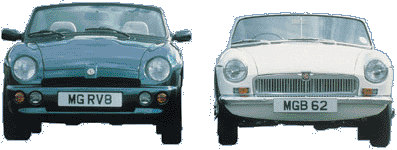
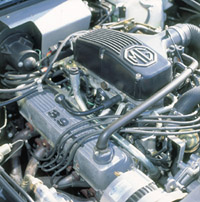
 I saw a number of MGB and MGC roadsters that tempted me, including one MGB with a 3.9 V8, but the price of the best was nudging towards that of an RV8. An MGF was tempting, test drives in both 1.8i and VVC having proved what lovely drivers’ cars they are, but not perhaps sufficiently “classic” for me. The RV8, I decided, had everything I wanted – a soft-top, that glorious V8 engine, suspension and brakes to handle it and a classic feel when driving. I doubt that an RV8 would keep up with an MGF round the bends but that lovely V8 burble when you lift off and the roar as you accelerate out, more than make up for a tendency to protest half way round. A run in Mike Tester’s British Racing Green RV8 was enough to convince me.
The search for an RV8 hotted up. With only 324 originally sold in the UK they are few and far between. I bought all the MG magazines and the best of the classic magazines and put all the advertisement details of RV8s for the last few months on a database. This was very revealing. Over half the ads were either openly for Japanese re-imports (1568 of the total production of 1983 had been exported to Japan) or their Japanese origins could be deduced from the description of the cars as having air-conditioning, which was fitted to counter Tokyo smog. Visually the Japanese cars can be easily identified by a Rover badge on the front wing and the replacement of the extra driving lamps by air intakes, as well as extra trims around the wheel arches. A lot of space is lost in the passenger footwell due to the fitment of the Aircon unit, there being too little space for it under the bonnet. Whereas most UK cars had a full service history and thus a six-year anti-perforation warranty, none of the Japanese cars I saw had a service record. Imports were also fitted with new speedometers and mileometers to replace the kph versions, so mileage could not be established, but to be fair none of them looked to have done a high mileage. Nor had the UK cars been heavily used, most having covered between 4000 and 25,000 miles, not much for cars between 4 and 6 years old. Clearly some had been bought as investments or to admire rather than to drive. Very few had covered more than 40,000 miles.
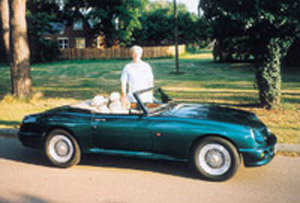
My database proved useful. I established selling prices, as opposed to asking prices, by tracking advertisements over several months. Cars tended to stick or come down in £500 increments until sold. Advertisers, both trade and private, were remarkably chatty on the phone, which was just as well given the distances necessary to view a reasonable selection. I saw about 12 cars for sale between Hampshire and Yorkshire and drove to view four. There were one or two RV8s for sale at each of the major MG events in 1999. Prices varied from £20,000 plus for very low mileage cars compared to the new price of between £26,000 and £27,000 depending on paint finish. Sellers were asking, in mid 1999, between £17,000 and £19,000 for cars with between 20,000 and 40,000 on the clock. Japanese imports were, perhaps £1000 cheaper than an equivalent car sold originally on the home market. The car I decided upon, bought from its first owner (trading up to a Jaguar XJ8) was a Le Mans Green model first registered in October 1993 having covered 18,000 miles. The RV8 came with a full service history and all the bills and promotional literature including the Times article which had prompted an order for the car unseen. Fortunately, the car also came with its original toolkit which is now unobtainable.
 So, was it a good buy? What problems have I had and what pointers can I offer if you too are tempted by an RV8? Firstly, the driving experience is just fantastic – I can’t believe how some owners have covered so little mileage. The only slight drawback for me, as I am over six feet tall, is that the top frame of the windscreen can obstruct sight lines, particularly when the hood is up at traffic lights which requires ducking down. Tall drivers may also need to remove the tonneau frame to get enough rearward tilt to the seat when the hood is down. But these are minor issues. The temptation to use the MG rather than the ‘normal’ car usually gets the better of me provided the weather is reasonable. It is an easy motorway cruiser with a tall top gear, although the cockpit suffers from wind noise at high speed. It attracts attention everywhere, mainly from ‘car buffs’ who have never seen one.
Mechanically the car has not been without problems. Its alternator and battery were replaced when I bought it. At its annual service, as I suspected, the radiator needed replacing at a whooping £300. The largest repair required however was the replacement of the windscreen frame, which had rusted through from the inside, a fault that I had spotted when buying the car, and which I had noticed on one or two others. As the car had a full service history Rover covered the entire cost, just inside the 6-year time limit. I suggest all RV8 owners or buyers should check the frame carefully. The frame is made from steel rather than alloy, but is very similar to that on the MGB and secured in the same way, necessitating dash removal on replacement.
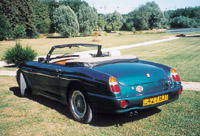 Other problems have been minor and typical of the model. The footwell gets wet in persistent rain, betraying the car’s MGB origins. The hood was very stiff to operate but lubricating all the frame rivets fixed that. The beautiful alloy wheels are starting to corrode so I will need to have them blasted and re-lacquered soon.
The first six months of RV8 ownership have been great fun. A holiday in the Loire valley confirmed that the RV8 is a marvellous long distance tourer as well as a boulevarde cruiser. It has the feel of a classic car to drive and acceleration to turn hot hatches into dots in the mirror. Best of all, it’s an MG.
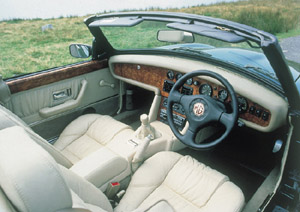
John Wilson Caption John Wilson with his RV8 The burr elm and Connolly hide give the RV8 a luxurious feel Rover 3.9 V8 engine provides large reserves of torque, which peaks at only 3200 rpm and gives effortless performance RV8 on holiday in Loire Valley RV8 or modified MGB? A difficult choice