A Different Sort of Bar to Lean On
A bar provides support, usually to be leant on whilst completing the heavy task of lifting a pint, and something that has to be solid and sturdy to cater for many doing the same year in year out. Now the bar I am thinking about has to do the same but it gets moved about quite a bit.
The bar I am referring to is one that connects between the suspension tops of an axle and provides a strengthening function in resisting movement and associated distortion. This is commonly called a strut brace and whilst not the total solution to the forces that it is trying to contain, it provides a useful degree of control that can be felt in improved handling.
The benefits of a stiff body are well known and documented. The stiffer the body then the better it is in retaining its shape and so the suspension is subject to much reduced distortion and variation in geometry. Better suspension control is obviously going to then improve the car’s handling. It can also be used to provide a much more comfortable ride. I have clear memories of a hire Daewoo Leganza just after this car was introduced into the UK. Driving was hard work with a constant need to correct the direction as it was disturbed by almost every undulation in the road. What was worse was the definite feel of the body lozenging (twisting) that seemed to be the main cause of the problem and later it could be felt as a rear seat passenger. A nine storey jelly in a cross wind if ever there was one and I thought that title was claimed by the Morris Ital – mind you the Leganza was by Ital Design, so I wonder…
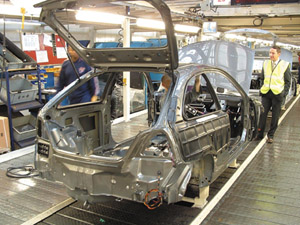
Hatch back cars have a compromised design, wonderful owner practicalities but dreadful engineering challenges in terms of adequate body stiffness. The simple way of demonstrating this is to open the back of any hatchback and look at that great big open void at the back of the car. I recall some ‘internal feedback’ when the ‘new’ Rover 400 range appeared in 1995 to the effect that the saloon body was markedly stiffer than the hatch and could be felt in the handling of the car. I recall later trying a 416 hatch and a 420 saloon back to back with a pal, and apart from the performance difference the saloon did feel more sure-footed. It was interesting to note that ZS press cars at the Z launch were only saloons and this information direct me to buy the ZS saloon.
Untrimmed ZR shows extent of rear opening
Over the years I have driven a number of cars with full roll cages, including the ZR. What is immediately obvious is that the body structure is so solid compared to the standard road going cars and this leads to an immediate and hugely obvious improvement in the steering and suspension responses and the ability of the car to change direction. Keep this effect in mind.
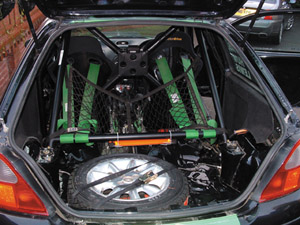
Rally car complex roll cage provides exceptional body stiffness
When the MG Express was launched at the beginning of 2003 I had the opportunity to drive a 160 version out of Longbridge for an afternoon on familiar roads. Familiar roads used to evaluate cars is important as it allows meaningful comparison and smaller differences can be more easily observed. What was very obvious with the Express was the stiffness in the body and how responsive the car was. There may be an open void in the rear for light loads, but this was a notably stiffer car than the normal 3 or 5 door saloons. The main reason is in the integrated load support platform welded in as part of the rear structure. This provides significant bracing for the body, yet is not that intrusive. Look at the open rear views of the Express compared to a 3 door saloon. Not that it is possible to drop rear seats in the Express and expect anyone other than children to fit or be comfortable.
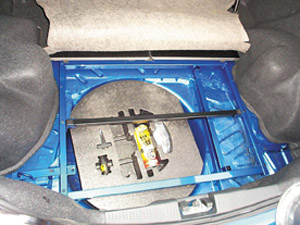
MG Express additional stiffness
It doesn’t take a genius to work out that adding stiffness to the rear section of the ZR body helps the suspension and so improves stiffness. What is more important here is that the experience of cars with roll cages and the Express showed that the improvement was worth pursuing and could a compromise of worthwhile improvement and retained practicality be married together?
Looking at the way roll cages are tied into each rear (and front) suspension towers shows how loads are transmitted through the suspension and into the car’s body. With the roll cage this then adds resistance to body movement to these loads. The Express was most enlightening as the relatively small degree of steel bracing clearly had a significant effect. As this was only in the rear half of the body it indicated there were grounds to look deeper.
Strut braces are nothing new and in truth many are more for show than go. It is a fashion accessory in many cases and looking at some shows that carefully crafted papier-mâéould offer similar strength. There are many considerations to take on board when creating and fitting one of these, and here we were attacking the problem the opposite way to most, back first, but experience said it was the most appropriate route.
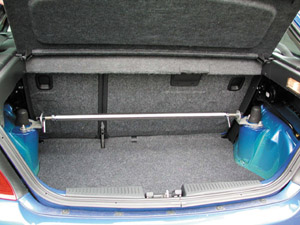
ZR 160 with rear brace fitted
Commonly strut braces are fitted by bolting them to the suspension bolts/fixings although consideration has to be given to ensure that there is enough length in the threads to provide correct and secure clamping with any additional plates, plus a sound fixing so as not to cause failures. Generally once fitted there is usually no simple and quick means of removing them other than unbolting them so whilst this may be quite suitable for a front brace for a rear brace this was deemed an inconvenient and flawed fitting method. The other point is that the brace needs to be strong enough to do the job intended as well as look good as it is more on show.
The brace illustrated has been developed over a number of years and evaluated originally on an 180bhp Rover 200 BRM, and then on ZR 120 and 160 models. It is created using high quality stainless steel in various forms chosen to suit the specific demands of the component. The brackets for example are made from 316 L Stainless Steel, which when folded work-hardens, thus there no need to weld a gusset in place to strengthen it. The cross tube is also made from large diameter seamless 316 L, thus both have great strength and very little weight.
The main advantage with this design is the quick release, quick refit facility so that the brackets are a permanent fit and letter box slots are cut into the load space carpets for access, the bar is then slid into place and locked using the levers. This process requires little effort and so is a practical means of retaining complete flexibility of load space use, yet also enjoying the benefits of the brace.
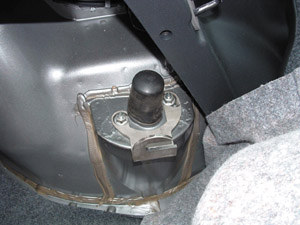
Brace is mounted to the top of the suspension strut
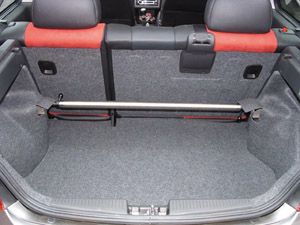
Brace fitted with trim in place
Many ZR owners will be familiar with the creaks and squeaks that often annoy them about their cars, and much of this is due to bodyshell movement and flex. Whilst a simple strut brace will not be a cure all, a session of seam welding and a full roll cage would be more appropriate there, it does actually provide a noticeable change through stiffening the body. The long period of development has been used to hone the details of the design and prove the benefits in a number of cars of different basic specs. With the confirmation of improvements the brace has entered production and is now available through MGOC Spares. See Hot Lines on pages 8&9 of this magazine for price and ordering information.
Needless to say there will be those who having tasted the benefits of the rear bar will want to extend this to the front of their cars also and yes one of those is in the development stage too. There is no release date for the front bar as it has to prove itself over an adequate period like the rear one has, unlike many of the cheap items that can be found on Internet sale sites.
Roger Parker