Eleven years of motoring in an MGF
In the spring of 1996 I proudly collected my only new car purchase off the forecourt of Edwards of Stratford upon Avon and gingerly ran it in on a celebratory trip up to the Lake District with my fiancée, Haidee. The car was registered ‘MGF 578’ from birth and this British Racing Green 1.8i manual version was the 2083rd one off the line.
Although MGFs were still rare then I was lucky enough to have had the pleasure of driving them for over a year as part of the Rover Group design and development team. While my particular responsibilities were the fuelling, cooling and exhaust system of the car there were still plenty of opportunities to sample the delights of an MGF including a press car with ‘blueprint’ suspension geometry. The car handled immaculately with impeccable feedback through the wheel. Any remaining doubts I had about buying one were nailed that day. Sadly I have to say that no other MGF I have driven since, including my own, quite lived up to that early experience but I don’t regret buying it all and we’ve had plenty of fun and very few down sides over the last ten years.
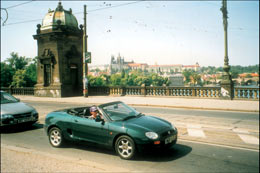
MGF 578 in Prague 1997
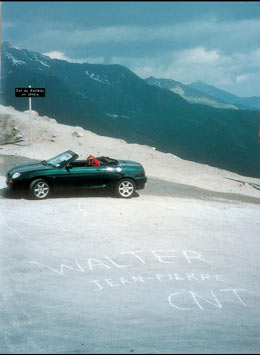
The MGF tackled alpine bends with consummate ease
The MGF was initially developed almost covertly within the Rover Group. British Aerospace had decided that Longbridge needed three separate car lines to get an acceptable return but the investment money available had already mostly gone into the Rover 400 (which developed later into the Rover 45) and the Rover 200 (latterly the Rover 25). Very little was left over for another investment, especially in the supposedly risky two seater sports car market. It is a testament to the sheer vigour of the Chief Engineer, Brian Griffin, who nursed the project from a pipedream to reality that much of the early development costs were absorbed elsewhere and the car was delivered for a headline figure of £25 million. Even the true costs of nearer £60 million would have set an industry record for a completely new monocoque body that met all the latest crash safety requirements. The original body concept was supposed to be based largely on a Metro in order to save on investment costs but it actually ended up with only one carry over panel, in the pursuit of Gerry McGovern’s attractive interpretation of a timeless classic sports car. The basic subframes and suspension are the only significant Metro content that made it to the final car.
BMW, who were the company owners by the time the car was launched, were well aware of the shortcomings of the car but were unwilling to invest in it, not least because they were launching their own Z3, a direct competitor. MG-Rover subsequently tried various makeovers with Peter Steven’s more contemporary styled TF and the modified Metro hydrogas suspension was ditched in favour of a more conventional spring and damper set-up which sharpened the handling but made the ride worse. Unfortunately despite the car’s overall success, reaching full capacity of 15,000 cars per annum at launch and again at its relaunch as the TF, the car never got the investment it deserved to fix some of its shortcomings that could have made it a really desirable. Lack of outright power coupled with body and trim quality issues tended to undermined its intrinsic appeal. Of course Rover could hardly use its success in developing such a good car on a shoestring as a sales pitch but it was a phenomenal achievement that it was as good as it clearly is.
So when I bought our MGF, I did it in the full knowledge that while the car may have had some shortcomings it was still an excellent little sports car and a credit to the MG line. Back in the summer of 1996 the car was still very new to the market and it looked fantastic when we left our wedding reception in it and took it to Tuscany on our honeymoon. It looked so chic that some of the hotels we stayed were keen that it was parked in pride of place outside.
It proved to be an outstanding holiday car lapping up both the miles from autoroute to alpine bends with consummate ease. The ride quality against other sports cars of its time and the economy it returned on long runs were two of its hidden assets while its boot was more than adequate for all our clobber. We developed a rule that all of the luggage must fit in boot on the outward journey. This meant that much of it could be secreted it the nooks and crannies under the bonnet on the return trip leaving most of the boot free for all those things that you might not have otherwise brought home. This is not the end of the places to put things either; I’m six foot so I have the driver’s seat set well back but even so it’s a doddle to clamp at least a dozen bottles of carefully stacked wine between the back of the seat and the fuel tank front cover as well as being one of the coolest places in the car.
The tardis like abilities of our MGF became legendary amongst our friends who stood in amazement that so much could be absorbed by such a small car. I think we excelled ourselves when we competed on the Beaujolais rally. Setting off, at midnight, from Villefranche in the Beaujolais region near Lyon we managed to get 73 bottles of wine into the boot. Three dozen bottles in the original cases with the remainder on top in bubble wrap, and a token bottle of white wine were placed in the boot while our luggage went behind the seats and under the bonnet. Despite such a tail heavy weight the car cruised happily at 120mph up the autoroute and was surefooted through the twisty country lanes as we circuited Paris and even coped well with ‘the icy bit’ still getting us back to the port by 6.30am, inside the first 10 competitors to arrive and well before any of the exotic machinery such as Ferraris and Aston Martins that we would have expected to outclass us.
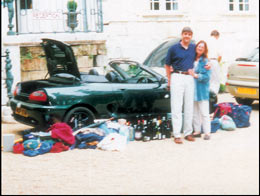
All of the baggage about to be packed into the MGF
Between our annual touring holidays abroad my wife adopted the car as her local transport while I used my company car for everyday motoring. So it was on the holidays that MGF 578 got to really stretch her legs. It’s been to Cornwall most summers, toured Scotland and visited France on numerous occasions including two trips to Le Mans. One year we went to a friend’s apartment in Prague. Despite the length of the journey it was a comfortable cruise and the car, as always, didn’t miss a beat. The highlight for me, although perhaps not for Haidee, was a dust up with a Z3 on a German autobahn. Both cars were relatively new at the time and the Z3 was quicker on paper although our 1.8i had slightly understated figures to make the VVC version look better. Both cars travelled for miles at high speed through the sweeping and hilly county east of Bayreuth, swapping positions as the occasional traffic advantaged one or the other of us. In the end he managed to slip stream the MG and get alongside but couldn’t capitalise any further on his advantage. Absolutely locked together for the next two miles with our accelerator pedals buried to the floor I managed an indicated 135mph on one gentle downhill section before he turned off, honours even. While I don’t pretend that the speedometer was fully accurate I think its safe to say the car more than lived up to its official maximum speed of 122mph!
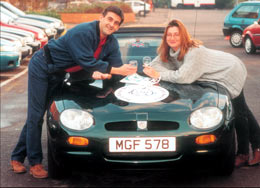
After the 1998 Beaujolais Rally on the forecourt Edwards of Stratford. The profits were for Great Ormond Street Hospital, hence the bonnet decal
Our last big touring holiday was in 2001 and we knew it was our last with the car as Haidee was already 5 months pregnant. We came off the ferry in Santander and after one night in Spain we crossed over into France en route to Provence all the way to Monaco, with the crash barriers still in place from the recent Grand Prix, before heading back up the Franco-German border. It was a fabulous holiday full of great memories. After all the miles we’ve covered the only failure we ever had while on holiday was a blown cooling fan fuse and the car has never broken down at any time.
I had thought that after George was born I’d get the car back again but Haidee loved the MGF and delighted in having George in his baby seat next to her – no passenger airbag is fitted in our early version. Both of them really enjoyed the summer drive back from the nursery with the hood down. It’s the soft top that really endears the car to her although she is glad of practicalities of the hardtop in the winter.
The car has always been regularly serviced and has been very reliable over its ten years and 77, 000 miles with no significant problems and has never suffered from the dreaded headgasket complaint. I guess that I’ve also been lucky as I was able to use my work contacts for the two new hoods giving upgraded sealing and new backlight respectively. Its also had several failed side-window check blocks replaced, the most annoying recurrent complaint. Early cars like ours tended to blemish easily as environmentally friendly paints introduced at the time were still being perfected. This was especially true of BRG versions and ours suffered significant stone chipping after travelling on the Italian roads in that first summer. As it was still in its warranty the garage had the front end and lower sides resprayed in the aftermarket version of the paint that used the older and more robust paint technology.
Ten years on from when I first purchased MGF 578 and a great deal has changed. MG Rover is no more, nor is Edwards of Stratford and its former owner has gained notoriety as part of the gang of four who ran MG-Rover. I’ve now got a job in the aero industry in Derby but I’m loath to put thousands of miles on the car doing my daily 120 mile round trip. Last year my wife gave birth to our second child and so she can’t use the MGF any more. Regretfully I think it’s time to let it go. MGF 578 is no longer a pristine example but has aged less than the rest us and is still just as capable of being a rewarding car to drive. Is there anyone out there who would like to offer her a good home and more TLC than we have time for now?