Exhaust system changes
Here I am initially looking at less invasive changes that can be done to the engines, as done in the VVC feature, and so logically move to the exhaust system. The first modification comes from my observations of the MGF Cup race car specs and seeing that they used standard exhaust manifolds, but that the manufacturing process was different.
Looking at the images will make the differences clearer, but the standard production manifold has the pipes welded to the flanges internally. That is to say the welds are on the inside of the pipe to flanges, so immediately this is creating a restriction to the exhaust flow. The Cup race cars I noted were using manifolds where the welding has been done to the outer edges so that the inner pipes were unrestricted.
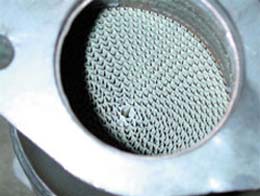
Looking at the core of sports cat showing the wider space for exhaust gas to flow through
Finding some spare manifolds is easy as between 1995 and 2001 all K4 engines, well over a million, have used the same exhaust manifold (yes for the pedantic ones I know there are a couple of rare variations). As a result these can be had for pennies in breakers yards, but do check the lambda boss thread is still serviceable. A little time cleaning the rust off and then attacking one with a MIG welder soon had external welding to allow the inside welds to be ground away. There are often some ports that have a significant obstruction of weld, whilst others are less affected and the pictures on page 18 show this quite well.
This treatment was also applied to the lower flange where the same internal welding now has a greater impact as there are now only the two holes serving four cylinders rather than a single cylinder per runner at the manifold end.
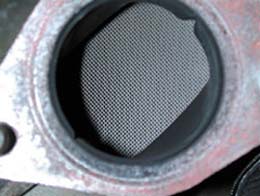
The core of a standard cat showing the much tighter spacing for exhaust gas to flow through
Once done I tried this on a couple of 1.8 engined cars, one seriously modified and the other almost standard. The modified manifold provided no tangible changes and so I took the modified car to a rolling road and ran it up. The recorded power readings from run to run always vary so you look at an average of several runs and note only clearly repeated result changes as being a result of whatever work you have been doing. In the case of this modified exhaust the result was a big fat zero change. One difference was seen though and this was in the colour of the manifold during the maximum power runs. The unmodified manifold was glowing a deep orange, not far short of an electric fire bar and radiating heat in a similar way too. The modified one was at the same power levels much darker and a deep cherry red. This clearly demonstrated a lower operating temperature for the modified manifold, and unfortunately not having anything to measure this range of temps I could not quantify the differences. Clearly though lower temps in the manifold eases stress on it and also removes heat away from the engine quicker, both aiding reliability. It would also have a benefit in allowing more heat energy to reach the catalytic converter and so this would initially ‘light up’ faster from start up and be more likely to operate at a higher level of efficiency during normal use. As a power modification though it was a waste of space.
Naturally the next move was to try a purpose designed replacement manifold and downpipe such as the Janspeed one as used on the VVC. Fortunately the change here is worthy of some improvement, but not much, again reflecting the fact that the standard lesser powered engines are considerably less restricted than the high tune VVC engine. I have not had the opportunity to do individual item testing on the MGF or TF but only as a complete manifold and exhaust system and noted just 5 bhp improvement on a well set up non VVC car. The engine feels stronger but the figures don’t support the seat of the pants feelings. As a stand alone change it does give some improvement but this is one where exhaust note and style dictates the system change and the manifold is a worthwhile investment where deeper modifications are being done later. Incidentally, take the power gain claims in most adverts with a pinch of salt. My gains were comparing well set up standard to well set up modified, not poor set up standard to well set up modified.
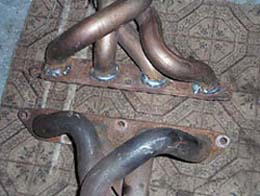
Standard pre 2001 exhaust manifold externally welded (top)
Another offshoot leads me to mention ZR and ZS exhaust changes which show how a different chassis can make significant differences in the results gained from similar changes. With the somewhat disappointing results for the exhaust manifold changes on an MGF or TF many would think the same applied to the front wheel drive cars too. Not so. The front mounted engine allow the exhaust manifold to be designed with good primary and also importantly long secondary pipe lengths, remembering that there is virtually no secondary pipe lengths for MGF/TF applications. The difference is quite stunning as a simple manifold change between standard manifold/downpipe and a Janspeed item on a car with a non VVC 1.8i, with the VVC alloy inlet, 52mm throttle and bigger ITG Maxogen showed a gain of 11bhp on its own. This is around twice as effective than the more comprehensive changes on the MGF, but remember the smaller ITG on these FWD cars doesn’t give quite as much so there is a degree of swings and roundabouts that makes the exhaust change even more impressive.
I have one additional comment on manifolds and this relates to the post 2001 redesigned standard manifold which is identified by using six bolts to fix it to the down pipes rather than the earlier four. Purely as a matter of interest I have tried back to back comparisons on a VVC engined ZS look alike, where the newer down pipes are actually bigger bore and smoother than pre 2001 cars. There was no quantified difference, so again what looks better doesn’t always perform better. This means that the gains seen when changing the early four bolt standard manifold to Janspeed applies to the post 2001 six bolt manifolds too.
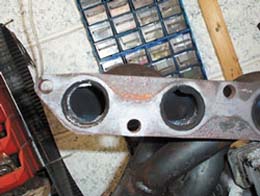
Manifold to down pipe junction showing left port in process of being opened up
Next is the catalytic converter and I only have to repeat what applied in the March feature that the standard item working well, not blocked and is not restricting until 180bhp has been exceeded. If there is a problem with the standard cat then replacement with a sports cat can be cheaper than a standard replacement, and it will still work perfectly with the engine management system and meet emission requirements. It also offers no restrictions to any of the specifications of engine that I shall be discussing, here and in future instalments.
Standard exhaust systems fall very much into the same area as the cats. People too quickly eliminate them and assume they are restrictive and should be thrown in the nearest land fill. The reality is quite different and it is worth noting that on one near 160bhp spec MGF engine I created, the standard cat and exhaust was only a couple of bhp down on proven efficient sports alternatives! I only then changed from the standard system because the exhaust was too quiet and the engine in tuned form so unobtrusive it became quite difficult to drive smoothly in traffic as only the rev counter indicated the engine was running. More exhaust noise allowed the engine to be heard and made the car much easier to drive smoothly in traffic. These generalisations apply equally to the FWD cars and basically illustrates that the standard exhaust, engine to tailpipe, is quite effective and far removed from the perceived easy ground to gain power. Style and sound are the only big alterations to be had here.
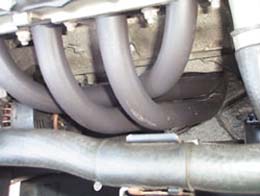
Purpose designed large bore, long primary pipe length exhaust manifold which on its own provides a very useful power increase
Finally for this instalment it needs to be said that going through the itemised gains for each change and then adding them all up and arriving at a final figure doesn’t work. The cumulative numbers sees some ‘smoothing’ so that for a pre 2001 MGF 1.8i induction and exhaust changes will push the power to around a standard TF135 level, or about 16bhp. The same mods on the TF135 would only gain about half as much and raise the power to about the level of the old MGF VVC engine, about 8 bhp. The bonus comes in that these BHP increases are matched by torque increases of note throughout the more normal use rpm ranges, so yes the changes are more effective than these figures suggest.
Remember that the situation is not quite the same for the front engine cars as they have so much more space for an exhaust system. The photos below show that there is no substitute for a carefully designed purpose built exhaust manifold and system with long primary and secondary pipe lengths, and in some cases larger bore diameter. Although this set up provides very significant increases in power and torque throughout the whole engine rpm range, such a system can only be practically fitted on the front engined K series cars.
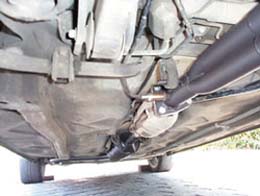
Purpose designed manifold long secondary pipe shown here mated to an efficient system and sports cat complements each other to provide a substantial increase in power and torque
The next instalment caters for those of us who are not put off by removing a cylinder head and either working it by themselves or by having a professional touch. As like the older A and B series engines the cylinder head is ‘the’ main aspect to get right to create a most effective engine. This is followed by cam and engine management changes.
Roger Parker