Front Wheel Drive MGs
Front Wheel Drive MGs
Say ‘Front Wheel Drive’ to any group of older, staid MG owners, and they will all shrug their shoulders and mutter ‘Modern Rubbish’. The reason behind this rather negative attitude is that no front wheel drive MG sports cars were ever made for sale to the public. Mention the word MG Saloon to the same group of MG enthusiasts, and you will get another shrug of those shoulders, with the comment ‘Badge Engineering’. Then shout in their ears that almost 33% of all MGs built are front wheel drive, modern, are saloons, and are now the normal entry car for youngsters in MG ownership, and that same group will somehow be rather tongue- tied.
 In the Spring 1999 issue of Practical Classics the editor of ‘Enjoying MG’ was reported to be having problems getting modern MG owners to write about their cars. Well, the first problem here is, that if looked after, the modern front wheel drive MG is boringly reliable. I write mini-articles for the ‘ MG-M’ Group magazine ‘Forward’, about the Metro, and answer queries about technical problems for the same club on my e-mail so I feel qualified to say that. For those who need help, do not forget the very lively web-page on the internet on www.mg-cars.org.uk and go to the ‘ Bulletin Board‘ to find the ‘1100/1300’ and Metro/Montego/Maestro’ chat lines. If anyone takes any notice of the amount of ‘chat’ that goes on, the front wheel drive MGs are here to stay, and have a huge enthusiastic following. Is this the problem, do the older enthusiasts worry about being taken over I wonder? As each MG model is so popular, I doubt such a thing will happen.
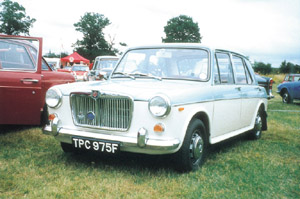
 The ‘Badge Engineering’ that the first fwd MGs were part of, in fact produced a superb little car, the MG 1100, first 1962-1098cc form, then later the MG 1300 in 1967-1275cc form. A stretched version of Alex Issigonis Mini, the MG 1100 /1300 did suffer the British Car Malaise of rampant corrosion, but so did many other MGs of the 1950s and 60s. As a young Technician in the RAF in the 1960s, who could also weld, I spent quite some time ‘gluing’ 1100 and 1300 cars together again. There was a joke that the only panel on the model that was not sold as a pattern part, was the roof. Better drainage and wax injection would have defeated all that corrosion, but in those days no car manufacturer wanted his products to last too long, did he?
 Road holding was fantastic and a slightly tuned MG 1300 would out manoeuvre any standard 1275cc MG Midget. In fact the Midget power was kept down to 65bhp, where as the rather similar 1968-MG 1300 Mk 2 thundered along with 70bhp. (The much later MG Metro 1300 only had 72bhp). The reason was to not let the Midget be faster than its big brother, the now rather dated MGB. The five models of the 1100/1300 range gave the MG owner a huge advantage at the time, in that spare parts were easy to obtain, and none too expensive. Whilst the 1098cc car was a bit under geared and frantic at high speeds with its long 84mm stroke and narrow bore, the 1275cc car was fun to drive and very economical on the pocket. In the two-tone paint scheme the car looked good as well.
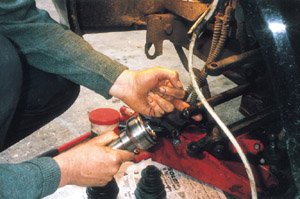
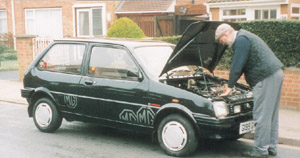
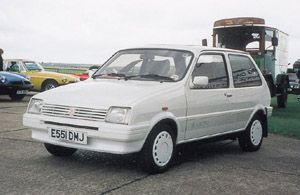 Rather sadly, the latest book on MG Saloons, by Anders Clausager, (ISBN 1 90143206 8, ) fails to include the modern MG models, even though, the last MG Metro came out of the factory ten years ago. The 1982 – MG Metro naturally fell into the mould following the 1100/1300 MGs, and today is suffering the fate of all middle-aged cars, too young to be a classic, too old to be of any great value. £2000 buys a brilliant MG Metro. The bigger cousins, the MG Montego and Maestro, suffer the same problem. Whilst MGFs get an instant classic status, complete with cylinder head gaskets blowing left right and centre, the reliable MG ‘M’ models appear to be struggling for status. The Metro, of which I have a 1989 model in daily use as a family car, is far less corrosion prone than the earlier fwd cars. Whilst the MG stickers may not appeal to everyone, the car certainly motors. It is far more refined than the Mini or the ADO16 1100/1300, and still has an excellent back up for spares. Our Metro recently had an overhaul by myself, which included new front and rear bearings; rear brake shoes and cylinders; front discs and pads; front CV joints and wheel bearings; all four front steering-swivel joints; rear radius arm bearings and fitting a lead-free cylinder-head. The cost of all this work was under £350, obviously with no labour charges and Rover/Unipart spares were used. The DIY cylinder-head, with just the fitting of the hardened valve seats being farmed out, was only £130 all in.
 Of today’s MGs, it is the MG Metro that is the ‘first MG’ that many young enthusiasts will own. When I am out in my 1952 MG ‘YB’ saloon, I always make a point of giving the drivers of an MG Metro a big grin and a wave. Most give me a big beaming smile back, though one or two look worriedly away and drive past a bit faster. For those who think a normally aspirated Metro a bit dowdy, get yourself a good MG Metro Turbo, and worry all those Golfs.
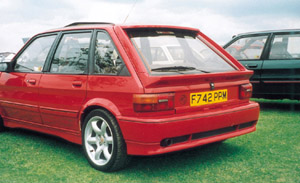
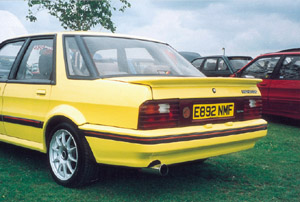
Any MGOC National will attract a good smattering of MG Maestros and Montegos, in standard specification, tuned, turbos, and some really hairy examples fitted with a Rover ‘T Series’ tohc engine. Maestros and Montegos still hold a bit of the boy-racer image, but this model makes a good MG saloon, as it is fast, fun, and safe. For those confused by the various names, the cars are almost the same, but one has a boot, the other a hatch-back. Later cars used the ‘O’ series engine, a direct descendant of the same engine fitted to a few MGBs before production ended, The ‘O’ Series is a single overhead cam version of the BMC ‘B’ series MGB engine.
You only have to study the way these cars are shown at meetings and the startling condition they are in, to quickly realise their owners are just as enthusiastic as the older ‘traditional’ MG owner. Still seen on our roads and racetracks, the bigger fwd MG saloons have a good following. Looking at the MG web-site, plenty of technical advice flows from experts like Roger Parker. Like the Metro, there was a Turbo version of the bigger modern MGs, and these were really fast machines, with 60mph coming up in just 6.7 seconds.
The standard car must not be ignored, and one or two come up for sale for the enthusiasts to buy. Today, they are excellent value for money and cannot fail to increase in value once the ‘middle-aged’ trough is passed.
Again, production numbers were huge in comparison with most two seater sports MGs. The Montego made 45,368 and Maestro 33,230, not figures to smirk at either. Totalling up the production of the fwd MG saloons, we get the figure of 363,830 (by contrast MG only made 1,301 of my ‘YB Series’ saloons). Sales of this magnitude indicate that all those cars were purchased by people who wanted an MG, even though other similar models were available. These people paid a premium for the MG versions and enjoyed their cars so much the better for it.
“Huh, just badge engineering,” is a poor response to such a huge number of enthusiasts. However, it is interesting to note how many enthusiasts today, run both an OLD MG and a MODERN MG. I am certainly not alone there.
Neil Cairns