Fuel for Thought

What comes first, the chicken or the egg? It is one of those loop questions where one can’t be had without the other and so there is no definitive answer. Indeed at some point there must have been a start, but how and what was this? What this question has to do with MGs may be tenuous, but it will become clear later.
Now we are all aware of global warming and the arguments for and against the principle. Now though I think most reasonably minded people are aware that this is not some theoretical hypothesis, but something that will have an impact on us all, the only real question being by how much and when.
Road transport is highlighted as one of the major sources of CO2, a greenhouse gas that is one of the main contributors of global warming. Not that this CO2 hasn’t always been with us, just that nature had it locked away within other compounds and we are unlocking the door and letting it out faster than the natural environment can lock it back up again.
There has been a clear shift in public opinion towards ways this situation can be altered and in true historical fashion where public opinion goes so politicians follow, unfortunately this is often then politicised to a degree where the original point becomes lost and this is not a subject we can afford to do this with. Anyway getting off the speakers corner soapbox sees many useful changes and opportunities for the average person to be able to assist in reducing his or her own personal contribution to the CO2 mountain.
In respect to our MGs there is the simplistic and extremist view of throwing away our cars and buying a pushbike, otherwise walk or use public transport. In the real world that is not an option, at least not in the short term, just as the cost of changing to a more fuel efficient vehicle is also something that can only be factored in over a period of several years, assuming the individual has the will to do so.
In the immediate term there is a way of reducing our consumption of fuel and these have of course been stated many times as there is nothing new in them. Those of us around during times of national emergency when fuel supplies were restricted due to more immediate man made problems, usually war and price hikes such as in 1973, will remember how things were. It became socially unacceptable to exceed the 50 mph speed limit as to do so was being reckless with the nation’s reserves. Such an approach brought about a significant improvement in fuel consumption and for many surprisingly little difference in the travelling times for almost all journeys. This has since been lost on most and certainly those that have not experienced these emergencies.
Today’s cars are very much more fuel efficient and still continuing to develop in this area, but these improvements are of little real use because it is driving style that remains the biggest influence on fuel consumption. Reprogramming the approach of some drivers is a mute point, particularly those whose fuel bills are paid by someone else.
Most of us drive sensibly with a view to how much we spend and price is the biggest influence on how we drive. There is though a growing army of drivers who are looking at other ways of not only reducing fuel consumption but also reducing the direct increase of their CO2 output.
What the individual can do is obviously limited, but lots of individuals make a big statement and then lots of individuals also makes for a potential market, and that creates opportunities for products to be developed for that market and so it goes on. Government can seriously influence the growth or not of these markets, by positive or negative taxation and/or other support. The LPG growth was healthy in the UK until the ‘Powershift’ grants were unceremonially axed and immediately went the growth in cars being sold from new with LPG conversions or existing ones being converted, even though LPG can reduce costs around 50% per litre against petrol.
Not that it is a simple open and shut case, as you have to use more LPG to achieve the same power and the resulting average fuel consumption is around 20% down but still means there is a significant cost saving. Emissions are cleaner with about 20% less CO2 and other pollutants are reduced too. Against diesel there is only a small CO2 difference, but particulate emission of diesel is an ongoing problem without particulate filters that are creeping onto more new cars.
The other point that has to be considered is not just the CO2 measured at the exhaust pipe, but secondary emissions created in the manufacture and transportation of the fuel. In the case of LPG it is a by product of the petroleum industry and for many years has been burnt off as an unwanted nuisance, so finding a more productive use for this has apparent benefits, but is it as simple as this? The answer is of course dependant on who is giving you the answer and largely from where they stand.
So far we are still stuck with the refinement of fossil fuels and so this is still releasing large volumes of otherwise locked up CO2. So what other ways are there of powering our cars? The answer may seem to be in Bio fuels and on the surface there seems to be a fairly compelling case for these. Bio fuels are essentially those created from plant material and generating alcohol or oils that can be used in petrol or diesel engines.
The use of vegetable oil in diesels is nothing new as can be experienced today when following an older diesel car. Although, you may be miles from a chip shop, yet it smells just like you’re outside one, it’s a fair assumption that the car in front has a mix of vegetable oil and diesel. Newer common rail diesels will not live well if treated this way, but the older mechanical injected diesels are more resilient to using the back door of the local chippy as a fuel filling station.
Not that you can’t do something for the newer diesels, as it is quite possible to buy the equipment and refining agents needed to process vegetable oil and create a Bio diesel road fuel. This can even be done legally (in the UK) as there are facilities for HM Customs and Excise to visit the site where the equipment is located and assess the production capability and your potential use and levy a duty to enable you to be completely legal. As promising as this sounds the bottom line is that there are too few chippies to provide the volume of used vegetable oil for any significant number of diesel cars and I don’t see it being practical for traffic to drive down a Morrison’s aisle to stop at the vegetable oil shelves. Mind you I know someone with an old diesel who has found Morrison’s vegetable oil to be effective. Interestingly even though it has been nowhere near a chippy the exhaust still smells like one.
So the reality of bio diesel is that it would have to be produced on an industrial scale and with that comes the energy of producing it and distributing it. This may dent the overall CO2 impact advantage that those currently selling this product advertise, and adds weight to the need for a wider viewpoint and information.
Bio-ethanol is the ‘green’ fuel for petrol engines as it is the distilled alcohol from fermenting plant materials. This on the face of things is great as there are many thousands of tonnes of waste vegetable material produced by modern agriculture every year and the use of this to generate fuel for our cars is a very good one. Much like the advantages of the water companies who run some of their vehicles on methane that is distilled and collected from the operation of sewage plants.
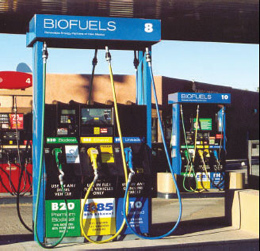
Bio-ethanol is already available in pump petrol from some suppliers as a mix of up to 5% as it is an octane enhancer since it has a very high natural octane number. It is also seen in E85, a fuel made up of 85% Bio-ethanol and 15% petrol. This mix allows petrol engines to start and run from cold in a normal way as 100% Bio-ethanol will not always allow cold starting, especially in cooler environments, the same as occurs with some LPG equipped vehicles. This fuel also has a degrading effect on natural rubber and so older cars that may still have such materials within their fuel systems may suffer problems. Modern cars moved to synthetic materials to meet the change to unleaded fuels so should be completely compatible.
Not only this but simple conversion kits are becoming widely available to enable you to convert your car in a matter of about an hour to be able to run on Bio-ethanol or petrol, and of course there is no need for a separate fuel system as there is for other fuels like LPG.
The big problem for any of us looking to convert though, is the lack of outlets supplying these fuels and so I return to the opening statement of this feature of the chicken and the egg. In this case the owner is the chicken and the fuel is the egg. One will not want to make their move before the other has moved. Currently in the UK there are only a handful of E85 suppliers in the West Country and East Anglia. Outside the UK the story goes from chalk to cheese with some countries committed to Bio fuels and others showing little interest.
Looking at the surface facts on E85 seems to make a very strong ecological statement in that 85% of your CO2 emissions are effectively neutral with this being supplied by plant material, which is then offset against the planting of more of these crops that will in turn be turned into fuel. The other interesting point is that countries like Brazil have been operating at 100% Bio-ethanol for some years and as such they are self sufficient in fuel.
However, is it all this simple as the plants used to supply the huge demands of a country the size of Brazil need a very large space to grow. Whilst Brazil is a big place, the distances the fuel has to travel adds to its CO2 cost and then there is a great deal of confirmed issue with the destruction of the rain forests to then plant all sorts of different crops, including the plants that are turned into Bio-ethanol. So is this as green as it seems?
There is a huge amount more detail to this large subject and to the individual fuels discussed. On the horizon we have the potential of Hydrogen (BMW is well advanced in producing a Hydrogen powered vehicle for sale), but this demands a complex fuel system and storage, then there is the subject of Fuel cells to produce electricity and of course other electric powered vehicles, all of which have a very much more complex CO2 signature when ALL aspects surrounding them are considered.
Many members reading this may have a specific personal involvement in one or more of the alternative fuels available now or coming sometime in the future. What this feature is aimed at it to raise the subject to a discussion point and invite anyone with a direct involvement with any of these alternative fuels to come out of the woodwork and provide more information in order that we, the end user who wishes to play a small but significant part can do so on the basis of as much good and complete information as possible. All submissions should be directed to the editor of Enjoying MG.
By Roger Parker