The Full Monty
The ‘FULL MONTY’
The May Bank Holiday is traditionally the time of undertaking a long journey, perhaps three or four hundred miles of driving. It was during this weekend earlier this year that a team of four MG enthusiasts got together for the first time to make their final plans for another weekend drive, one covering three to four thousand miles.That drive is an event called the Cape to Cape Challenge, an annual non-stop endurance run crossing Europe from North to South.
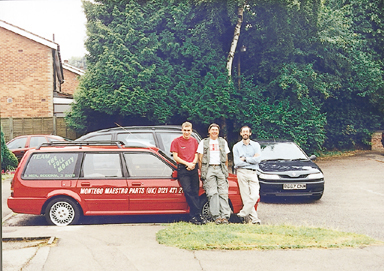
Team leader Neil Turner, a customer service engineer from Hoddesdon, is the MGM Group club secretary. He got to hear about the Cape to Cape Challenge about six months before and about this time that he was offered a rather tired Montego GTi estate by his local Nissan dealer. Neil already owned a pair of Montegos, an MG EFi which he had used in sprints and hillclimbs over the past couple of years, and a modified 16-valve MG Turbo. But he had an ambition to create and own an MG Montego Estate, so he acquired the GTi for the princely sum of £100 with such a project in mind. This acquisition also meant that he now had an ideal car to compete in the Cape to Cape Challenge, so he set about finding two or three other people mad enough to enter the event with him.
 The first person signed up for the venture was myself, John Dalton. I work for Rover and live in Coventry, but Neil knew me through the MGM Group and thought I might be an ideal candidate given my background. Apart from being an experienced rally driver, I had previously undertaken a number of motoring marathons in MG Maestros, including a trip to Scandinavia to watch the Finnish 1000 Lakes Rally, via the Arctic Circle, and more recently I had driven my 10 year old, 200,000 mile, MG Maestro from Lands End to John O’Groats and back in the same day.
Neil then persuaded a close friend, Dave Cowan, an electrician living nearby, to join the team. The Challenge was therefore on and an entry was submitted. But as we started to draw up plans a little spanner was thrown in the works, when in March my future at Rover suddenly looked rather uncertain. It was agreed a fourth team member should be sought as a possible replacement should I not be able to take part.
Neil got in touch with David Smith, another MG enthusiast who sprints and hillclimbs an MG Montego. David, from Wokingham, is an IT project manager with Siemens who has been taking part in grass-roots motorsport such as trials and sprints for over 20 years. At the time he was working in San Francisco, and thanks to the wonders of e-mail he was persuaded to join the team, and to arrange the team meeting back at his home on Bank Holiday Monday.
It was the first time that we had met to discuss the planning and preparation for an event that was now little more than a month away. The first big decision of the day was the team name, and as the team was to be four up in a Montego Estate, my proposal for ‘The Full Monty’ was agreed without any real debate.
Most of the preparation work involved the car, but there were administrative issues to sort, ferries and hotels to book, a plan to formulate, and a route to submit. Neil had been dealing with most of the documentation while I had prepared a route to be submitted to the organisers. The following outlines the Challenge we were about to undertake.
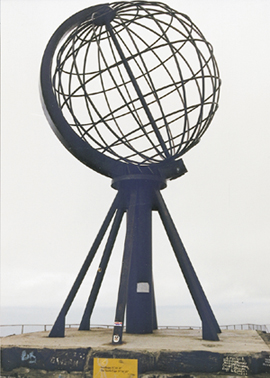 The Cape to Cape Challenge is an annual organised event, the aim being to drive the length of Europe, from the most northerly point, the North Cape of Norway (Nordkapp), to the southernmost point at Cape Tarifa in southern Spain (near Gibraltar), in the shortest possible time, without breaking any speed limits. A distance of over 3500 miles for which the record, set last year, stood at 56 hours 55 minutes.
The distance is about the same as the Cannonball Run across the USA, but unlike the American free-for-all, this event is strictly controlled, all cars being fitted with tachographs to ensure speed limits are complied with, and enable verification of any record that might be set. This year was the first time that the whole route could be driven directly without using ferries – the new Oresundbron linking Malmo to Copenhagen was officially opened on 2 July – giving another opportunity to lower the record.
Teams plan their own route and then submit them to the organisers prior to the event. I planned the route for ‘The Full Monty’ using Microsoft AutoRoute Express 2000 (MAREX) in conjunction with a Collins 2000 Europe Road Atlas, chosen for its better scale for Scandinavia.
In doing so discrepancies between the two needed resolution. Surprisingly MAREX did not seem to be as up to date as the paper map, although it did show the new bridge from Malmo to Copenhagen as being the route to take, despite the fact that this package was a year old and the bridge was not yet open. The team decided to take a land route, using the bridges that island hop from Denmark into Germany and chose a route around Stockholm because of potential traffic problems.
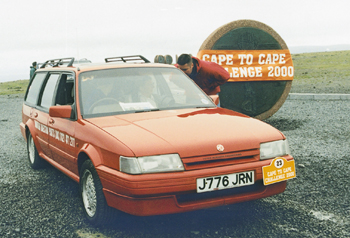
Although not strictly an MG, the car was modified to MG specification, similar to two factory cars built in the late 80s. It is in fact a Flame Red 1991 Rover Montego 2.0 GTI Estate, which, like the company that made it, looked like it might be heading for the scrapheap a few months ago, but it too was now to be reborn as an MG with hopefully a bright future ahead of it.
 In spite of paying just £100 for it the basic car was very sound. The bodywork was quite tatty with some dented and rusty panels, so Neil decided to replace two doors, the tailgate, rear bumper, front wings and bonnet also to get the car resprayed. This was volunteered by Montego & Maestro Parts in Birmingham (0121 471 2111) as a sponsorship deal for the event. Unfortunately we still did not have the car back by May Bank Holiday and the whole enterprise was potentially in jeopardy. On 3rd June, with only a month to go the team collected the car in an unfinished state to get on with the preparation. The car had not been driven at all (it had no tax or MOT), we still had not even done the basic servicing and in addition to having to fit body parts like a tailgate and a door, there were a number of other parts that were damaged or broken, so the jobs list was quite long! Also Neil had just started a new job, so I took on the task of getting the car sorted over a three-week period, before handing over to Neil for the final week.
In the first week the mechanicals were checked over and the car given a full service, prior to getting the MOT, which it passed without problems. Mechanically the car was totally original and seemed fine, having covered a mere 117,000 miles. The engine ran well apart from a high idle speed. The throttle body was swapped for a spare and Roger Parker, well known in MG circles, checked the settings. I then took the car to Peter Burgess, an engine tuner specialising in older MGs based near Alfreton in Derbyshire (01773 520021) who cleaned out the injection system and checked it on the rolling road (92bhp at the wheels and no problems to report). This treatment improved the response of the engine and would hopefully also improve the fuel consumption.
The suspension was changed for borrowed items, and new tyres were needed. I also borrowed a new radiator assembly, as a burst radiator is the only thing that has caused me to break down in 350,000 miles of Maestro/Montego motoring. I also fitted an extra fan switch, other enhancements included a convex driver’s door mirror and a maplight.
With just 10 days to go, the bodywork was completed after the back bumper was collected and fitted. I had got hold of one from a breakers’ a few days before, but then the paint shop had been put out of action by a fire!
A specific requirement for the event was the fitment of a tachograph. We thought we would be able to borrow or rent one but initial enquiries indicated otherwise and we faced a bill of £550 just for this item. However, my local vehicle electrics specialist, Carwood in Coventry, offered to help, until they realised that a high-speed tacho was needed. With time running out we borrowed a ‘test’ unit from VDO Kienzle Birmingham, and Carwood agreed to fit and calibrate it.
This was eventually done on the Friday with just over a week to go after yet another snag – the takeoff T-piece from the speedo was too big and we had to order a smaller one. The correct one was delivered at the second attempt on the Friday morning, and the tacho was wired up and calibrated just ten minutes before the workshop closed.
But the big news with just over a week to go was that Dave Cowan had dislocated his shoulder and this more or less ruled him out from taking part. It was not the first time that it had happened, but it was now serious enough to warrant an operation. So with me finally confirming my availability to do the event, ‘The Full Monty’ would be a team of three as originally planned.
It also meant that there was a question mark over who was going to do all the electrical work that Dave, the electrician, had planned to do in the final week while the car was in Hoddesdon. Maybe we would have to drive 7500 miles with no music! Fortunately Neil and Dave were able to fit a radio unit and 4-way cigar lighter socket for additional electrical items in that final week. The multi-plug unit was to enable us to have two refrigerated cool boxes in the back, plus a laptop PC up front.
With a week to go I handed the car over to Neil. Despite changes to struts and tyres because of stability and handling problems, Neil found that the car was still unstable at speed with weight in the back, nor was he happy with the brakes. Some different rear struts and tyres were then borrowed from David and fitted in the final week, and it was hoped that this would solve the problems and everything would be ‘alright on the night’.
Sunday 2 July ‘The Full Monty’ team met up in Hoddesdon and we faced our first real challenge: getting ourselves and all our gear in the car. The fact that one of the team had dropped out at short notice was possibly a blessing in disguise. Having squeezed it all in, we set off for Newcastle just after 09.00 with Neil thankfully commenting how stable the car felt despite all the weight in the back.
David got his laptop and GPS device installed and they both appeared to be working correctly, but the steady speed readout on the GPS was showing the tachograph to be under-reading by over 2%, and this error would likely result in a penalty on the event.
The 300 mile journey passed by very quickly, boosting our confidence for the 3500 mile one we would soon face. Scrutineering in the car park outside the hotel did not present any real problems, and we were also able to get some instruction on the use of the tachograph. Here we met our fellow competitors for the first time.
The teams were driving a variety of vehicles, a 4×4 class having attracted a number of 4WD vehicles this year. Volvo had entered a team of the new V70 XC models, supposedly the only three in Britain to date, and from Vauxhall there was a team of Fronteras. The favourite seemed to be an Audi A6 TDI estate, but the nearly new car had already been beset by problems, including having been run into on the left side, plus the need to fit a new gearbox a few days before – so much for German ‘technik’. The RAC had also been summoned to fit a new power steering pump on one of the new Volvo V70s! This reminded us to extend our RAC cover for Europe…..
There were a few teams from the forces, and one foreign entry, a team in a Peugeot 406 estate from Norway. One of the last cars to arrive was the car running at number 1, a Bentley Turbo with the team name Chelsea Blues, driven by businessman and Chelsea FC director Greg Stanley.
As expected most teams were driving brand new cars provided by dealers or manufacturers. In contrast ‘The Full Monty’ was the oldest car entered and the team intended to prove that the much-maligned Montego could be just as reliable and efficient as any modern car, while also flying the flag for the clubs that cater for enthusiasts of these cars, particularly the MGM Group .
‘The Full Monty’ was already attracting attention with the team name written on the side, but it was a bit embarrassing to be expected to provide the entertainment for the night when we pulled into a pub car park!
Monday 3 July to Thursday 6 July
In torrential rain, the cavalcade of cars to the docks did not quite go according to plan, when one car failed to follow the others on the correct route, and those behind also went the wrong way.
After a comfortable overnight ferry trip from Newcastle to Kristiansand in southern Norway, the crews then made their own way to Honningsvag, the main town near Nordkapp. This is a distance of over 1500 miles (2400km).
We changed our plans after Erik, from the Scandinavian team, recommended an easterly route on faster roads through Sweden, rather than travelling straight up through Norway. On Tuesday morning we left the ferry and drove east around Oslo, and on towards Stockholm in glorious sunshine, before turning north to backtrack our intended Cape to Cape route. This enabled the team to go over the first 1800km of the 5500km route in the reverse direction, and in addition to aiding us in finding the correct roads, it also enabled us to locate potential fuel stops, as petrol stations are some distance apart and not always open at night in the Arctic.
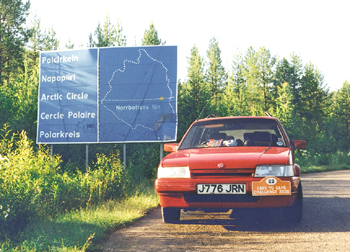
We drove continuously and travelled through Lapland on Wednesday morning after crossing the Arctic Circle at about 06.00. By the time we reached Alta in northern Norway at lunchtime, the weather had changed, and the rest of the journey was completed in pouring rain across very bleak scenery (although one highlight was seeing the only other Montego on the trip – a Polish registered Montego estate in BRG at a latitude of 70 degrees 10 minutes north).
We eventually arrived at Honningsvag mid-afternoon, the plan being to have a full day of rest before the Challenge started on Friday morning. Hopefully the weather would improve to do some sightseeing, including seeing the midnight sun, but it was still dismal as Thursday arrived when we did our final preparations, including sorting out food and drink for the trip.
We also drove the 30km up to Nordkapp and the start venue. There was not much of a view but we took some time buying souvenirs in the Visitor Centre, and Neil completed his collection of toys that meant that the Montego estate would be travelling in full 7-seater mode complete with two reindeers, a penguin and a gonk (which went ‘boing’ whenever the car slowed down). On the return I made rally-style pace notes that could aid the driver in case fog was a problem the following morning.
By now we had decided on the driving rota. Neil had volunteered to start, largely because he thought he might otherwise get car-sick on the twisty first section. David would then take over followed by me, the pattern to be repeated with each team member doing a co-driving stint before taking the wheel, and the changeovers coinciding with fuel stops.
THE EVENT – Friday 7 July
This year’s Cape to Cape Challenge got underway on the Friday 7 July, with the first car leaving Nordkapp shortly after 07.00. Competitors had chosen start times that were at least five minutes apart between 07.00 and 11.00. The weather was not as bad as the previous day but there was a biting cold Arctic wind to wake up the teams as we set off.
Our team started at 08.45, ten minutes behind a Land Rover Discovery, and 15 minutes behind a Defender, so all the ‘Rover’ models were running together. Although it was not foggy, the pace notes I had prepared for the first section still proved useful for Neil on the twisty road over brows down to Honningsvag.
The route to and from the island is via a new road tunnel that is 8km long, goes 200 metres under the sea and cost £100 million.
Here we encountered the first of a number of coaches that slightly impeded our progress. We had done a recce the day before at the same time and had not seen a single coach, but we had to pass at least 10 on this first section. Also in going through the tunnels we discovered that the GPS did not record the time or distance, so there was a 14km discrepancy already with the tachograph!
On the road south of Alta, after less than 300km of driving we caught and passed the only Ladies Team in the event, a team from the Royal Logistics Corps in one of the Volvo V70 XCs. We kept ourselves amused by guessing why they had lost nearly an hour in such a short distance – like stopping to read the manual on how to work the cruise control…. Of course we were aware that our tacho was under-reading, which would enable us to catch and pass other entrants but still finish behind them in the results, and we had taken a shortcut around Alta that we reckoned saved us at least five minutes. Neil drove the first section admirably, a six-hour 300 mile stint at the wheel, to our first petrol halt at Muonio in Finland. Keeping exactly to the limit all the time demands a hell of a lot of concentration, and at one point Neil said he had forgotten what a Montego dashboard looked like as he had spent so much of his driving time with his eyes focussed on the tachograph.
The petrol lasted slightly longer than planned so that was another bonus, and we were already well over an hour ahead of the schedule we set on Autoroute Express. And the team had even more incentive for a quick fuel stop – mosquitoes attacking us in force in the middle of Lapland.
David now took the wheel as we approached the Arctic Circle in Sweden, and the weather was now quite pleasant, bright but cloudy, so we were not missing the lack of aircon just yet.
The two border crossings had helped to break up the journey, as we were required to take photos and change the tacho charts. And we could now speed up to 110kph, but we remained mindful of the reindeer that had been wandering in the road rather too frequently for comfort.
David’s driving stint took us onto the E4, the main road from the north to the south of Sweden. He also managed about 300 miles on a tank full, again better than planned, although this was a much smaller range than most of the other Challenge entries. But after five hours behind the wheel a stop for a driver change was most welcome, and 3 or 4 minutes for a fuel stop and comfort break seemed to be a small price to pay.
Generally our preparation seemed to be paying off. For example the GPS connected to AutoRoute Express on our laptop was permanently on, and could show our position on the map exactly at all times. And our modified glovebox in which to fit the laptop was ideal. However, we discovered that we had located our refrigerated boxes for air-cooling such that it was impossible to open the top of one of them, so David had to rearrange the location of everything while on the move. I took over at 20.00 on the theoretically easy drive down the E4 following signs for Stockholm. For most of the way it was twilight, the worst of light conditions, and the night did not set in till about 23.30. I also had to contend with some very heavy showers and dazzle from headlights on a largely single carriageway road. Concentrating on the road while keeping a constant eye on the tachograph was very difficult in these conditions, especially when tired, but I managed a full five hours before handing back to Neil at Soderhamm at around 02.00.
Saturday 8 July
 While I slept in the back, David took over from a very tired Neil, who had not been able to get any real sleep in his rest period. He drove through Stockholm at around 04.00 and we stopped again for fuel shortly after six, just before we got to the shores of Lake Vattern. At this point I took over co-driving for David, who seemed to be in a very bubbly and jovial mood, indeed on a ‘high’. He then admitted to taking two caffeine tablets in addition to a self-heating black coffee. By the time we reached the Oresundbron at Malmo we were over four hours ahead of our original outline schedule. The new bridge had opened the week before and there were concerns that this first full weekend after the opening would be extremely busy. In fact there were no queues at all, and the team was soon crossing this impressive structure after taking the obligatory border-crossing photo.
The route took us across Denmark, via the Great Belt Bridge. Here we found far more traffic: it appeared that all Danish families were taking to the road with a caravan or boat in tow. Then when we arrived at the German border at around 13.00 we lost several minutes queuing, thanks to border checks. I was now driving and looking forward to some de-restricted autobahn driving: unfortunately heavy traffic and some heavy showers intervened.
Then in Hamburg we lost 20 minutes queuing at roadworks near the Elbe tunnel, so we had to pass the time guessing whether German girls fitted the stereotype painted in a Scandinavian joke we had been told a couple of days ago. Neil took over to the south of Hamburg and his experience of driving on the autobahns proved very useful. He managed to squeeze nearly 190kph out of the car, but the opportunities seemed few and far between. North of Hannover we waited in queues for no apparent reason, although we later discovered there had been an earlier accident. The Montego continued to run faultlessly and an oil check revealed negligible consumption.
David then took over for a trouble-free run through Frankfurt, although complying with speed limits on the autobahn was now becoming a real pain. It meant overtaking cars in unlimited sections only to have these cars pass us as they ignored ludicrous 100kph limits on downhill gradients, or 60kph limits in road works. Indeed it seemed as though most of the E5 south of Frankfurt was being renewed as we encountered over 20km of roadworks.
As night time descended on Saturday, I had the twilight driving stint again. We crossed into France at Mulhouse, with David making another self-heating meal in the back and Neil co-driving as the rota of duties became routine. A Fiat Bravo driver decided to irritate me by sticking on my tail after passing him – I was quite happy to become Mr. Angry as this helped me to build up my adrenalin levels to keep me awake!
Sunday 9 July
Neil continued the driving, taking the night time section through Lyons, but I was rudely awoken from a deep sleep at 03.00 as the team stopped for petrol 100 km short of the Spanish border and I apparently walked around in a daze not knowing what to do. At the border itself, in the dark I suddenly saw a sign for taking a border crossing photo and as David slammed on the anchors, Neil fell off the back seat. David asked “what was that?” To which he got a muffled reply from the rear footwell: “it was me”. It was a startling experience, which made it difficult for Neil to get any further sleep (again). Now I had the early morning shift, driving past Valencia, after the pleasure of seeing the sunrise behind us. We rang the organisers during the morning to inform them of our progress and give them an ETA at Tarifa of 16.00, what was to be a very accurate prediction. At that time only one other car had called in.
I handed over to Neil for the mid-day stint that took us inland via Murcia, and by the time we got near Granada Neil was suffering in the desert heat without any air conditioning. So I was soon accompanying David, and by this time I was also starting to get a headache thanks to little sleep and a hot interior – the journey was taking its toll!
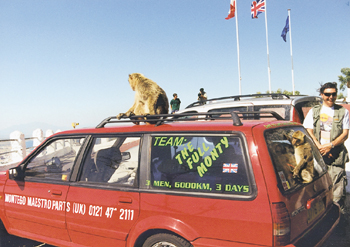
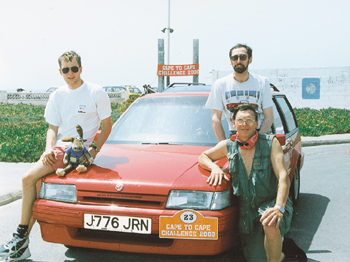 At Estepona the motorway eventually ended and the final 50km past Algeciras was very slow going. This was the sting in the tail – we were all getting tense and excited about finishing, but the end was approaching very slowly. Fortunately we had done a splash and dash fuel top-up much earlier, or it could have been much worse. Finally at Tarifa, we drove through the town looking for the citadel that was to be our finish goal, and at 15.59 CET on our clock we found the car park and clocked in with the organisers, the seventh car to arrive.
There was jubilation in the ranks as we took photos to mark the achievement. The navigation had been inch perfect without any wrong slots, and the good old Monty had never missed a beat. Even with 123,000 plus on the speedo it had consumed only half a pint of oil on the whole 3600-mile trip. And although feeling tired, none of us had any aches and pains after long stints behind the wheel or sleeping on the rear seat.
Indeed it was the new technology that had let us down. Despite all the hype and the millions spent on advertising the wonders of mobile phones, we found that our Cellnet phones could not gain access to any networks in Sweden or Germany (i.e. over half our trip). Also while on the move we could not send e-mail data transmissions as we seemed to get our connection cut, possibly due to cell to cell transfer problems.
On arrival at the finish venue hotel in Jerez I guess you could say many were amazed at our achievement. Apparently the person who took our call, when we phoned in to give an ETA, was so shocked she immediately phoned HQ in Jerez. Some of the organisers had doubts we would finish, so I think they had been stunned by our performance. Our time of 55 hours 14 minutes was well inside the official record of 56.55, but that was before an adjustment to the time because of our tachograph under-reading.
We had driven for more than 50 hours from northern Norway without seeing any of our rivals, having passed just the one car, so we were obviously interested to hear what had happened to others on the trip.
It emerged that several crews, including our Full Monty team, had recorded times below the existing record. The fastest time had been recorded by a Volvo V70 diesel, in under 54 hours, but official results would not be declared for two or three weeks while the organisers checked all the tachograph charts and other documentation to ensure that entrants complied with the regulations and ‘no-speeding’ rules.
1) Plan B – Volvo V70 TD – 54hrs 35 mins
2) The Full Monty – MG Montego Estate – 55.14
3) The Chelsea Blues – Bentley Turbo – 55.19
4) Vauxhall 1 – Vauxhall Frontera TD- 55.30
5) The Roadrunners – Toyota LandCruiser – 55.50
6) Dazed & Confused – Audi A6 Avant TD – 55.59
The Bentley Boys in the Bentley Turbo were one of the first teams to finish, although another team reported that they had been overtaken by the Bentley while already driving at the limit. A couple of Volvo V70s and the Astra GSi were among the stragglers at the back.
One factory Volvo entered V70XC had a Telegraph journalist on board who apparently spent several hours taking photographs en-route. They then went off route in Granada and did 100km on winding roads to Almeria.
The Astra team included a lady who had never driven abroad before, and she had not told her fellow team members of this before the event. They got drunk the night before the start and then took an unusual route via the Gothenburg to Frederikshavn ferry. Not surprisingly they arrived at Tarifa about 18 hours after the first car in.
Some crews were more professional than others. For example, while some carried all dietary requirements from Nordkapp, others bought food on the way, and the Discovery crew even stopped off to eat at MacDonalds on two occasions! We had tried to bring all our food with us, but Neil made a large quantity of pasta and tuna mix and then found that he could not eat any of it after the first day. My sandwiches were certainly past their sell-by date by day 3, despite the effectiveness of our two refrigerated cold boxes.
One crew had a big argument at the finish, and two of them left Jerez to return in the car, leaving the third member to get a flight back. I hasten to add that this was not the reason why David flew back from Gibraltar, although Neil and myself did have a much smoother ride back without David behind the wheel…..
Most crews had taken similar routes or the same route as us. The Norwegian Peugeot 406, actually crewed by three people from three offices in three different countries as a team building company exercise, seemed to be the only one to have taken the Rodby-Puttgarden ferry into Germany. They jumped the queue much to the annoyance of the people loading the ferry, and squeezed on the back of the boat thereby losing only a couple of minutes, so this should have given them quite a time advantage. Of course it helped that they could demand to get on the boat in three Scandinavian languages.
And most cars made it to the finish in one piece. A Scottish crew in a Frontera had been less than complimentary about ‘the Full Monty’ at the start, but their view seemed to have changed, especially as they developed a clutch problem on their vehicle. The Defender was the only car forced to retire: it headed for home from Germany with a blown turbo and a top speed of about 50mph.
1) Plan B – Volvo V70 TD – 55hrs 56 mins
2) The Roadrunners – Toyota LandCruiser Amazon – 56.05
3) Vauxhall 1 – Vauxhall Frontera TD – 56.17
4) Blackjack – Toyota LandCruiser Amazon – 56.24
5) Team Nesthood – Peugeot 406 Estate – 56.36
6) Vauxhall 2 – Vauxhall Frontera TD – 56.43
7) The Full Monty – MG Montego Estate – 57.16
8) Dazed & Confused – Audi A6 Avant TD – 57.29
In the final results ‘The Full Monty’ dropped to 7th overall with a time of about 57 hours including time penalties. These included a 90-minute penalty, much bigger than they expected, for tachograph error. The organisers calculated it to be over 3%, although the team reckoned on about 2.7% from their own analysis. Also like many competitors they were penalised for driving to 80kph rather than 70 kph in northern Norway. Even the organisers had been confused about this, and had given conflicting information at the start, but the lower limit was correct and the penalty equalised the times.
The team was not that disappointed with the outcome as their performance was still very impressive. Their old car costing £100 was up against modern machines valued at over £20k on average, while it had less than half the range and lacked a 140mph top speed of the Audi A6 diesel estate for example. In addition many teams had the experience of doing the event before. Neil also seems to have been bitten by the bug and was already talking of an entry next year at the finish in Jerez.