An interview with Basil Wales, the former manager of BMC/BL ‘Special Tuning’
MG Specialist
An interview with Basil Wales the former manager of BMC/BL ‘Special Tuning’
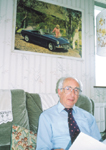
For the devotee of the BMC cars of the 60s and early 70s the term Special Tuning had total credibility. A fellow enthusiast would proudly lift his bonnet to reveal a modified engine, boasting a performance manifold and larger carburettors with the all-important confirmation that these items were Special Tuning factory approved parts. The Special Tuning logo was an assurance that those components had been developed in competition and would deliver the performance promised and they invariably did just that. Basil Wales the former manager of Special Tuning invited me to visit him to look at the progress on his ongoing MGB rebuild, so I was privileged enough to get to talk to him about his days running ‘Special Tuning’ and his part in its development.
 |
 |
 |
Having always wanted to be an engineer, after leaving school without much distinction, Basil went for interviews with Allard, AEC, Vauxhall and BMC. He recalled that the Vauxhall interview was interesting with lots of practical tests, but he finished up with a choice between Morris Motors and Allard who had just won the Monte Carlo Rally. Allard told him, “We won’t expect you to make the tea or sweep the floor, it will be a good apprenticeship”. Despite this reassurance he chose Morris Motors and almost ‘with a pin’ picked out the engines factory in Coventry. At the time Basil’s home was in Ford territory Brentwood, Essex but he never had any interest in working for Ford.
 |
 |
 |
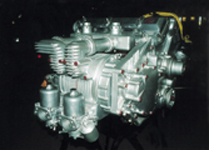
Basil joined the Morris Engines factory, starting as a tool-making apprentice. “The only engineering I had done was to have constructed a model MG TC from a modelcraft plan. It was all in tin plate complete with wire wheels, the rims were fabricated from curtain rings, fuse wire for the spokes and using Singer sewing machine rubbers for the tyres”. Within six months of joining Morris they upgraded him to an engineering apprenticeship which meant that he worked round the whole of the factory and was taken under the wing of Eddie Maher, the chief engineer in Coventry. “He really looked after me and gave me all the best jobs to do, test driving and things like that.” When they came to do EX181, Stirling Moss’s record breaker, Eddie said, “Well no one else has done any work on supercharging so you might as well do it.” For an apprentice this was a wonderful opportunity. “We learnt quite a lot on the project. I remember filing down carburettor needles, we just couldn’t believe how much fuel the engine needed. It was initially running weak and misfiring, it was incredible the amount of juice it consumed. We ran it on a mixture of methanol, benzol and Shell fuel. Which was very strange, as if you left it in a bucket, it would overflow because the methanol is hydroscopic and draws moisture in from the atmosphere. We got over 200 bhp out that supercharged 1500cc twin cam engine. I liaised with Abingdon over the engine mountings to go on the test bed, and how to make the gearbox connections”.
Eddie Maher really helped and gave Basil every possible opportunity but when the EX181 was sent out to America it was the foreman and not Basil who went with it. This did not surprise Basil but then Eddie Maher said that because he didn’t get to go with the car he would send him to Abingdon so he could go on the Liege Rome Liege Rally. “I was the first ever apprentice to do that, there again that was a forerunner of things to come. That was the sort of guy Eddie was. He really took me under his wing. It meant that later whenever I came across apprentices I tried to treat them in the same way, I tried to give something back. Somehow today you don’t find people have the same enthusiasm for the job”.
Sports car specialist
 |
 |
 |
Basil’s first trip to America was when the MGB was about to be launched there. Syd Enever was convinced there would be a problem with excessive oil consumption and right at the last minute decided it was necessary that all the American Bs needed a piston change.
“I was made responsible for organising that operation right across America, we got all the build records and packed the pistons as required. My excess baggage cost twice as much as my airfare because I was carrying crates of pistons. I got to New York airport; one of the customs officers opened the crate, he held up a piston and loudly declared that what he had in his hand was “a genuine MOWOG” having no idea of what it really was. I didn’t have to pay any duty or anything on the pistons after that!
 |
 |
 |
When the Mini Cooper was launched, Basil claimed it too was a sports car, because it had disc brakes which was to set another chain of events into operation. This meant that he was liaising with Abingdon even more closely.
 |
 |
 |
It turned out that the service department was due to be closed when Gordon Phillips was to retire. John Thornley was always keen to keep interesting things at Abingdon and he came up with the idea of a Special Tuning Department to meet customer’s needs, using the experienced service mechanics and taking the problem of privateer customers away from the Competitions Department.
New role One day Basil’s phone rang and he was summoned to meet John Thornley, who explained to him that Special Tuning was making a loss. However, the loss didn’t matter, as it was principally a service to customers and that, as its new head, Basil would be reporting to the Competitions Manager Stuart Turner.
So Basil started this new job at Abingdon in 1965, never having done any accountancy. Fortunately his father had always encouraged him to keep careful accounts of his personal finances, so he knew how to make books balance. He went to Abingdon to look at the accounts and the first thing he discovered was the amount of time spent on Pre Delivery Inspections for the export company which was not bringing any money back. So Basil managed to find other more lucrative jobs and it wasn’t long before he was making a profit. The accountant Norman Higgins was very pleased and so was Stuart Turner because now Special Tuning was standing on its own. Basil describes how he went to see Stuart Turner on the first day and had a bit of a chat with him. Turner said, “There’s the job, I’m very busy, I don’t want to get involved but if you have any problems come and see me but if not, away you go”.
In this respect Turner was true to his word and Basil regarded him as the best boss he ever had. “I could go to him and say. Look I’ve got this problem and he would make a series of cryptic relevant observations and leave the decision to me”.
Special Tuning
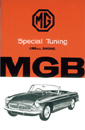
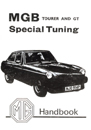
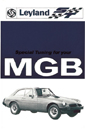
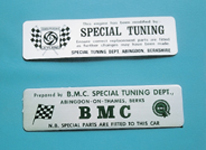
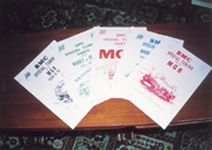
Basil explained that the term ‘special tuning’ was first coined by Syd Enever and that certainly there was an XPAG special tuning booklet which Syd had written. There was another for the MGA and also one he had done for the MGB, a nice A5 attractive booklet. When Basil joined he asked if he should take over the production of these booklets to which Syd replied ‘Oh yes please, that’s fine?’
The Special Tuning operation was totally separate from the manufacturing side; there was less equipment that came from Abingdon than anywhere. Things started to improve after someone wrote to the Daily Mail complaining that they couldn’t get a crankshaft for the formula junior engine and that letter got published and then a director from Longbridge phoned Basil and asked, “Why can’t you provide this man with his crankshaft?” To which Basil replied, “Well frankly because you haven’t made them for me, in fact there is whole range of parts I am waiting for that you can’t supply”. Basil had orders going back for months; there were all sorts of things he was waiting for, crankshafts, camshafts, carburettors etc. So he suggested that if Longbridge did bigger production runs it would be better all round, following further discussion he managed to get the whole production situation onto a much better footing and after that, components came through as soon as he wanted them.
Syd Enever took the view that “You don’t need to market full kits of tuning equipment, just sell them the manifold and they’ll make up the rest themselves”. But Basil felt that he could sell customers all the other bits as well. That is what really caught on with Special Tuning products. Basil remembered what a struggle he had experienced when trying to put twin SUs on his Ford engined special, it was sourcing all the right linkages and fittings that was the problem. At the time Unipart was solely responsible for standard replacement parts and this was a severe restriction on Basil’s operations because he could not sell standard parts. However, if he put 26 standard parts in a box that was sold as a Special Tuning kit then he could sell them. That really helped the turnover of Special Tuning. These kits consisted of all those necessary little parts, carburettor fittings, throttle linkages; in fact all those fiddly bits that you can never get in one go from a parts dealer. Now, if you wanted to tune your MG, you could buy every part you needed in one complete kit. It was following through with this idea that enabled Basil to go forward and for Special Tuning to develop.
Special Tuning products were ordered through simple typed sheets sold in the form of Tuning Booklets comprising a list of parts including all the necessary part numbers. These Tuning Booklets were designed for specific models, explaining progressive steps to improve performance. As well as all the necessary parts, the kits also contained detailed fitting instructions and a contents list.
 |
 |
`We’ll bring out the beast in your car’, was the Marketing department’s slogan for Special Tuning products. Basil charged for most things, for example the tuning booklets he priced at half a crown a copy because he believed that people will only take care of something they have paid for rather than a free handout. “It is very different these days”, muses Basil, “modern publicity tends to be high cost and just thrown away.”
When Stuart Turner left and Peter Browning took over the Competitions Department, Basil then reported straight to Les Lambourne as the plant director, which meant he was on a level footing with Peter and didn’t come under the Competitions Department. So when the Competitions Deptment closed and Peter left, Basil took on the ‘responsibilities’ of the Competitions Manager. He represented the company with the FIA and things like that, just in case ‘a Competitions Department’ ever came back and it made a good contact. “At the time it seemed a crazy decision to close the Competitions Department,” said Basil. “However, to be fair the Mini was approaching the end of its international competition career and would need a great deal of new development and money spent on it and at the time people around just didn’t seem that interested. It just faded away”. It was becoming obvious to everyone that Lord Stokes and Michael Edwards were not interested, certainly not in Abingdon and MGs because they were Triumph people and the final demise of MG was almost inevitable.
When the Morris Marina was launched the Marketing department wanted Basil to prepare that for instant competition in the RAC Rally of 1966 which he and his team did successfully along with several other things on Marketing’s budget. “So competitions was not necessarily out, we just didn’t have a Competitions Department. We carried on so at least there was some continuity and heritage” Basil explained. After nearly 10 years John Egan ‘rescued’ him from a deteriorating management style to join Unipart and rationalise the multi-partnumbered identical parts and provide a technical approval system for accessories. Basil later rejoined the service arm to organise worldwide problem reporting and analysis, before working with the Honda Service and Engineering Teams on new model design. Obviously a very challenging but enjoyable career.
Basil was philosophical about the final winding down and closure of MG Abingdon and it was no surprise to him as the management had long made their anti MG position clear. There was no doubt that MG was killed off to leave the American market open for the TR7, a marketing strategy that ultimately failed completely.
Mini Cooper and MGB
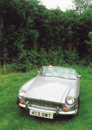
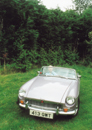
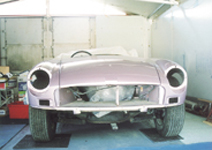
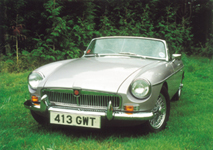
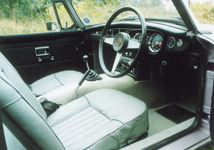
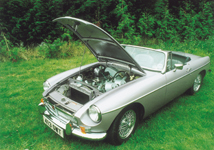
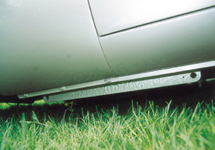
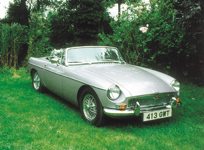
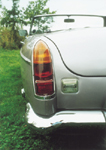
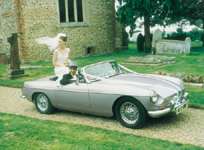
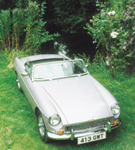
Basil has maintained his links with the Competition cars of Abingdon through his enthusiastic ownership of a classic Mini Cooper S and being very active in the Mini Cooper Register. Since my visit he has completed the rebuild of his MGB roadster. This was the 1966 Motor Show display car, it was finished in the special lilac metallic paint used on the Morris Minor 1,000,000, a special model built to commemorate that the Minor reaching production of over 1,000,000 cars. This MGB was built up just for the show to the American specification having originally had an emission controlled engine, three windscreen wipers, wing mounted reflectors and an American type padded dashboard. The MGB was displayed at Earls Court rotating slowly in a huge spit like arrangement and the castle sections still have the very solid attachment brackets welded to them. After the show the car was discarded and left to one side at Abingdon, it grew shabby and various parts were robbed from it. Eventually, Basil made an offer for the remains of this ex-Motor Show car and put it back on the road. He removed the emission equipment and used the MGB as a runabout until he had children and moved house. It was then totally ignored in a barn for 25 years before having to come out when a full strip and repaint was undertaken, back to bare metal but to the original colour. There was no real urgency to rebuild the car but when his son announced his forthcoming wedding Basil decided to use the event as a completion date, the MGB was finished just in time to serve on the big day by taking the bride to the church.
During the rebuild Basil has removed much of the American specification equipment but he has retained the utterly distinctive lilac metallic paint finish which really suits the lines of the MGB. He also kept the sturdy brackets on the underside, which provide protection for the sills and must be strongest jacking points ever seen on an MGB.