KV6 – Variable Intake System
It wasn’t until I started to write this article that it occurred to me that the V6 engine is not really an altogether common configuration in the MG. The 6R4 was fitted with a V6 which was a development of Rover’s (nee Buick) V8 and more recently the KV6 as installed in the ZT and ZS. Developments of the K Series engine have led to the introduction of both 2 and 2.5 litre capacities. More interestingly both engines have a 90 degree configuration which contrasts the more typical 60 degrees as found on almost all other V6 engines. Odd? Whilst it’s obvious at why the 6R4 used 90 degrees I’m not entirely sure as to why the KV6 was designed in the same vein. Anyway, let’s get down to business, the KV6 in 2.5 litre form is found in the MG ZS and ZT and like its four pot siblings is a cracking motor. It’s light and powerful and when used sensibly it’s economical as well. Although the MG ZS “only” has the 177PS specification engine when you consider the nominal 340kg difference in weight the ZS has a power to weight ratio of 135BHP per ton compared to 115BHP per ton with the ZS (190). Not bad considering the difference of 13PS, I’ve not driven a ZT190 but I can’t help but think I might be disappointed comparing it to the ZS180. Anyhow on to the plot…
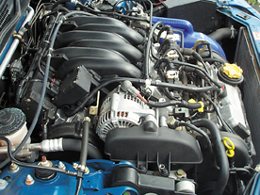
ZS 180 standard engine with cover removed. The two VIS motors are the square boxes at this end of the plastic manifold.
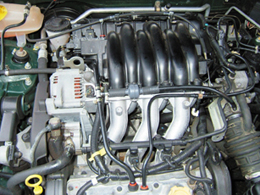
Mat Smiths engine bay with new VIS manifold fitted and Rover V8 flame trap as oil separator in breather line.
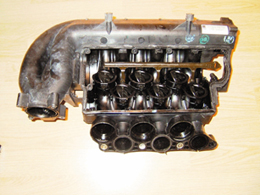
Underside of VIS manifold opened up to show the way the short tract ports are closed with the 6 throttles and the control rod. The oil deposits inside here have better adhesive properties than superglue.
To be completely frank I wasn’t over enthusiastic with the MG ZS 180 at first. I used to own a Rover 200 BRM which I loved, Roger (Parker) and I had developed the car over the years and it was close to 180BHP and it flew. I’ve the point (not prizes) to prove, Roger had owned a ZS 180 and when I mentioned the BRM was on its way out strongly suggested I have a look. To be fair even before the (sad) demise of MG Rover they represented excellent value for money, I picked up a 6 month old car with 6k on the clock for a little over £10k which at the time was good value for money. I’ve now clocked up over 50k in the car and it’s performed faultlessly up until recently. Now the KV6 is not the smoothest of engines, there is a bit of a flat spot around the 3,000 rpm mark but once past this it pulls like a train. After about 40,000 miles I noticed that the car started to run a bit “lumpy” which seemed to be worse at slow speed and after a constant 70mph (sic) run on the motorway. I had a chat with Roger on the phone, he’d heard of some issues with the KV6 and suggested I get up to Cambridge, connect it on to the “Testbook” and see what the computer had to say. We checked all possibilities and Testbook indicated that the fault lay in the motors on the variable intake system. Variable Intake System, I hear you say, what’s all that about then? Well here’s the technical bit:-
The inlet manifold chamber incorporates a Variable Intake System (VIS). The air flow from the throttle body feeds into a “Y” piece which separates into two secondary pipes. The secondary pipes feed into two main plenums, one for each bank of three cylinders. At the closed end of the plenums is a VIS balance valve, operated by an electrical motor. This valve enables the two plenums to be connected together. From the two plenums, the primary tract length to each cylinder is approximately 500mm. Each of these tracts has a side function, fitted with a VIS power valve and feeding into the short tract plenum, approximately 350mm from the cylinder head face. All of the VIS power valves are connected to a link rod which is operated by an electric motor.
What does this mean? Well in simple terms all engines are a compromise and manufacturers will use all the tricks in the book to help them produce engines that are ecumenical, ecologically sound and yet develop maximum power throughout the rev range. You wouldn’t run a Cosworth DVF in a road car because it’s designed for maximum power at maximum revs and at the opposite end of the spectrum you wouldn’t want a Massey Ferguson tractor engine for International Rallying. The Power Train designers have employed a variable inlet tract system on the KV6, our tests proved that on my car this wasn’t happening hence the “rough” running.
So how did the fault occur? It seems there is one flaw in the design in as much as the engine breather system is fed into the throttle body which means that a slightly oily mixture is fed in to the engine. Some customers have complained of an oil leak, this is caused by “oil” running from the throttle down in to the air filter and out of the water drain. Later cars have this hole plugged with a self taper (one assumes the air filters become soaked in oil). This nothing new or different from any other manufacturer but in the case of the KV6 with the VIS the oil becomes sticky with heat and makes valves harder to operate leading to the electric control motors to become over worked and eventually fail. In extreme cases the valves wear and begin to “rattle”, or one or more of the motors fail. You are now faced with two possible cost scenarios. First, a pair of motors for about £100 or second a complete new inlet system for around the £500 mark. Bit of a difference! I spoke with the service manager at my local (ex) MG Rover dealer; he said that many of the cars brought in (mostly ZS and 45 autos) were cured by cleaning the intake with carburettor/intake cleaner. A few cars required new motors but some 35% of cars required a complete new intake system, some sounding so bad that owners believed a new engine would be required. More often than not it is the horizontal motor that fails but I decided (and sensibly in my mind) that I’d try the cheapest option and have a go at cleaning the inlet manifold.
Removing the Inlet Chamber
- First disconnect the vehicle battery, not totally necessary I hear you say but, hey better safe than sorry. Also be sure you note any radio code numbers are available to re-awaken the radio when you reconnect the battery and the need to re-synchronise each alarm fob to the car.
- Next up, get the engine cover off.
- Remove the air intake to throttle body hose.
- Disconnect the fuel system, be sure you’ve some old cloths/rags to soak up the fuel I don’t smoke these days and I would strongly suggest you don’t when carrying out this job.
- Release connector, disconnect the hose, multiplug and vacuum pipe from the purge valve.
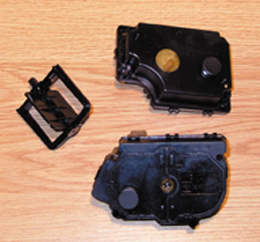
The two different VIS motors and the second control flap.
- Remove the engine breather hoses. I must add I do like all the modern connectors on the ZS, don’t pull at them, depress the red locking collar and gently pull the pipe out. Excellent. Take off the engine breather pipes from the cam covers. Don’t try to separate the “T” piece, you’ll break it. I did.
- Remove the throttle cable from throttle body and move out of the way.
- Remove all the multiplugs, vacuum hose and throttle cable from the throttle body taking note of where you took them from. A little tip here, why not take a high resolution digital picture before you start for reference? At this point I removed the throttle body, it was a bit awkward but straightforward. It’s pretty obvious so I’ll spare you the detail.
- Disconnect the brake servo hose from the manifold by depressing the red locking collar.
- Disconnect the multiplugs to the VIS motors.
- Now you need to remove the two screws securing the harness brackets to the manifold chamber followed by two bolts securing the manifold chamber support brackets to the RH camshaft cover.
- There are now 4 bolts securing the inlet chamber to the front inlet manifold. Once removed you can gently, and I mean gently lift the inlet chamber off. It might need some persuasion by means of a pry bar but be very careful.
Once off clean the inlet chamber with any carb or intake spray cleaner. Do not attempt to strip the unit any further, believe me it is not possible without the use of extreme violence. I would suggest you also give the throttle body and associated hose a good clean as well. You will be surprised at the amount of gunge coming out, but keep going until you’ve flushed it through.
To digress slightly here, I am also aware that the KV6 can develop a sticky throttle and clogged idle control valve. After a constant speed run, the engine will hold at about 2,500 rpm for a few moments before returning to idle. This again is caused by gunge building up in the throttle body and keeping the butterfly part open. This is simple to rectify, simply spray liberal amounts of carb/intake cleaner into the unit once the air filter pipe has been removed. Please note that it would be wise to have a good supply of rags or cloths as this is rather messy to say the very least.
Re-assembly is just as straight forward; reverse the process as already covered. If there is no improvement and the car is still running rough, it would be wise to change the VIS motors, I carried this out but there was still no improvement so I replaced the entire manifold chamber and noticed the difference immediately.
I’ve considered the problem I encountered and discussed it with Roger. We both agreed that the engine breather system and the extended oil change frequency were the most likely cause of the excess oiling. I’ve always had my ZS serviced religiously, but after MG Rover and their warranties collapsed, I couldn’t see the sense of paying dealer rates so I’ve done it myself. I now think that changing to a 6,000 mile oil change interval would help. As a point of interest I’ve always used a semi synthetic 10W40 of good quality.
Looking at the engine breather system, there is not really too much that can be improved. I did consider venting to atmosphere but in today’s politically correct climate and emission legislation this wouldn’t be right, so the next idea was to insert some sort of filter or trap. A look in the parts box in the garage and I found a flame trap for a Rover V8. The outside diameters of the flame trap pipe and engine breather are almost identical, so I chopped the breather pipe and using some rubber hose inserted the flame trap in line. It’s a bit early to comment but here’s hoping I won’t spend another £500 in 40,000 miles.
Mat Smith
Mat’s ZS 180 is currently up for sale as he has had to opt for a vehicle with off-road capabilities if you are interested call him on 07770640771