Le Mans Legends
2009 marks the 77th running of the iconic French sports car race at the Circuit de la Sarthe near Le Mans, and what a year it turned out to be. Despite all the hype around Formula 1 these days, it is the French sports car race that manages to draw increasing numbers of fans out of their armchairs and into their cars for the annual pilgrimage to this spiritual home of motor sport. Whilst it is the main 24 hour race that the spectators come to see, it is the Le Mans Legends race that keeps them entertained in the hours leading up the traditional 3pm start on Saturday. Since 2001 Duncan Wiltshire and his team at Motor Racing Legends have undertaken the formidable task of putting on an historic sports car race on the morning of the main race. Because of the 24 hour race’s long and illustrious history, there is a vast range of cars vying to compete in the Legends Race. In order to keep it interesting for the spectators, the organisers choose a different era each year. 2008 saw the return of the 1980’s Group C cars, but this year it is the turn of that golden age of sports car racing, 1949 to 1965. This period covers a diverse range of cars, from the exotic Ferrari 250LM, to a little 745cc 2 cylinder Panhard X86 and everything in-between.
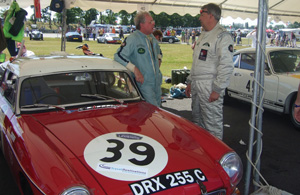
Barry and Jeremy in the paddock with the Le Mans MGB
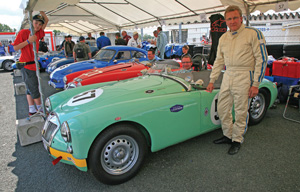
Mark Ellis’ stunning 1958 MGA Twin Cam in the paddock
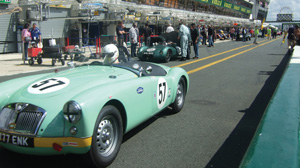
The MGA Twin Cam exits the pits
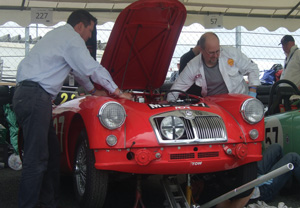
Can we fix it?
Out of the 59 cars accepted for this year’s Legends race, three carry the MG badge: Bruce Chapman’s 1955 Mille Miglia MGA, Mark Ellis’ stunning 1958 MGA Twin Cam and, arguably the most famous MGB of all, Barry Sidery-Smith’s 1965 Le Mans MGB. The rest of the grid reads like a who’s who of sports car racing, with dazzling array of Aston Martins, Jaguars, Austin Healeys and Porsches, to name just a few.
Racing at such a big event is never easy, and it takes an immense effort from all those involved to put on the 45 minute race on Saturday morning. The teams start arriving on the Wednesday, with scrutineering taking place on Thursday. The cars may well be over 44 years old, but many look as if they have just rolled off the production line and are maintained to near concours condition. However, regardless of their pedigree, the cars must still pass the strict scrutineering process before they are allowed to race. As always, scrutineering throws up a few surprises and this year is no different.
The ex-works MGB Le Mans is one such example, which fails due to the harness date having expired at the beginning of the year. Luckily help is at hand, with one of the 911 owners offering the loan of his harness from his passenger seat (he had had the same experience only the month before). The offer is gratefully accepted and the team set about swapping the harness over. A few minutes later the Porsche owner is back, his car also having failed scrutineering due to an out of date crash helmet. After much laughter from both teams, a spare helmet is located and both cars are passed to race. This sort of activity is repeated up and down the paddock, with everything from alternators to axle stands being lent between the teams as they prepare the cars for the official qualifying session on Thursday afternoon.
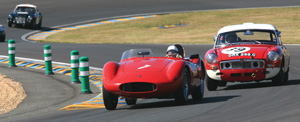
Barry dicing with Sir Stirling Moss in the 1956 Osca
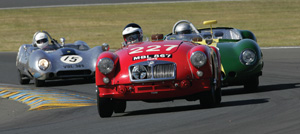
Bruce Chapman’s 1955 Mille Miglia MGA with Lister and Lotus in pursuit
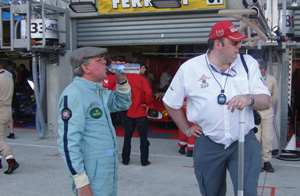
Driver refuelling
With the teams for the modern 24 hour race taking up all the room in the pit lane, the teams in the Legends race only have access to the pit-lane during qualifying and the race. A one minute pit stop is compulsory in the race and most teams take this opportunity to change drivers. This means that both drivers must take part in qualifying and complete at least one lap each.
The session started well, with the cars quickly spreading out across the 14 km long circuit. Lap times were somewhere between 5 and 6 minutes, depending on the car, so driver changes tend to take place after the first driver has completed just 4 laps. Like much of the field, the MGs were having mixed success. Whilst Jeremy Rogers completed a flawless stint in the Le Mans MGB, before handing over to Barry Sidery-Smith, the Green MGA Twin-Cam was less fortunate. When it arrived in the pits for the driver change the team were horrified to see water and steam pouring from the holed radiator. One of the team ran back to the paddock and retrieved the spare radiator. On his return an automotive miracle was performed and the hot damaged item was replaced within 11 minutes, thus allowing a relieved Conrad Bos to take over and complete the session (anyone who has ever tried to change a radiator themselves will know how tricky this task is, and how little space there is under the bonnet of an MGA).
After qualifying had finished, there was the agonising two hour wait for the drivers to find out where they would line up for the race. Bruce Chapman and Julius Thurgood in the Red Mille Miglia MGA that had originally belonged to Bruce’s Grandmother, were delighted with the handling of the MGA and lined up 56th out of the 65 cars. This was good enough to put them one place above Sir Stirling Moss in his recently restored red Osca. After the excitement of changing the radiator, Mark Ellis and Conrad Bos were relieved to be on the grid at all, let alone in 44th place. But top MG honours went to the experienced pairing of Barry Sidery-Smith and Jeremy Rogers, who qualified up in 36th place, much to the surprise of a number of Porsche and Aston Martin owners. Sir Stirling Moss was amongst the first to congratulate them on the car’s performance. With qualifying over, Friday was supposed to be a day of rest, but for many teams it was a chance to fix damage sustained during qualifying. Sadly, despite their best efforts, some cars did not make it onto the grid. The most noticeable of these was the stunningly beautiful Aston Martin DBR1 driven by Peter Hardman.
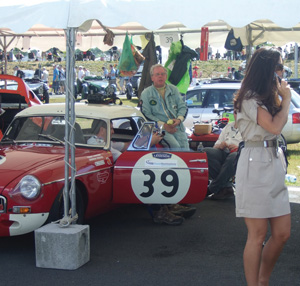
Focusing on the task ahead
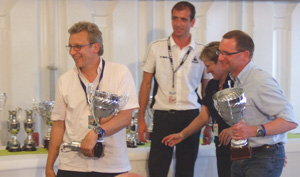
Mark Ellis and Conrad Bos
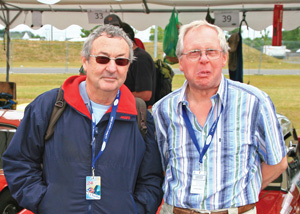
Barry with old friend Nick Mason
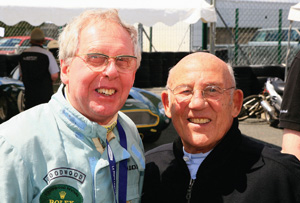
Barry and another old friend Sir Stirling Moss
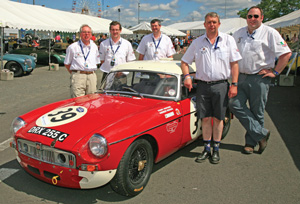
DRX and the Le Mans team
Saturday morning dawned, with clear blue skies and perfect racing weather. Safety requirements have meant the end of the traditional Le Mans racing start, which has been replaced with a more modern rolling start. With cars coming down the start/finish straight at the end of the green flag lap, the red lights go out and the noise intensifies as 62 drivers floor their throttles in a mad dash to see how many places they can make up before the first corner. With the cars so tightly packed in the fist few laps, there is always excitement and incidents. One of those to get caught out was Holly Mason, daughter of Pink Floyd drummer Nick Mason, who spun out in her Alfa at the first chicane, after hitting some oil, with the TVR Grantura caught up in the ensuing melee. The MGA Twin Cam was forced to take avoiding action, damaging second gear in the process. This was not good news, as they require second gear for five of the circuit’s corners. However, they were able to continue lapping quickly and eventually bring the car home in 40th place. The Mille Miglia MGA was able to avoid the trouble and managed to make up 10 places during the race, to cross the line in 46th. Further up the field the racing was very close, with drivers having to fight for every inch of tarmac. Right in the thick of it all was the Le Mans MGB, originally driven by Paddy Hopkirk and Andrew Hedges in 1965. But for this race it was Jeremy Rogers behind the wheel for the first stint. He managed to get a good start and was soon trading places with the TVR Grantura, a brace of Aston Martin DB2/4s and a Porsche 911. Just before half distance Jeremy brought the MGB in to hand the car over to its owner, Barry Sidery-Smith, who this year is celebrating his 50th year of racing. But few of the spectators out around the track would have had a clue of the driver’s age, as he powered round the circuit in pursuit of the ever present Porsche 911. Barry’s driving style is pure “old school”, hardly lifting off the throttle for chicanes and drifting the car through the corners on his way to 32nd place.
After the race, it is a chance for the teams to relax and swap experiences at the celebratory awards lunch. The MGA Twin Cam drivers Mark Ellis and Conrad Bos maintained MG’s proud heritage at Le Mans and were delighted to have come third in class 5. They are presented with their trophies by Vincent Beaumesnil, Director de Sport at the ACO.
There is no other circuit anywhere in the world that conjures up such passion and excitement as Le Mans. Very few drivers get the chance to race there, and those who have are always left with a lasting impression. This applies just as much to the teams in the Legends race, as it does for those in the main 24 hour race. As they pack up their equipment and load the cars onto trailers, promises are made to return next year. I just hope that I am able to join them.
James Pitt
Photos by James Pitt and Richard Hampson