MG Heritage Cavalcade
For anyone with a passion for MG cars there can be few experiences to eclipse the sight of virtually every model of the marque from the earliest 1925 Super Sports to the very latest 2009 TF 85th Anniversary model all passing before you in the historic setting of the Quadrangle at Windsor Castle. The streets of the town were lined with visitors and locals as over 200 MGs made their royal procession from King Edward VII car park up to the castle.
Black clouds and an early shower of rain had cast a damp gloom over the parade vehicles as they assembled in the King Edward VII car park. Owners were defiantly leathering down the bodywork of all manner of gleaming MGs as they made their preparations for the parade and kept an apprehensive watch on the dark skies.
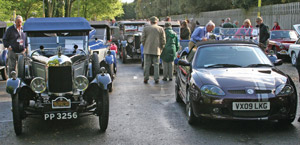
Waiting at the start the 1925 MG Super Sports and 2009 TF 85th Anniversary, the oldest and youngest MGs on the Heritage parade
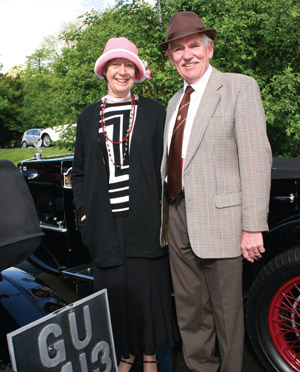
John and Janet Day dressed to match their 1929 18/80 MKI
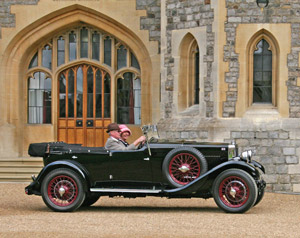
John and Janet Day in their 1929 18/80 MKI Tourer
Eighteen months of planning was about to be set in motion and tension was high because the cars had to leave in strict order and comply with tight security checks. Miraculously the clouds dissolved and as the first MG got underway the sun came out and the Royal MG Heritage Parade was underway.
In the hushed silence of the Quadrangle we waited for the arrival of the Duke of Edinburgh who was to review the parade. The Duke arrived and was introduced to the invited representatives of the MG Car Club, the MG Owners’ Club, the Early MG Society and the MG Octagon Car Club. After all the formal introductions had been made the Duke was joined on a small dais by the eminent MG author Graham Robson. Graham was on hand to describe all the MGs in the parade and outline the production history of the marque. Meanwhile outside Jon Pressnell, another famous motoring author, provided a commentary for the general public.
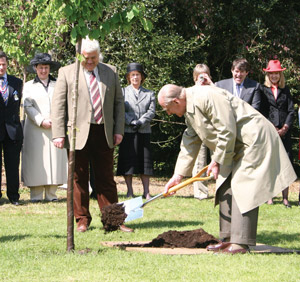
The Duke of Edinburgh planting a cherry tree with Deputy Ranger Philip Everett looking on
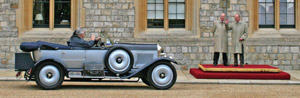
Chris Keevil with his magnificent 1925 MG Super Sports
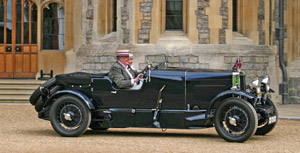
Geoff Radford with his 1930 18/100 MKIII Tigress
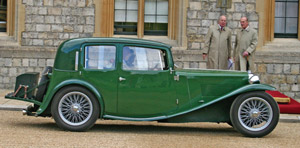
Peter Prosser’s 1935 MG KN Pillarless Saloon
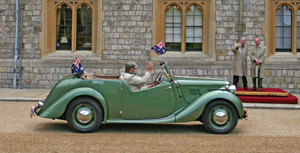
Glen Whitehead in the 1949 MG YT Tourer
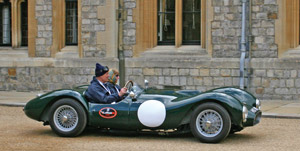
Chris Pamplin in the 1954 Dargue MG
There was a tremendous sense of anticipation as the sound of the first MG arrived in the Quadrangle and began to make its stately way around the large imposing courtyard. This was the latest model from the MG Motor Ltd and was liveried as an 85th anniversary MGTF. This TF was followed by the oldest surviving MG a 1925 Super Sports, a striking Bullnose model built on a Morris Oxford chassis and finished in Silver Blue and Dark Blue. Next was a wonderful selection of early MGs, 14/28s, 14/40s, 18/80s including two Tigress models. In amongst these imposing early MGs came the tiny 1929 MG M type fabric bodied two seater, the first of a line of affordable models that was to establish MG as a builder of nimble sports cars, the M type proved so successful that by the end of production 3,253 examples had been built.
From the early 1930s we had the F type, a J1 Salonette, J2, C type, Magna, Magnette, MG PA and a Cream Cracker MG PB. Then came the elegant MG VA, SA and WA saloons and tourers, Leonard Lord’s influence on MG’s direction into the luxury saloon car market is clearly apparent and it is equally obvious that Cecil Kimber had the flair to create these imposing but graceful touring machines. Many examples were fitted with Tickford bodywork incorporating their special wind-up hood raising and lowering mechanisms.
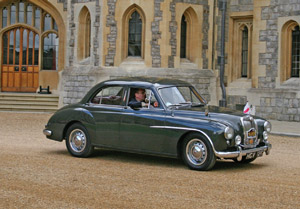
Grant Howlett 1955 MG ZA Magnette
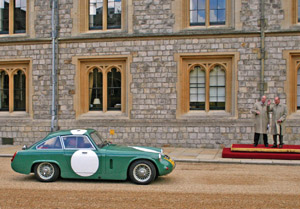
Malcolm Beer in the 1961 Jacobs Midget
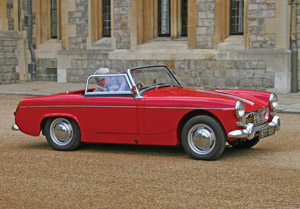
John Davies’ 1963 MG Midget
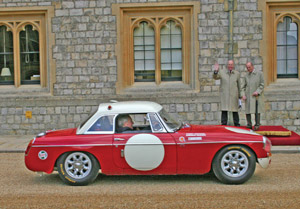
Paddy Hopkirk in the 1965 ex-works Le Mans MGB
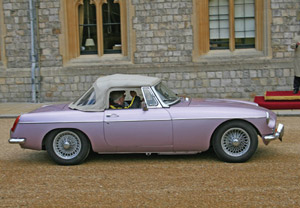
Basil Wales former Head of Special tuning in his 1966 Motor Show MGB
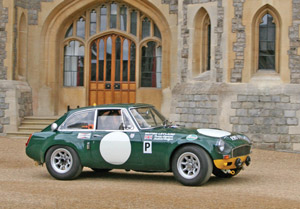
Nikki Saunders in the ex-works 1968 MGC GTS
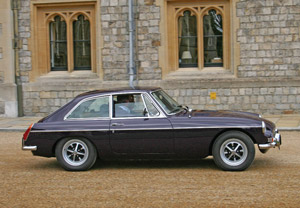
Peter Morgan’s 1973 MGB GT
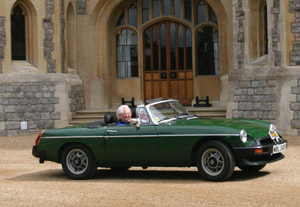
Don Hayter’s prototype O Series MGB
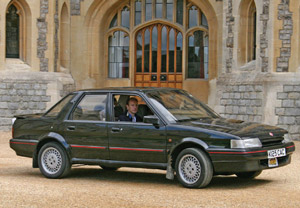
Patrick Roberts’ MG Montego 2.0i
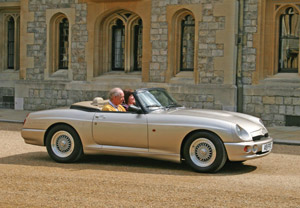
Frank Clemmey’s MG RV8
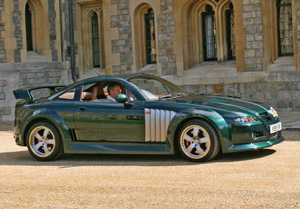
John Newey – MG SV-R
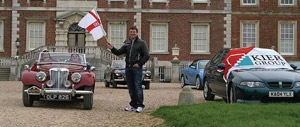
Mark Blundell waves off Cambridgeshire MGOC’s Road Run from Wimpole Hall
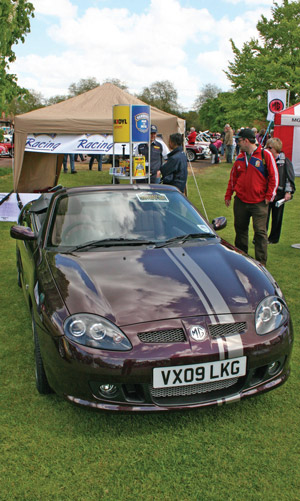
MG TF 2009 85th Anniversary Model
Post war MG production was well represented by a succession of sports models with the TC, TD and TF two seaters, while MG’s range of saloon models was shown by the Y type and Z and Farina Magnettes.
The MGA was well represented with many sleek road cars plus SRX 210 the Le Mans fastback coupe driven at Le Mans by Ted Lund and Colin Escott, MJB 167 the works MGA owned by Pat Moss and driven by her in various rallies and MBL 867 another works MGA driven by Nancy Mitchell and Pat Faichney in the Alpine Rally where they won their class.
Among the MG Midgets on the parade was an ex-works Midget MK II, one of the Jacobs Midgets, also a Lenham bodied Midget. MGBs were well represented by road going and works models, 6 DBL the first MGB to compete in a major race the 1963 Sebring Twelve Hour, then there was BRX 854B the Tulip Rally works car and Paddy Hopkirk was reunited with DRX 255C the Le Mans MGB.
Among the MGBs was a 1980 prototype fitted with an O series 2 litre fuel injection engine driven by Don Hayter the designer of the MGB. MGCs were also very well represented with a succession of immaculate road cars, as well as the factory MGC prototype and a works GTS.
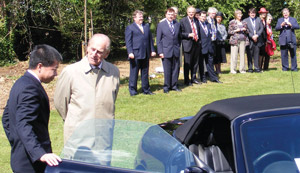
MG Motor UK presented a new MGTF LE500 to the Duke’s charity
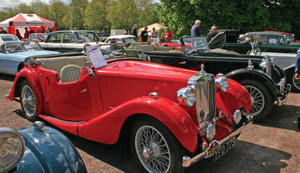
John Bannister’s 1938 MG VA Tourer
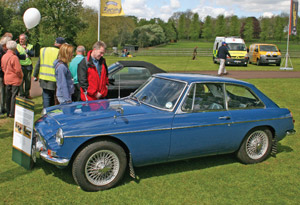
Prince Charles’ 1968 MGC GT is part of the Sandringham Royal Vehicle Collection
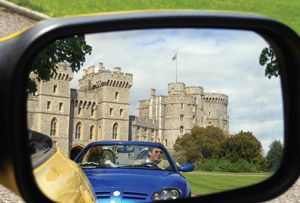
Castle view
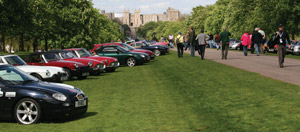
Road Runners were allowed to park on the Long Walk
MG production of the late 80s was represented by an MG Metro and Montego from the company’s range of sports saloons. A fine selection of RV8s heralded MGs return to sports car production in the early 90s, preparing the way for the launch of the MGF in the mid 90s. MGFs and TFs were also represented by an example of most models as well as the one-off 2002 Golden Jubliee TF. MG Rover’s ZR, ZS, ZT and ZT 260 then followed along with the dramatic MG SVR, MG’s supercar project, while the final MG in the parade was 2008 MG TF LE500.
It’s not possible to list in appropriate detail all the MGs in the Heritage parade but it formed an almost complete timeline of the history of these much loved cars. In order to muster the parade vehicles the MG Owners’ Club approached all of the MG clubs, The Early MG Society, MG Octagon Car Club and The MG Car Club to suggest appropriate participants. The Clubs were all contacted and their members were invited to take part but it’s important to note that the parade was entirely made up from volunteers who as well as owning a good example of an MG model they were also prepared to make a charitable donation of £75. We are most grateful to all those who took part because they made the event and we’d like to stress that every penny of their donation went to The Prince Philip Trust Fund and the Rotary Club of Windsor and Eton nominated charities. The organisers of the parade had to rely on those owners who were prepared to put their MGs forward in the quest to locate sufficient cars to represent the evolution of MG and not disappoint too many of those who wished to take part.
After the parade there was a tree planting ceremony in which The Prince Philip and Mr He Xiaoqing, Chairman of MG Motor UK Ltd each planted a cherry tree in a special garden at Frogmore. For this reason Royal Palace security restricted access to Frogmore until the ceremony was over, after some deft spade work Prince Philip chatted with the members of the Rotary Club and the executives from MG Motor UK Ltd about the new MG TF LE500. As the Duke of Edinburgh drove away he paused to lower his window and talk to members of the crowd made up of those in the parade and MGOC stewards.
All the road runs were planned, manned and organised by volunteers and all of the £25 entry fee went to the charity, therefore we are equally grateful to all of the MG road runners who played their part to make the day a success. It was special concession to allow parking on the Long Walk, while organisers were aware that it was still a long way from the castle. The entire point of this event was to raise considerable sums for the various charities and without exception everyone involved gave their time and skills freely, in addition all those involved with producing and printing the MG Heritage Festival souvenir brochure did so without charge so that all funds raised by its sale also went to the charities. Particular thanks must go to Kelvin Blyth Studios who designed the souvenir programme and Malcolm Green for his authoratitive historical input, both invested a considerable amount of their free time.
MG Motor UK Ltd were the main sponsors for the event and very generously donated a brand new MG TF LE500 to the charity which was sold in a sealed bid auction. Other major sponsors were Mercure Hotels, Balfour Beatty, St Ives Web, James MacNaughton Group Ltd, Ridge, George Jones, Hammerite and the Crown Estate. So far the Windsor MG Heritage Festival has raised funds approaching £50,000.