MG Rover News
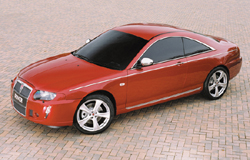
New concept cars from MG Rover
Once again, the motoring media headlines have been focused on matters other than cars and the sad part is the way in which these headlines have swamped the significant announcements of two very elegant concept cars, the MG GT and the Rover 75 Coupe. Both fully demonstrate that whilst MG Rover’s model line up may have more age on its side over most rivals; age and beauty can often go together. It further proves that not having the capital to develop a full range of new products doesn’t mean that the ability to design and produce them doesn’t exist and that given the required investment such cars would grace our roads sooner rather than later. The pictures tell their own story and need no further description, but there are a number of differences between a concept car and a production car, so let us have a look at a few.
Rover 75 Coupe Concept
Coupe styling is a way of achieving a lower sleeker line to existing saloon body style to create a niche model and extend the appeal of that base model much further. In recent years this has seen mixed results for various manufacturers, but much of that success has depended on the perceptions of the original models and how the coupe variant extended these.
Rover Coupe draws some of its design cues from the MG X80
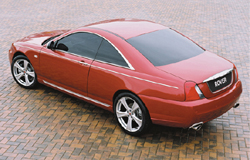
Rover Coupe longer doors with frame-less windows
Firstly, let’s look at the Rover 75 Coupe Concept, as there is less to discuss. Based on the existing Rover 75 saloon platform there are changes to doors, roof and glass line to create a significantly different looking car with lower and sleeker lines for what is actually little change to the basic architecture. This concept is built on the front wheel drive platform, and for those wondering how this can be seen look at the brake caliper positions. Contrary to what many have believed, the use of V8 style exhausts either side of the car, apparently using V8 XPower style oval tail pipes, can be applied to any ZT. Clearly whilst this concept is built on a FWD platform I see little if any real difficulty in using a V8 platform, subject to ensuring body rigidity is maintained.
Doors on the Coupe Concept are longer to allow easier rear access and this immediately requires the structural B pillar to be moved. In addition, the clean glass line between door and rear quarter glass indicates a pillar less construction, but close examination of the images indicates the pillar does extend to the roofline in this coupe. That would seem to be essential to allow for continued good structural performance in collision situations.
The roofline of the Concept is all new although as far as can be seen the screen angle and screen glass are the same. The roof height appears very similar to that of the saloon for approximately a third of the way rearwards from the screen and this will retain original headroom for front seat occupants. Rearwards of this there is a smooth curvature towards the boot, styling that was also seen in the original MG X80.
The screen pillars are thicker as now the doors follow normal soft-top and coupe styles of using frameless glass. What used to be space occupied by the door glass frame is now used as part of the roof structure and so should be stronger in this application than in the saloon. The smooth curvature and lower overall roofline is accentuated by new glass that makes the car look lower still.
This Concept model has been created to help mark the 100-year anniversary of the Rover marque, but with a useful extra function as a test of public opinion with regard to the potential sales success of such a car. What has fed back to us so far is that public reaction has been quite positive. From our own perspective of course is the obvious question, what about an MG version?
Naturally, with the development of the new MG GT, to propose this concept car as an MG also would have left the Rover brand out in the cold, and hence we see this branded as a Rover 75 Coupe Concept. There is of course no reason preventing an MG version being built and here marketing comes into play as there are many markets where MG would do far better than a Rover and to be fair probably some others where the reverse is true. Overall, I feel an MG version offers the bigger potential market. MG GT Concept
Without doubt, the Rover 75 Coupe Concept will have many admirers but for us the real interest is in the MG GT Concept. The MGB GT has been the obvious comparison for the new MG GT, not least of which is seen in the concept’s title. The MGB GT pioneered a number of new ideas and whilst it added weight and height to the sleek MGB body, it actually gave more back than it took and which made the closed coupe the undoubted success it was. One of the pioneering developments for the BGT was the use of a large opening rear hatch, some years before hatchback cars were officially coined with that moniker.
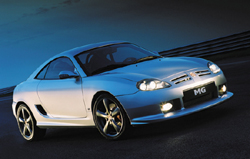
Fastback MG TF Coupe the new MG GT
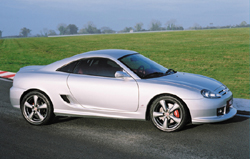
Side repeater flashers in door mirrors and door handles concealed beneath mirrors
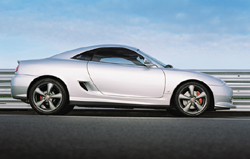
Profile reveals improved aero-dynamics and new front splitter
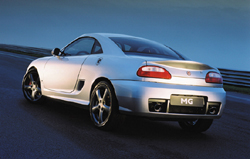
Handsome rear end treatment but access to the mid mounted engine remains and issue a hatchback style tailgate may provide the solution
With the proposed MG GT here is a car that could be turned into a production model fairly quickly and rapidly become a common sight on our roads, wherever the MG TF is currently sold, and in many markets a coupe would be a far bigger seller.
Based on the current MG TF the GT concept takes on all the current positive advantages of this modern open sports two seater when it’s fitted with a high quality hardtop and then incorporates them into a closed coupe with smooth attractive lines. In addition is the bonus of adding further to the already rigid body structure and also providing a snug and cosy interior. Clearly it’s the GT’s beautifully proportioned lines that stand out most. Whilst the TF’s optional hard top was always a neat and balanced addition to the car, it was also an obvious add-on feature and did not integrate completely into the lines of the car. No such comment can be made against the MG GT. In practical terms the aerodynamic efficiency of the MG GT is much better than the already reasonable MG TF, with a Cd of 0.31, down from the MG TF (with hood raised) Cd figure of 0.35, assisted by changes to the front splitter and rear boot shape. I would emphasise that the MG TF and other sports cars always publish aerodynamic performance figures with the hood raised, however very few sports car manufacturers publish the quite significant increase in drag that occurs with the hood lowered. Anyone who travels at speeds above 50mph with hood down will be aware of the level of wind buffeting that gets considerably worse as the speed increases. This has a significant influence on both the performance and the fuel efficiency of the car, something many owners do not fully appreciate.
Having owned a soft top car for a continuous period of over 30 years the need to give careful thought to warm and protective clothing, especially to the upper body is second nature. Travelling for long distances on fast trunk roads and motorways is not the best environment for a soft top car with hood lowered and most I have seen in recent years on such roads have both the side windows up and a rear windstop fitted to effectively turn the car into a targa top.
I clearly recall a test day at Bruntingthorpe quite a few years ago when I was able to achieve well in excess of 130mph hood down in my V8 EFi MGB and the buffeting was like having a navvy standing on the boot of the car smacking me in the back of the neck with his shovel! Hood raised driving over the same available distance saw the MGB’s speed rise to in excess of 142mph. Now the aerodynamic efficiency of modern soft top cars is better than the MGB, but this still provides an illustration of the effects on performance and comfort as speeds rise, another reason for drivers covering high mileage on these sort of roads to opt for an MG GT.
Another small but potentially significant point lies in the styling of the GT as it seems to provide for subtle creasing in the roof line from front to rear. This subtle crease could quite possibly be used as a form of rain channel avoiding the drawback of a lap full of water when you open the door.
It will be natural to draw comparisons between the MG TF and MG GT to the MGB and MGB GT, and indeed the MG GT is a spiritual successor to the MGB GT. However MG enthusiasts should not assume that the MG GT offers the same range of attributes as the MGB GT, when it added a massive dose of daily practicality to the MGB. The MG TF is already a far more advanced and practical car by comparison to the MGB GT, and indeed to some of today’s competition in the two seat soft top market. There is not the same distance in convenience between the open and proposed closed version of the TF as there was between the MGB and MGB GT. There is also the significant matter of engine location on the MG TF and MG GT, which precludes the same principles of space adaptation as applied to the MGB GT.
In fact the mid engine position of the MG TF is the greatest consideration when looking at the MG GT. In positive terms the mid engine position is the one that can provide the closest to ideal handling balance, and the results average drivers get from the MGF and MG TF shows this to be the case. On the negative side is the reduced access for servicing and working around the engine. This provides perhaps the biggest obstacle to getting the MG GT into production as currently the MG TF, and MGF before it, enjoyed the convenience of a removable hood section to expose a large engine cover to gain access to the top of the engine. This is in addition to the restricted access into the engine bay that can be gained from the front of an open boot.
The MG GT Concept has a new integral and permanently fixed roof section with a permanently fixed rear window, so access to the still present engine bay cover would have to be from inside the car which may lead to all manner of potential damage and dirtying of interior trim through mechanics working inside the cabin and handling dirty engine components. The alternative would be to do more work from the underside which would inevitably mean more frequent removal of the whole powertrain and subframe. Although this approach is not unheard of in some other mid engined sports cars, it would add to the servicing and maintenance costs, not a good idea for cars in this market sector. One partial solution would be to have the rear window as a removable section so that some of the less intrusive maintenance would still be possible, although with a little more difficulty and a greater need for mechanics to protect the paint. This would create the minimum access needed to reduce the serious cost implications of having to drop the engine for relatively simple jobs. However, in the MG GT some additional development work would have to be done to reduce the frequency of subframe to body mounting bolts seizing and breaking when the assembly has to be removed, and perhaps the introduction of some quick release cable and pipe connections.
MG GT 2.5 KV6
One of the other highlighted points of the MG GT announcement was the reference to a possible future version using the 2.5 litre KV6 engine, although there would be strong demand for cars with the existing engines. The V6 TF is a possibility that has been discussed for many years, with some people, myself included, having done some detailed viability studies. There were rumours of a 2.5KV6 MGF within Rover during the latter part of the BMW era. Discussion became all the more concentrated in mid 2001 when the ZS 180 arrived with the KV6 already attached to the same PG1 gearbox that was also used in the MGF at the time. Even the internal ratios were the same as the 1.8i models! Surprisingly it is only quite recently that a private KV6 engined MGF appeared.
The problem with fitting the KV6 into the MG TF body, and which would apply equally to the MG GT, is simply space. Being a 90-degree V6 means the engine is wider than the existing K4 engines, but surprisingly not by a huge amount. As the engine position is dictated by the rear wheel and driveshaft positions, which are in turn dictated by how the engine connects to the gearbox, you have to find room for it. The difficulty comes for the intrusion of the front bank of cylinders and the exhaust system which require some of the space currently occupied by the fuel tank. At least the KV6 unit is short so there are no conflicts with the inner wing or suspension.
Pinching the space for the KV6 is not difficult, but when you’re installing a more powerful and thirstier engine you do not want to reduce your fuel tank capacity but this is inevitable. Alternative locations may be sought, or the added complexity of an additional fuel tank in the front spare wheel well. This is an obvious one for a home brew conversion and it would offset the additional 30 to 40kgs extra weight of the KV6 and help restore the original front to rear balance, but crash worthiness with a front mounted fuel tank raises huge concerns. Indeed the same would apply for a rear mounted one. This problem would need addressing for any production version of a V6 MG TF or MG GT.
Adding a KV6 brings more than performance to the party, as there is a certain refinement and infectious aural combination that is as strong as the well perceived V8 scenario. In standard 177ps form there may seem to be only 17ps increase in peak power over the TF 160, but in the background, there is a much more valuable 38% increase in torque. Historically that is a similar change to what was seen with MGB when the V8 arrived and I expect the depth of improvement to be as significant with today’s MGs. The small increase in peak power and the reduced drag will immediately place the car’s top speed in the mid 140mph area. That is of small significance compared to the real world performance increases that will come in the lower and normal speed ranges. I wouldn’t expect this performance to be too costly in fuel either as the averages achieved by ZS180 and ZT190 are in the high 20s so it would be reasonable to expect around 30mpg in the lighter TF based models – lead feet permitting of course!
17” Diameter Alloy Wheels
Among several other interesting features on the MG GT Concept was the use of 17” diameter alloy wheels. On all previous MG TF and MGF models the use of a wheel larger than 16” has often gone hand in hand with tyre contact with the front bodywork under certain conditions. Any tyre to body contact, including any plastic liners or trims is going to attract an MOT failure, so for the MG GT to introduce the 17” wheels will be of considerable interest. However, what modifications have been made to address this issue is not yet known.
Other changes involve the move of the indicator side repeaters to the door mirrors; something most of you will associate with recent Mercedes models. Additionally the doors are without handles or key slots with the door operation being controlled via an electric solenoid with the operating button under the mirror, and easily included on the remote fob as well. In the event of a battery going flat the key access to the boot remains, providing a means to open the bonnet and from there to apply jump leads to the battery. Perhaps not convenient in bad weather whilst waiting for the breakdown service though, so I expect an alternative access could well be provided in a production car.
Overall, the MG GT Concept offers much to support the already strong selling MG TF just as the MGB GT did with the MGB. There is without doubt a market out there for the GT and I expect there to be few sales lost by TF to a GT as it fills another distinct market sector so ably demonstrated by the Audi TT. The UK is one of the biggest markets for soft-top cars, probably because the sun is rarely out long enough to burn the skin. However in many of the warmer and sunnier climate markets the TF is sold, the top would rarely come down because of the speed at which the sun burns. A closed coupe offers the style of a sports car, but the practicalities of insulating the occupants from the harshness of the sun and heat. Naturally, the same attributes can insulate the occupants against the less desirable ravages of British weather so the production of the MG GT seems to be a win-win situation. So over to you Mr Howe, if you can find the resources I am sure buyers will repay your investment.
Roger Parker