MG XPower SV Looking under the skin Part 1
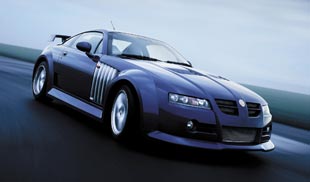
The MG XPower SV is a car that has attracted much attention in its short life, but few in-depth studies. The MG Owners’ Club has benefited from exclusive use of a couple of examples on two notable occasions, the National Classic Car show in November 2002 (just a week after the cars first unveiling at the British International Motorshow) and the second at our National event at Brands Hatch in May 2003, when we had the opportunity to experience the car on the main circuit.
This current MG SV story began back in 2000 when the group of four Midlands businessmen, who were to become known as the Phoenix Group, were in the process of trying to formulate a way that they could take over control of the then Rover Group. One of the group, Nick Stevenson, was challenged with the task of creating a viable business plan for the new company. On his side was that the MG brand possessed enormous depth and strength, which was then not being used to its potential. If anything, the MG brand was seen as something historic and old fashioned, so one of his core plans was the re-launch of MG into a full model range. Not only this but he also had plans for what was described as an MG ‘Ultra car’ to show the world in the clearest possible terms that MG was a true 21st Century sporting brand, built on the strengths of MGs that went before.
As we know in May 2000 the negotiations between the Phoenix Group and BMW resulted in the former becoming owners of a number of parts of the Old Rover group; shortly to be renamed MG Rover. This brought to the fore the stated aims to raise the profile of MG and create a full model range brand.
|
Peter Stevens, designer of the McLaren F1 comes on board
The following months saw much consolidation, many changes, developments and very importantly, the bringing on board of Peter Stevens whose world class CV was both a surprise and a pleasure for all MG enthusiasts. Certainly, if a designer of his stature was prepared to join MG Rover, then there really was a clear case for believing that the company had a far stronger future than the pundits claimed. There was one other event that was central to what was to become the SV, and this was the purchase of Qvale’s sports car facility in Italy in June 2001. Again at the time something of a surprise, but now with historical viewpoint quite a sensible move. This Modena (Italy) facility was producing the Qvale Mangusta for the US market, a fully certified car with Ford 4.6 litre V8 power.
Initially MG Rover considered a less complex re-skin of the Mangusta and a concept car known as MG X80 was shown at the Frankfurt Motor Show on September 11th 2001. World shattering events of that day overshadowed all else, but the reception to the X80 was somewhat chilly. This prompted further development and the results of this, the MG XPower SV, was revealed at the Birmingham Motor Show on October 2002 to rave reviews. Behind the headlines many questions have been asked and many answers given, but here I want to provide some different perspectives of the car and how it sits in the MG world.
The SV isn’t a product that has simply been developed off the drawing board and into production, but one that has evolved over a number of years, although arriving at the SV is a somewhat comprehensive evolution. Rather like the metamorphosis of an effective but not too attractive nymph into the exquisite and even more effective dragonfly.
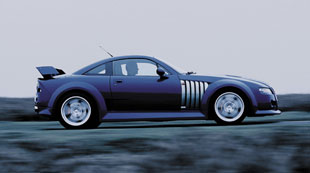 MG SV -R |
Critical to the success of any project is the dedication and skill of everyone involved. Unfortunately it is not possible to name all, only make reference to their efforts, be it a chemist in a lab developing adhesives to the chap screwing in a door pull. There are however, a couple of names that do need to be mentioned, Giordano Cassarini the Chief Engineer who has been with the car in all its forms and who is probably as committed to it as he is to his own family. Secondly, Ian Moreton whose job as Production Manager means he has overseen the car from a concept to production reality.
De Tomaso Bigua to Qvale Mangusta
Starting long before any MG connection can be made the Mangusta story begins with a name many car enthusiasts will recognise, Alejandro De Tomaso, whose high performance sporting cars were always intended to live with the likes of Ferrari and Lamborghini, but never quite seemed to reach that level. One reason is possibly from the use of Ford’s rather dull, but effective, mainstream production cast iron pushrod V8 engines rather than the exotic multi cam V12s associated with the other Italian supercars of the 1960s to 1980s. Although perhaps a little crude, the Ford V8 was solid, very reliable and without any of the high-strung temperament that could be attributed to the Latin V12s.
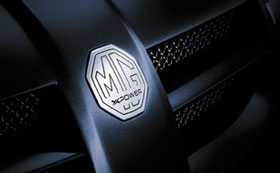 MG SV understated bonnet badge |
In 1996, De Tomaso introduced a new model at the Geneva Motor Show called the Bigua. This model was a two-seat convertible, targa top or full coupe grand touring car, courtesy of a clever roof and the driver’s whim. It was powered by another mainstream Ford production V8. However, by now these engines were much closer to what people regard as modern, being all alloy V8s with twin cams per bank and four valves per cylinder, also retaining the positive attributes of the older engines. In this form, the engine normally powered the Ford Mustang Cobra and delivered a very respectable 305bhp and excellent torque which endowed the car with more than respectable performance, including a sub 6 seconds to reach 60mph. Styling was not perhaps its best feature, although the actual dynamics of the car were sound and of course, because it was intended for the US market it was already compliant with all then current legislation.
Two years later and De Tomaso enters into a licensing agreement with US Company Qvale (a name associated with MG from 1947) covering present and future De Tomaso products. Unfortunately, this relationship floundered within two years, and from March 2000 Qvale took over total control when the Bigua became the Qvale Mangusta. However, sales were not strong and as a result, in June of 2001 Qvale sold his part of their business, the Qvale Automotive Group to MG Rover, but what had they actually bought?
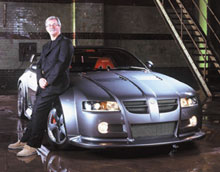 Peter Stevens designer of the McLaren F1 and the MG SV |
 Giordano Cassarini Chief Engineer |
Well the basic car may not have been that pretty, but the underpinnings were certainly more than competent, as proven by positive results from the US Trans Am Championship. It also opened a door to enter a market sector with a product that was already developed and certified, a route both cheaper and far quicker than would be the case for a new product. Then with a separate chassis this allowed a greater degree of flexibility to create an individual body design that would completely change the vehicle and allow it to take on a new identity, although certain fixed elements of the car would restrict a completely clean sheet of paper approach.
MG – Qvale connection
Qvale is a company that bears the name of its founder, Kjell Qvale, who formed a car business called British Motor Car Distributors in San Francisco after the Second World War. This was the first MG dealership on the West Coast of the US and it grew to become the largest distributor of British cars in the US. Qvale is a name that has long and deep association with MG as well as many other classic British sports car brands, including being the major owner of Jensen Motors in the early 1970s and having deep involvement in the Jensen Healey.
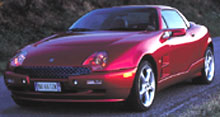 The Quale Mangusta |
MG X80 to MG XPower SV
The X80 was the first fruit of this transition executed by Peter Stevens and his hand picked team. The whole project was now separated from the main company with the formation of MG X80 Ltd, now MG Sport and Racing. The X80 concept model had the new MG frontal look with TF headlamp units, which perhaps seemed a little small on the expanse of body. Confirmation of the luke-warm reception was illustrated by the number of people who were applying their own thoughts to the official images of the X80 by using various computer graphics programmes.
There was then a pause to reassess direction, this was followed by concentrated development period, culminating in the arrival of the stunning MG XPower SV at the 2002 Birmingham Motor Show. The new look was much more aggressive, imposing, aerodynamically efficient, as well as light by employing carbon fibre in the body, produced using an innovative method of manufacture.
Aerodynamics are critical to the operation of such a high performance car, not just from the aspect of being able to efficiently cut through the air and reach high speeds for the available power; but more importantly to ensure that when travelling at high speed the car remains stable and firmly planted on the road. Another direct airflow consideration with a high performance car is that it is far more than just creating a shape that manages airflow over and under the car but also involves airflow management through the car.
Consider that this car starts with an engine producing 320bhp and think about the amount of heat that this engine will generate. Having the best aerodynamic shape will not allow sufficient cooling air to pass through the radiator and cool the engine, but to get air flow you need to not only have an access point but also a way to allow that air out again. This creates a range of conflicting needs, so to arrive at a design that looks both stunning and yet has full positive management of airflow is no mean feat, and why Peter Stevens is rightly positioned as one of the world’s best car designers.
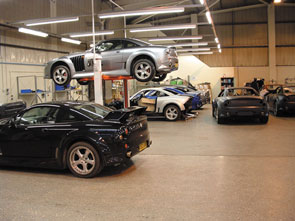 MG Sport & Racing preparation |
In designing the SV to be an MG, Peter has said that he doesn’t look to pinch styling elements of previous cars, such as a grille or some louvres, but he looks at the history of the company and what they were trying to achieve with the models they made. As the SV was to be a specified as a high performance technology buster, also with a clear eye of a possible competition career, one specific historic MG, the 1934 K3 Magnette, stood far above any other MG in following a similar theme. It has to be remembered that the K3 was a very expensive car for its day at £795. Simply transposing the 1934 price to today’s values and £795 equates to between £110,000 and £115,000 today! Affordable? Well, possibly when you start to look at the K3’s competitors of the period like Bugatti, which were far more expensive.
The cost of an MG XPower SV was initially projected to be from circa £65,000 and subsequently rose to circa £75,000. However, at the Geneva Motor Show in March 2004 prices were finally set at, ‘from £65,750 for the base model SV’ and ‘from £82,950 for the SV-R’. ‘From’, is the applicable term here, as a very wide range of SV options are available to take the car from the 320bhp ‘base’ SV, through to the SV-R’s 400bhp, with clear potential to reach 765bhp and with ‘talk’ indicating an ultimate target towards 1000bhp. Such steps cost extra cash and the higher the target the bigger the cost! This and the announced start price immediately caused many MG enthusiasts to simply dismiss the car as far too expensive, irrelevant and not in the MG tradition of affordable sporting cars. £65,750 is without question a very substantial sum and well beyond the means of many, so this up-market sector is an uncharted area for MG, or is it?
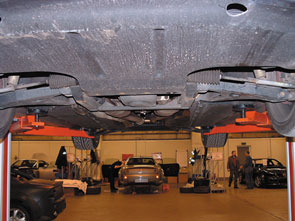 The view from the smooth underside of the SV |
Affordable MG?
Most enthusiasts’ perceptions of MG is as a maker of ‘affordable’ 2 seat open sports cars, yet history immediately shows that for every two MG open cars there has been one closed MG saloon car, so immediately these perceptions are undermined. This continues with examination of the word ‘affordability’, as it shows considerable variation of meaning depending on individual interpretation. Obviously, income is a primary factor here, but there are many differing demands on personal income to keep that variation wide.
Take the price of an SV at £65,750, which is comparable to many other current high performance cars. Here many SV competitors are more expensive, some very considerably, but some are cheaper, meaning comparative value assessment is very individual. Indeed, in plain financial terms, £65,750 is way above most people’s budget for a car, but how distant is this price tag compared to the classic MG values of their respective periods?
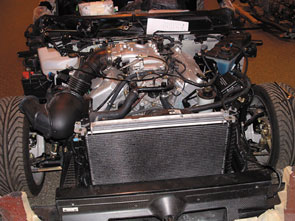 Double overhead cam, 4 valves per cylinder V8 engine |
Two purchases usually dominate most people’s lives, houses and cars, and the two have often been inextricably linked. It seems reasonable then to make some comparisons between (UK) house and MG model prices over the decades. The house price values I have used are based on UK Government statistics and record average house prices since 1930. Against these, I have used the published retail prices of various MG models in the same year. Clearly there are a number of variables, such as vehicle taxation and geographical property value fluctuations, but the bottom line is that the figures provide a reasonable representative means for comparison over the decades.
In late 2003 Government figures indicated that an average house price in the UK was £150,000, which makes a £65,750 MG SV 44% of the value of that average house. The SV is rightly compared to the 1930s MG K3, but if we look at the average house price in 1934 against the new cost of a K3 we see that the K3 is 150% of the cost of an average house! Perhaps something of a surprise to show that SV is better comparative value than a K3, but then the K3 was always a very rare and expensive road racer, so what about more representative production MGs? Let’s look at the opposite end of the MG range to the M type Midget. In 1930, this entry-level car was still some 42% of the value of the average house, just short of the SV figure! Surprised? I was.
Many social differences applied in pre war days so let us move forwards a couple of decades to the MGA of 1955 when the UK economy was rising out of post war gloom. The MGA is clearly regarded as an affordable MG, yet when it was introduced it cost 43% of the then average house price. A Coupe of 1957 saw that increase to 47%, and the 1958 Twin Cam Coupe was 57%. I was not expecting this and had to double-check the figures. This high cost ratio continued into the 1960s during which taxation reductions allowed MGB and MGC values to reduce to between 27% and 35%, but that is still much higher than most perceptions. Lastly let’s look at the more recent MG RV8, which has always been regarded as an expensive MG at £26,500 when introduced. This ‘new classic’ MG was at 42%, much the same relative value as the SV!
Although not strictly relevant to this feature I do have to mention the relative values of today’s mainstream MG ranges, as they are such incredibly good value. Bought on the MGOC Privilege Purchase Scheme an MG ZR105 is just 6%, a TF 135 just over 9% and a ZT 260SE under 20% of their value against the current average house price.
Taking another slightly different viewpoint and looking at the typical budget spent on ‘family’ cars today can also make interesting reading. Just add up what you have spent on your car(s). I expect it to be in the plural as multi-car ownership is the norm rather than the exception. Then just look at the driveways of so many houses and mentally add the cost of the cars you see and many will be in excess of £30,000. Now consider that classic MGs are now mostly ‘recreational’ cars rather than daily use cars, so this is an additional expense on top of the family cars so add this value to the previous total. The total is certainly a very considerable sum and indicates that cars of the SV price range are perhaps not as far out of reach as they may appear.
Residuals
So far, I have concentrated on the price of a new SV, but a reasonable concern for any potential owners has to be its residual value, and in this respect many limited run sporting cars have shown up very well. Using the MG RV8 as a recent example with clear low volume and high model profile similarities reveals that after 10 years, this model was able to maintain approximately 50% of the original value. In motoring terms this is exceptional when the best that can usually be expected with mainstream sports cars is 50% retained value after 3 years and above 40% over the same time is good for saloons. Do remember that the original RV8 price was generally perceived as overpriced, so overall it is not unreasonable to expect the SV to mimic a similar retained value performance.
The MG XPower SV is intended to have a four-year production life with a maximum planned capacity of up to 250 cars per annum. With a slowly increasing start to production and a slowing down towards the end, it is expected that total SV production will be in the order of just 850 cars. Even if production is extended, production totals will still be small and as such, all will remain rare and exclusive. That is almost certain to guarantee enough buyers for all the cars made. In fact, Peter Stevens in his design philosophy has said that he expects the bold styling to offend some potential buyers, whilst attracting others, the general view being that he has created a design that is attracting more than it is offending.
Roger Parker
Part 2 concludes the SV story with more details of its design, manufacture and innovative specification.
| Specification tables | |
| Initial Entry Level – MG Technical | |
| TECHNICAL Engine: 4.6-litre V8 Material: All aluminium alloy Valves: Double overhead cam, 4 valves per cylinder Compression Ratio: 10.0:1 Power: 320hp SAE @ 6000rpm (230kW @ 6000rpm) Torque: 410Nm @ 4750rpm (302 lb.ft @ 4750rpm) Transmission: 5-speed manual Tremec gearbox Electronic Traction Control PERFORMANCE(estimated) Top speed 165mph (264km/h) SUSPENSION STEERING WHEELS TYRES BRAKES Bosch 5.7 electronic ABS 324mm diameter ventilated and cross-drilled front discs 310mm diameter ventilated and cross-drilled rear discs BODY CHASSIS DIMENSIONS Cd: 0.38 |
UNLADEN WEIGHT 1540kg (estimated SV STANDARD FEATURES EXTERIOR
INTERIOR
AUDIO
ELECTRICAL
INSTRUMENTATION
SAFETY & SECURITY
CLIMATE CONTROL
SVR |