MGA – Australian Adventure
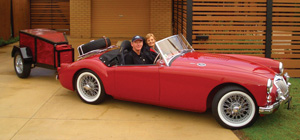
In 2007 Dave and Laurel Godwin set off on an epic journey across Australia in their MGA. Part One of their adventures
When I said to one of my staff ‘I may do the Peking to Paris run in my MGA in 2010’ he replied ‘You will, you always do what you say you will.’ I didn’t realise I was that transparent. Well, in late 2006, we decided (or more accurately, I decided and Laurel, thankfully, agreed) that we should do the right thing, travel our own Australia first. Besides, it would be a good training ground for the real thing, Peking to Paris.
By way of preparation, ‘RIP’ our beloved Monza Red, (Australian MGA colour), 1961 MGA, was stripped to the bare chassis and rebuilt and painted. Not that it needed such a thorough rebuild, but I was desperate to learn as much about ‘RIP’ in as short a time as possible. Someone mentioned camping, I think it was Laurel, so a trailer was sourced. Being towed behind ‘RIP’, there was no choice; it had to be converted into a coffin shape. It’s hard to believe that we needed so much stuff for the trip. The boot was full of tools and spare parts, while the coffin was full to the lid with clothes and other necessities.
The Godwins leaving for Aussie trip
So, on Wednesday 11th July 2007 we left Runaway Bay on the Gold Coast, and headed for the hills, Toowoomba Hills. We spent our first night in a hut at Jondaryan Wool Sheds, 45km West of Toowoomba. ‘RIP n’ Coffin behaved themselves and the wool sheds were laid out well and worth a visit. The next day was perfect, but cold. We had Billy tea and damper before heading off for lunch at Dolby and the night in Miles. We booked into the same motel that we stayed in on our very 1st weekend away with the Gold Coast MGCC three years earlier. There was still a ‘thankyou’ letter on their notice board with a picture of our MGs.
Friday dawned with frost on ‘RIP n’ Coffin but she still started first flick and we headed for Carnarvon Gorge. Laurel and I were awed by Carnarvon Gorge, taking time out to explore the interesting footpaths, although the 25km we walked was totally excessive for our unfit bodies. We left for Emerald, promising to return one day. So far, our trip had been in perfect, top down, motoring weather but it was too dangerous to speed with so many traffic police on the roads. Also, many kangaroos had met an early death, providing food for large flocks of birds. We passed two groups of drovers on horseback, each with over 100 head of cattle, real cowboys.
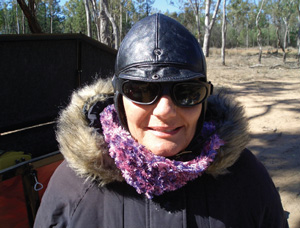
Laurel all rugged up
‘RIP’ did have some minor problems, the white wall inserts started to peel off from the tyres so we had to have them reinstated at Beaurepairs at Miles; the heater fan blade was touching something; the CD player stopped working, the removable face being partially disconnected. Nevertheless, ‘RIP’ pulled like an ox, had no oil or fuel leaks, cruised at 3000rpm, 63 mph, 60 psi oil pressure and 175 Degrees Fahrenheit all day but was a bit thirsty at 25 mpg. The RX7 seats were absolutely fantastic and ‘RIP n’ Coffin was a constant attraction and source of conversation everywhere we stopped. I can’t tell you how many people told us they do/used to own an MG/MGA and wish they had kept it, etc.
After a tour through an underground Ruby mine at Rubyvale, we headed for Longreach, with a bit of a scare when a strong petrol smell led our noses to a stream of petrol pouring out of the rear carburettor overflow pipe.
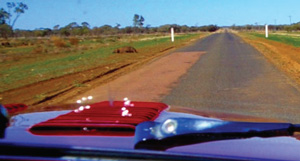
Another dead Roo on road
Thankfully it fixed itself, so we had a good trip through to Barcaldine. There were lots more dead ‘roos on the road due to the road trains just ploughing through them without stopping. The road maintenance teams simply clear them off the road where the eagles and other scavengers clean up the body in a day or so. These road trains are massive, over 50 metres long with three trailers behind the prime mover and its own trailer. I never really got used to them passing us at 110kph.
We usually had a picnic lunch along the road amongst the little black flies, we had to check our food before we took have a bite. They really cater for the travellers, with stopping points and picnic tables under cover every 50 miles or so. As you can imagine, there are lots of open spaces; the roads tend to be straight with vegetation of small scrubby trees, a little boring but Laurel tended to sleep a bit and read, heaps, so the trip passed quickly.
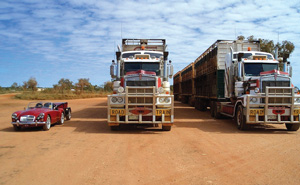
Roadtrains versus RIP’n Coffin
At Longreach we found a little 100yr old cottage, built of mainly corrugated iron and stayed two days there. It was great, just like old farm days, with a dunnie (toilet) outside and all. Reaching Longreach was the first goal of the trip so I took a photo of Laurel filling in the route on the map on ‘Coffin in front of the Hall of Fame. We then headed off to Winton, a very isolated place. If it wasn’t for the “Waltzing Matilda Museum”, there would be nothing there. The Artesian water was smelly (rotten eggs) but tasted OK. Next came an exciting bit of the trip, trying our luck fishing at Karumba in the Gulf country.
We found a small motel on the beach front at Karumba and witnessed a beautiful sunset over the Gulf of Carpentaria. Here we set off aboard the ‘Kerry D’ to catch some ‘Barra’ but soon found out that the barramundi only visit the Gulf during the summer months. However, it was okay, because the skipper found a school of mackerel, of which Laurel caught six and David only two. As fishing at Karumba was our second goal, we updated our map on ‘Coffin in front of a Big Barra with a well earned glass of wine.
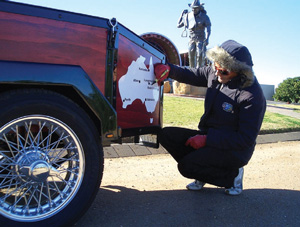
Our first goal recorded
Then it was time to head west. The trip from Karumba to Cloncurry, then Mt Isa, was a breeze with the sun behind us all the way. The only small problem was an over zealous ‘Grey Nomad’ (old caravaners) flinging up a stone and cracking our windscreen. Ouch. We planned to have it replaced in Perth if it didn’t disintegrate before then.
We spent the night as the only guest at the Mt Isa Hotel, we were even given the key to the front door and were asked to be sure to lock it when we went out for dinner. Unfortunately, it didn’t fit the bar door, you know I tried. We then pushed on to Three Ways and turned south and booked in at Tennants Creek for two nights. This was the start of our ‘Cultural’ experience where we met various Aboriginals and learnt something of their culture and their art. We also got permission to enter their property one afternoon and canoed on a lake until well after sunset: then we talked around a fire until late, a beautiful experience in the outback.
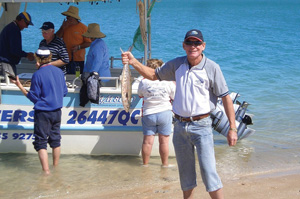
Holy Mackeral at Karumba
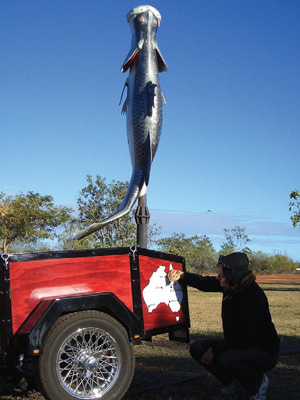
Recording second goal
We then headed south a few hours to spend a night at Wauchope (pronounced ‘walk’ ‘up’) and The Devils Marbles. These are a collection of large rocks balancing precariously on top of each other. This was a special night, as the Devils Marbles had been successful at being placed on the Australian Monopoly board, over other competition, such as Uluru (Ayres Rock). It’s a spiritual place for the Aboriginal people and an 80-something year old Aboriginal Elder gave us a two hour talk around a fire about his tribe, his youth, the effect of the arrival of the White Man, the motor car and his view of the future of the Aboriginal Culture. To top it all off, a dingo arrived at the outer edge of the circle of people, sniffed around a little and trotted away again.
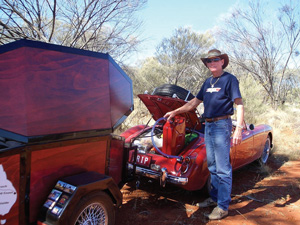
288 miles on 10 imperial gallons
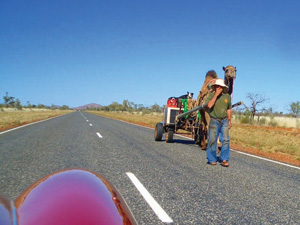
Mad camel and German
Next we started the long drive south, away from the sun, (thank goodness.) to Alice Springs. Being a Sunday, we treated ourselves to a tasty cooked breakfast at the first roadhouse we reached before pushing on and running out of fuel…. Now I know that ‘RIP’ can do 288 miles (450km) on a tank-full. Luckily “Davey Crocket” is a planner and had 20 litres of fuel in ‘Coffin, so the delay was short and the trip made more exciting.
If we thought we were doing it tough, we weren’t. We met a German chap walking northwards with two camels in tow, plus a trailer and a Kelpie dog. He had left Adelaide five months earlier and visited Uluru and many other places on his way up to Alice Springs, and was on his way to Darwin, a 3000km journey. What do they say about mad dogs and Englishmen? This was mad camels and Germans.
To be continued…