MGB GT 1966 – Test Car
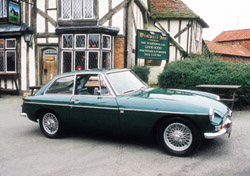
MGB GT 1966
The ‘Motor’ Magazine Test Car
Provenance
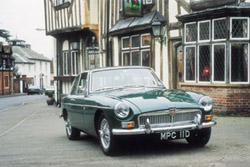
History is everything when you try to assess the value of a classic car. Especially when the car in question is an early MGB GT that was originally featured in the ‘Motor’ magazine as one of their long term test cars. Not only that but here is a BGT that also found fame again years later when featured in ‘Classic Cars’ magazine after undergoing a meticulous restoration. This special BGT belongs to MGOC member Cliff Woodthorpe. Last December Cliff wrote to me to relate the complex story behind his remarkable car.
Proud owner
Cliff had studied the market and had been looking for an MG for some time; he had developed quite an experienced eye for a sound car and a astute appreciation of exactly what he was looking for. When he first saw the car he was totally captivated and decided to buy it, although at the time he was quite unaware of the BGT’s extensive history and distinguished past. He bought the BGT because of its exceptional condition. The car had clearly been expertly restored and Cliff realised at once what an remarkable vehicle this was, he had already looked at too many other GTs which were either rotten underneath, badly restored, over rated or over priced. Cliff’s appreciation of the car’s condition was only matched by his delight at finding it for sale at a price he could afford. So it was that MPC 11D found a new home and a truly appreciative and enthusiastic owner.
However buying this BGT introduced Cliff to much more than just the acquisition of a desirable classic. The car brought Cliff into contact with John Day, who had restored MPC 11D to a very high standard in 1988. John is a well-known MG owner/enthusiast who has spent many years driving and restoring a wide range of MG cars; currently John’s collection includes an18/80, an MG Magna and a supercharged TD.
John’s story of ownership and restoration
John bought the GT in June 1988 as a restoration project for £200. Stored in a barn for many years the car had been pulled out only when space was needed, John’s first sight of MPC 11D was not inspiring and he bought it principally to save it from being scrapped. At this point John was unaware that the BGT had an interesting past, but the fact that it still had its original green logbook was a definite extra incentive for restoration. Unusually for a barn find, what was left of the bodywork was in sound condition. This is because it had already been partly dismantled, with the rusty metal cut away while the remaining sound panels had been well primed with red oxide paint before storage. During the summer of 1988 John began by replacing the sills. In addition the body also required inner front wing repairs, a new boot floor and new full rear wings along with a new rear valance. The original offside front wing was re-used but a complete new wing was required for the other side. Doors were stripped back to bare metal and resprayed and re-fitted. Throughout all this work John kept a careful photographic record of each stage.
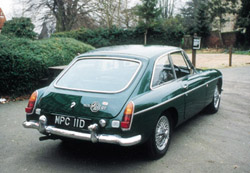
Initially John’s intention was not to build a high quality car but a good everyday vehicle. However on a chance visit to a concours competition at Chigwell north London in 1988 John spotted a beautiful original unrestored MGBGT in mineral blue. With the owner’s permission photographs were taken from every possible angle and a detailed study was made, thus equipped John decided that he was going to build MPC 11D up to the best standard he could achieve.
After all the welding was completed, the body was then very carefully primered, John applied two primer coats, then sprayed on a guide coat and blocked the guide coat back. All the low spots were thus shown up as untouched by the block. The depressions were then filled and the process repeated. John went through as many as 8 or 10 coats before he was satisfied. Once satisfied with the primer John researched the original colour and discovered that it had been British Racing Green GN29. This is the lighter green of the many shades of green that come under the heading of British Racing Green. In all John applied 14 coats, which he blocked back with wet and dry, every two coats. In total the spraying took three months of painstaking work, however eleven years later the paintwork on MPC 11D still looks excellent. In addition to the care with which John tackled the visible paint he also stripped the underside and painted it with Bondaprimer and Hammerite then applied 3M Bodyguard anti-chip paint before final spraying.
The paint finish on MPC 11D is all the more remarkable when you learn that John sprayed the car entirely by himself in his own garage applying cellulose paint with a Bosch airless spray gun. This choice of the airless spray gun, which John describes as being more suitable for spraying a fence than a car, is explained by its only real advantage over more conventional spray systems. It is able to deposit a large quantity of paint onto the car without the need for compressed air, which only serves to stir up dust in the garage. The chief ingredient in the immaculate paint finish on MPC 11D is many months of hard work; spraying, blocking back and then spraying again, it is this gradual build up of coats gives great quality and depth to the appearance to the paint.
After the thoroughness of the attention John had applied to the painting the body it comes as no surprise that he also decided to powder coat as many parts as possible. All the front suspension was dismantled and powder coated including the wishbones, spring pans, brake back plates anti-rollbar and crossmember. On the rear axle the differential case was coated along with the brake drums and brake back plates. While the splined hubs for the wire wheels were restored by zinc plating. As a matter of course, all fasteners, brake pipes and rubbers were also renewed.
All the chrome trim was stripped and sent the platers, although John admits this is was more expensive than replacing with new parts, he felt it was important to retain the original parts and that the quality was excellent.
Typical of John’s attention to detail, the new number plates were to be of exactly the original specification and because of the shortage of letters it took the company who supplied them two months to collect enough of the right letters to make both plates.
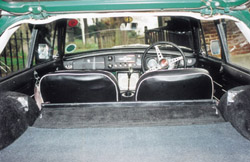
John describes the work on the trim of the car as the area where he spent the most hours and the least money. In his quest for originality he was determined to use what came with the car, although ten years in the barn had taken its toll. He had to give up on the carpets, as they had become rotten and frayed but these were the only trim items replaced. The remainder of the interior was kept as original, seats, door panels and cappings and also the roof lining. It took months to soften the leather seats and then considerable hand stitching to repair them; he also made up new hardboard panels for the trim. John explains that this was not cost effective but well worth it, because in his opinion, the car’s interior was able to retain that unique aroma only the years can give. Now Cliff owns the BGT it has new leather seats but the originals are still around, not surprisingly John thinks Cliff should re-fit them.
 John’s aim of retaining as much original equipment as possible was also applied to the mechanical components; the engine was stripped for examination. It was found that the bores were already + 0.030 and with an indicated 78,000 miles on the clock it was considered more likely that the car had covered 178,000 as the engine needed another rebore. All the engine parts were taken to E&A Roberts of Whitwell, who have been restoring engines for over 60 years. After inspection it was decided that the crank could be reground -0.030 on mains and con rod bearings. However the bores would need a 0.020 rebore and +0.060 pistons. Circlip type pistons were not available from Rover so it was decided to use Lotus power max pistons and bore the engine out to 1900cc. Roberts also balanced all the rotating parts including the clutch. The cylinder head was sent to Peter Burgess for gas flowing and converting to run on unleaded petrol. A Kent 714 cam was also fitted giving better timing and an improved power output without degrading driveability.
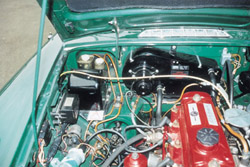
 The chief object of the engine rebuild was to create a reliable efficient uprated unit with no external changes. When Cliff took me for a drive in MPC 11D recently it was quite evident that the GT has plenty of punch and yet it is still smooth and tractable. The same attention was applied the engine bay where the detailing was carefully observed, John paying particular attention to the pipe runs.
The gearbox that came with the car was the original 3 synchro non-overdrive box. John was familiar with overdrive and non-overdrive boxes and would prefer to upgrade to overdrive. The original gearbox was stripped for examination and found to be in excellent condition (evidence of careful use by the previous owner) and so John decided to build the overdrive unit onto the original box with all new bearings, synchros and seals, and retain as much originality as possible.
John’s philosophy on restoration is interesting; he says that anyone who has completed a restoration will admit that they could do better if they tried again. He had previously restored an MGC, which he believed to have suffered from over restoration, being too perfect to use. John was anxious not to follow the same route with MPC 11D he wanted to retain every part that was not beyond repair and build a car that would be durable, usable but as original as possible.
In April 1991 the first event that John attended with the finished car was Waddeson Manor Bucks where MPC 11D came out as ‘Car of the Show’. Various people commented that MPC 11D had been the long term test car used by Michael Bowler and featured in ‘Motor’ magazine in 1966. All this was tremendously exciting and led to ‘Classic Car’ magazine becoming interested and wanting to do an “25 years on” report with Michael Bowler.
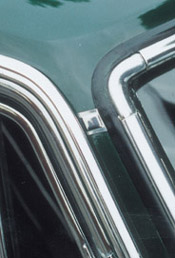 Motor Test Car
Michael Bowler’s test reports from 1967 make familiar and fascinating reading for any fan of the BGT.MPC 11D was bought new and displayed a few minor faults in the first 250 miles: a curious clonk when braking, misaligned exhaust system, an oil pressure gauge that became frantic at idle and the clutch wouldn’t disengage properly first thing in the morning. It seems that even in 1967 new MGs were not without niggles on delivery. Overall Michael Bowler was impressed with the car he made a few notes on his first opinons. He like the smooth torquey engine which overcame the gap between second and third gear which he considered too wide. The BGT surprised the motoring journalist with its quietness when underway even with the side windows open. He found the heater controls confusing because of the symmetry of the design making them difficult to operate by feel; he also found the heater output disappointing. But he liked the fresh air flaps that blasted cold air into the footwells. The ride of the BGT was described as rather firm, especially at the rear but Bowler felt the harsh ride was a price worth paying for the excellent road holding “the car just went round corners remarkably smoothly and quickly”. He found the standard steering wheel too big, he later fitted a leather rim Formula steering wheel. Only an inch smaller in diameter but this made for much more elbow room and manoeuvrability. He was not keen on the method of adjustment for the seat backs but loved the access through the rear door. The plastic interior door handles did not impress and one was to eventually break off at 15,000 miles .
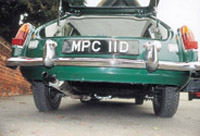 “Clean underbody shot reveals the extent of thorough restoration plated parts proving resistant to corrosion” |
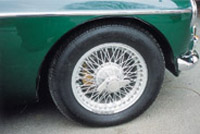 “The BGT was originally fitted with steel wheels but John upgraded to wires during the restoration” |
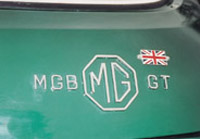 “MGB tailgate badging getting octagonal the message across” |
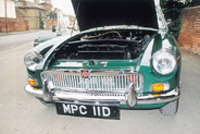 “Brightwork is still very impressive ten years after re-chroming” |
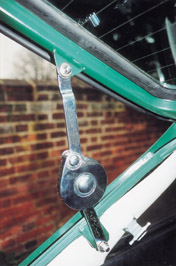
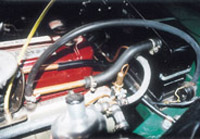 “MPC 11D is fitted with the early D-type overdrive unit” |
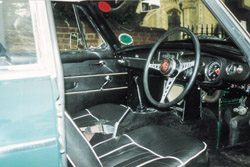
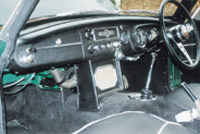 Interior shows attention to detail and the fresh air flap in the footwell praised by Michael Bowler is clearly visible” |
 Long term observations on the BGT
As the mileage increased and as his experience of the car grew Michael Bowler noted various characteristics of the GT. Tyre pressures for example were significant in terms of the steering effort and road holding, he found that rising the pressure from 21 to 24 lbs at the front and 26 to 29 lbs at rear improved steering, even though the ride became harsher. He also noted that the performance figures he was able to achieve were better than the original ‘Motor’ road test BGT, he managed a top speed of 107.1 mph and 0-60 time of 12.2 seconds, MPC 11D was then in completely standard tune. Fuel consumption averaged out at 25mpg with a best of 30 mpg, not bad with an enthusiastic motoring journalist behind the wheel.
After 6,000 miles Bowler took the GT over to the Isle of Man where he entered a hill climb at Tholt-y-Will. Despite the fact that the car was overdue for a service it performed exercise taught me just how quickly the car could be hurled around without any drama other than self-correcting tail slide.” While still on the Island he also recounts “I was pounding the BGT around the TT mountain course with an indicated 110mph on the clock, the brakes faded right out and no amount of pressing would slow the car below 40mph. Fortunately it was only a 41mph corner, so we survived.”
 It also interesting to read that in Bowler’s view petrol was a key factor in the B’s performance. “The B runs quite happily on its standard settings with 98 octane, but with anything less it pinks, runs on and the plugs wear; currently I mix the poor stuff with 101 octane at every other refill.”
After a Crypton tune Bowler entered the Cambridge University AC Slalom at Snetterton where he hoped to compete with his friend with an open B to determine which was the superior car. “The Slalom is a series of short sprints scattered around the Snetterton circuit. Damp conditions were ideal for everyone to have some driving on the limit without going too fast; on this type of surface the B steering is first class and transmits plenty of feel as it floats around on the threshold of adhesion. I managed to uphold GT honour, but there were too many variables to assess whether or not the car was faster, the tyres gripping better or what.”
Michael Bowler’s final comments on MPC 11D sum up the car and its abilities really well. “After 12,000 miles the MGB GT still gives as much pleasure to me as it did initially, having performance for enjoyable driving, flexibilty for lazy driving plus extremely good roadholding and stability; despite exploitation of this, the tyre wear has been very reasonable and the life of the set of five SP41s looks like being 24,000 miles. Oil consumption has averaged out at 700 miles per pint and there is no bearing rattle when starting from cold. Fuel consumption has averaged 24 mpg. In fact the car is going so well that I am sorry the fairy godmother who granted it to me has now decreed that I should have something in which it will not be such a strain to observe the 70 limit. The B is one of those effortless fast cruisers that force you to watch the speedometer on the open road- and the mirror.”
 In fact Bowler managed to hang on to MPC 11D for another 19,000 miles. At 14,000 the tailgate lock broke and at 15,000 the water temperature gauge ceased to work. A rear exhaust mounting bracket also broke. At 18,000 miles an ominous increase in tappet noise turned out to only be a missing rubber grommet in the firewall, allowing a lot more engine noise into the cockpit. When he finally handed over the car at 19,000 miles the only fault apart from the still unrepaired water temp gauge was another exhaust split, this time where the twin downpipes join.
From this point at 19,000 miles MPC 11D was handed over to another ‘Motor’ journalist Tony Kydd. During his tenure the GT suffered a puncture and he changed the wheel without difficulty but encountered problems when replacing the punctured wheel in the bay under the rear deck. He concluded that you either need three hands or a makeshift stay to accomplish this task. The awkward position of the foot operated dip switch also caused adverse comment as did the intense cabin heat in summer, (I wonder if ever he found the ventilation flaps). After 24,000 miles MPC 11D was finally sold on with plenty of life still left in it.
B Re-Union
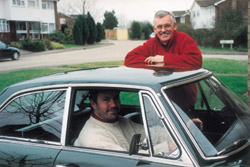
In 1991 ‘Classic Car’ magazine became interested and decided to run a feature on the rebuild of MPC 11D and reunite the car with Michael Bowler and introduce him to restorer John Day. Bowler describes being quite excited at the prospect of seeing the car again, “of all the cars that I ran on ‘Motor’, the MGB was the only one that would tempt me to buy it again”.
At their first meeting Bowler presented John Day with the smaller diameter leather rim steering wheel mentioned in the road reports. On the day of the re-union Bowler was accompanied by motoring photographer Maurice Rowe, who is also well known to MGOC members for his stunning race pictures and regular attendance at MG events. Maurice too had covered many miles in the car during Bowler’s tenure. Bowler was very impressed with the quality of the restoration and marvelled at the story behind John Day’s efforts to return the car to its former glory.
Driving off in the BGT with Maurice beside him Bowler describes the experience as an instant flashback, as they had covered so many miles in the car together chasing the GP circus. Bowler also liked the fact that they were sitting the original seats, so painstaking revived.
The care with which John had sourced the number plates caused Bowler some amusement, as he had discarded the original rear plate in favour of the Fablon stick-on variety then popular, to avoid barking his knuckles when washing the car.
Present day
Now MPC 11D resides with Cliff Woodthorpe who really savours its history and takes his role as custodian seriously. The car is obviously well cherished but gets used regularly. He drives it with flair, exploiting the extra performance from the uprated engine to the full and getting the best from the B’s predictable handling. I am particularly grateful to Cliff for tipping me off about his great car and its fascinating past and also to John Day for sharing his experiences with its painstaking restoration.
Cliff now has plans to rebuild MPC 11D’s gearbox and he is looking for an early 3 synchro unit to play with, if anyone has such a unit then please contact the Club.
Managing director’s car
 “We’ve produced a motor car now in which no managing director would be ashamed to turn up at the office,” is what John Thornley of MG said about the BGT to ‘Motor’ in 1966. The BGT has a unique appeal in that it is a genuine grand tourer which provides useful extra accommodation for small children. Executed by Pininfarina the GT fastback design won universal acclaim and remains a true classic.