MGB V8 Roadster Supersports (part 3)
MGB V8 ROADSTER SUPERSPORTS
Part 3 – Handling & Braking
With 265bhp being delivered to the rear wheels of a sportscar originally designed in 1960 with a power output of approx. 85bhp, the next consideration has to be improving the braking and handling. Using the latest modern technology and materials, the V8 Supersports rises to the challenge, and demonstrates that by using readily available components, handling and braking can be uprated to match the car’s exhilerating performance.
Front Suspension
There are a number of different solutions to consider, the easiest of all is to replace the front crossmember, (complete with brakes and suspension fitted) with a British Motor Heritage Front Crossmember. This was developed from the RV8 design and features coil over suspension with telescopic shock absorbers, and enhanced steering geometry by having replaced the MGB’s original king pin system with modern ball joints. This gives lighter and more precise steering. Brakes are enhanced by the fitment of four-pot callipers and ventilated brake discs, providing better response and stopping power whilst the vented discs help to prevent brake fading under extreme conditions. The fitment application is wide ranging and units are available for all MGB & V8 models of both Left and Right Hand Drive, supplied with either standard steel wheel or splined wire wheel hubs. Fitment is direct to the body via four crossmember mounting bolts, leaving only the steering rack to be re-fixed to its new mountings, and the brake pipes to be connected. In summary, this is a straightforward way of professionally upgrading front brakes and suspension in one go. The handling characteristics of this set up is as you would expect, strongly similar to the RV8 with quite soft springing and as such, suits a touring style of driving better than the kind of hard cornering, enthusiastic styles sometimes exhibited on the race track.
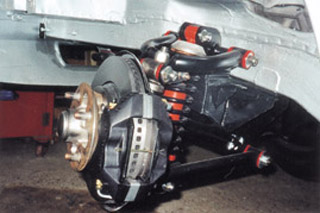
Next is the preferred choice for the V8 Supersports which is the MGB adjustable telescopic coil-over front suspension kit which is featured in your latest MGOC Accessories Catalogue. This kit is professionally engineered using tubular wishbones to close tolerance. The units can be assembled using urethane bushes for precise handling, comfort and durability. A feature and specific advantage is that adjustment is built into the components to allow the camber and castor to be set to match the individual driver’s preferance. Springing and damping are provided by coil-over units using Avo shock absorbers, and the overall length of these units are sufficient to provide adequate travel for correct operation. The degree of damping on the shock absorber is adjustable, again to suit driver preference, and being a coil-over unit, spring height adjustment is available to accurately set the ride height and level. Spring tension is not adjustable, but fitting replacement springs to different poundage is inexpensive and simple to carry out.
A modified crossmember is required and this is available on an exchange basis.The kit re-uses the original MGB king pin steering, and in all cases reconditioned exchange units should be included in the installation.
To complete the job, a 7/8″ front anti-roll bar together with urethane mounting bushes and brackets are fitted to control body roll when cornering.
This option is best summarised as a modern tubular steel suspension kit, which allows full adjustment to suit every driving preference. When set up using the infra-red vehicle alignment equipment used at crash repair centres, the best and most accurate front to rear wheel alignment can also be set. This advantage outweighs the need to retain the original king pin steering, which in practice works perfectly well, if maintained and greased properly at normal service intervals. A wide range of brake options can be used with this option.
Finally in this section, there are bolt on type telescopic conversions from both Spax and Koni, which require the removal of the valve in the original lever arm suspension units, allowing the fitted telescopic shock to take over. In practice these work very well, but again the stub axle assemblies and wishbone arms should be replaced. Urethane bushes should be fitted and the original lever arm shock should be checked for wear in the spindle. Again a 7/8″ anti-roll bar and urethane mounting bushes should be fitted. There is only shock absorber adjustment using this equipment, and the action of the shocks and springs is less efficient than with coil-overs. It is the least expensive of the options listed here.
Front Brakes
The front braking system chosen for the V8 Supersports project is a four pot calliper and vented brake discs kit manufactured by Willwood. This features the kind of billet callipers seen on many high performance modern saloons, and is a bolt-on kit which is assembled directly onto the original MGB stub axle. The brake pads supplied are a fast road type which operate from cold. A set of stainless steel overbraided brake hoses complete the installation. If you have access to any original MGB V8 callipers, Tarox offer six and twelve slot discs which help keep the operating temperature down under heavy braking.
Rear Suspension
It is well known that the rear end of an MGB has a tendency to oversteer under heavy cornering, and taken to its extreme the rear wheels will lose grip and break away causing the car to turn itself into a spin. Some of the root cause for this is inevitably inherent in the chassis design, but there is much that can be done to improve on the original steel leaf springs and the lever arm shock absorbers. Starting with the springs, the shortcoming here is that the flexing of the individual leaves, and the collective flexing of the spring as a whole assembly is less even in its operation than the coil springing of modern independent rear suspension. The American car enthusiasts realised this with their big Camaros and Corvettes, and overcome the problem by using composite fibreglass springs, which have the positive advantage of being even, accurate and durable in their rate of springing. As such, they do not lose springing rate and consequently do not progressively sag after prolonged usage. Being made of fibreglass, they weigh only a couple of kilos, providing a significant weight reduction advantage. The overall thickness of the spring is reduced to the extent that composite spacer plates are needed to build up the thickness between the axle U bolts. This allows adjustment of the lateral levelling of the car so that by placing the spacers above or below the spring, the car can be set level thereby overcoming the leaning attitude seen on many MGs.
The springs are very strong. They won’t stand being struck with a hammer or used to attach towing ropes, but after prolonged testing both in the UK and America over very bumpy and pot-holed roads they have proven a great success. Having evened out the springing, there still remains the problems of lozenging and tramping. Lozenging is the twisting effect that happens to a leaf spring when a car is cornering hard and the lateral centrifugal energy created by the weight of the body is resisted by the grip of the tyres to the road surface. The latent energy searches for the weakest point in the chain and finds the length of the road spring. This, whilst bouncing up and down to compensate for the road surface, is now also coping with lateral twist which changes its springing rate relative to the forces being exerted.
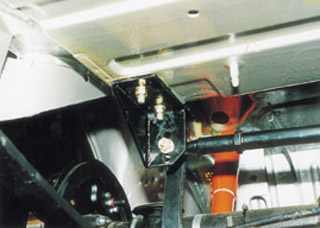
The car body also moves out over the axle at the same time, causing an exaggerated weight transfer. This unnerving imbalance is transmitted to the driver as oversteer. The lozenging of the springs and body dislocation can effectively be controlled by fitting a panhard rod. This is an adjustable length steel rod mounted laterally, parallel to the rear axle. It is connected at one end via a urethane bushed joint to a bracket mounted to the chassis. At the other end it is connected again via a urethane joint to a bracket bolted to the axle. This rod allows free movement of the normal spring action, but prevents any lateral movement, thereby controlling the problem.
Tramping is where loss of grip occurs at the rear wheels, due to an inability of the rear springs to absorb the engine power being transmitted to the rear wheels without flexing and rebounding. Stress is exerted onto the springs by the force of engine power rotating the rear wheels clockwise setting up a similar force onto the axle in the opposite direction,(ie. anti-clockwise). It is when this force meets the springs that the flexing and rebounding known as tramping occurs. By fitting RV8 lower spring/tramp bar mounting brackets and the RV8 anti tramp bars, and connecting these to the special reinforced anti tramp bar mounting brackets originally built into the V8 Supersports bodyshell, this energy becomes restrained by the anti tramp bar and the car body and is not released by tramping. The result is that all the power is transmitted to the road! Shock absorbers are important, and Koni rear telescopic units are fitted for efficiency and smoothness of operation. They are adjustable to suit individual ride/drive preferences, and by design operate more effectively than the original lever arm type.
Rear Brakes
Given that most of the braking is done at the front wheels, the rear requires less consideration, but by fitting Tarox slotted brake drums cooling can be improved to help retain braking efficiency during sustained heavy braking. Competition brake linings are also available if required. A popular modification is to fit competition rear wheel cylinders. These are actually smaller in capacity than the originals and as such are less effective with the result that more energy is directed to the front wheels where it can be made more use of. On an MGB roadster, this also helps to prevent rear wheel lock up which can occur when heavy braking transfers so much car body weight to the front end of the vehicle that even the less powerful rear brakes will lock the wheels and the car will lose grip and control. On the V8 Supersports the original rear wheel cylinders are retained as the front end brakes are significantly uprated and a correct balance has been reached at an all round improved level. The car will use 215/45 X 17″ Z rated tyres to extend the grip factor to match.
Wheels and Tyres
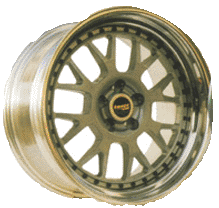 A car only ever looks as good as its wheels, and by choosing 17″ HT design composite three part aluminium rims the appearance is guaranteed to be stunning. The more serious aspect is that the rims are made to size to make fullest use of the wheel arch clearances to allow the widest possible tyre fitment. By turning back the wing lips on the rear wheel arches, and by using a wire wheel axle casing (approx 1″narrower) with steel wheel hubs, a maximum 7 1/2″ rim width with 215/45 X 17″ Z rated tyres are being used for this car. It is interesting to note that by measuring wheel arch clearances, the offsets for the wheels on this car are different, being more at the rear than the front. This will give the impression of greater width at the rear, albeit in fact, they are all the same. The grip and speed rating of these tyres are well up to specification for the application, whilst the 45 profile (tyre wall height) gives the correct combination of comfort and performance. Having now outlined in detail the high standard to which handling and braking have been be improved, the next stage is to install the car ancillaries before fitting a luxury interior.
For more details of any of the components used in this project telephone MGOC Spares and MGOC Accessories on 01954 230928 or 01954 231318