The Modern MG Engine part 1
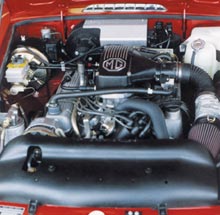
Of the many passion generating aspects of the car the most significant is the engine. The power plant is its heart and soul. Ensuring that a car has the right heart goes a considerable way towards its overall success.
Engine development has always been an expensive and time-consuming operation. Over the 80 years of MG’s existence engines have come from the parent group’s ranges, and in most cases the MG specification has involved tuning the base unit to extract more power and torque. Placing the MG specification on top of the performance tree has often hidden the fact that the same units are usually more common under other bonnets (hoods). This hasn’t detracted from the engine being regarded as an MG engine, even when the MG version was a later arrival.
Neither has it stopped engines being imported and fitted to create great MGs. Ken Costello showed the way in the early 1970s by using the all alloy Rover V8 (itself a discontinued US Buick design). The subsequent factory version, the MGB GT V8, was a very good car, restricted by small budget, where have we heard that lately and adverse market conditions. Where else have you seen the resurrection of a model some 17 years after it went out of production? The MG RV8 of 1993, another small budget development, used the then current production Land Rover 3.9 V8, now with fuel injection and 185bhp even though it was still essentially a remodelled MGB V8.
RV8 engine
As car companies have become global monoliths, brands have grown less individual and reduced to just a badge on the package. Sheer cost of developing any new car, engine or other main component has forced manufacturers into rationalizing and where possible entering into collaborative deals. Often the biggest cost element of a car today is in the electronics, not as you would imagine items like a body or engine. The trend to ever-higher equipment levels over recent decades is mirrored by the growth of collaboration to help control growing costs.
By 1983, British Leyland had evolved into Austin Rover and the Government was holding all the purse strings, tight. The Metro was already selling very well, especially the two MG versions, which accounted for around a third of all models ordered. The ‘Miracle’ Maestro, as it was dubbed, arrived in March of this year, with the Montego following 13 months later.
One of the effects of Government control was that playing politics became a necessity. This was due to the constraints placed on capital expenditure for which there was a perceived need for around £1.5 billion over the following five years or so. Such amounts, at 1980’s prices remember, had to have every ‘t’ crossed and ‘i’ dotted before money was made available. The effect on engine development was bizarre, and it gives all the signs that those holding the purse strings had no real depth of knowledge about the motor industry. One aspect was that essentially the government agreed finance to develop existing engines but needed convincing at Ministerial level before agreeing funding for new engines.
The 1980s engine range
The engine range at the beginning upon the 1980s relied heavily on old designs. The ‘A’ series had been given an update, called ‘A Plus’, and was available in 1.0 and 1.3 litre capacities. In transversely fitted applications it still suffered from being saddled with the relative crudity of the Mini ‘gearbox in sump’, which was an obvious hindrance for the MG Metro and more so with the MG Metro Turbo. Initially this was regarded as a small shortcoming, but over time it grew like a malignant tumour, blighting the whole range, until the arrival of the vastly improved Rover Metro, which had a modern end on 5-speed gearbox for some models.
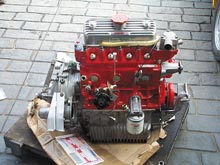
Metro ‘A’ series
The Allegro (1500 and 1750) and Maxi ranges shared the same ‘E’ series overhead cam engine, which was quite effective, but rather an ageing unit. Unfortunately, the engine capacities of 1485 and 1748cc were rather out of step with most markets and taxation classes. Then there was the Ambassador range (revamped Princess) which saw the use of just ‘O’ series engines in 1695cc (1700) and 1994cc (2000) formats, a twin carb 1994cc version replacing the previous 2223cc cylinder ‘E’ series fitted to the earlier Princess 2200.
The Mini was already a legend and could live more comfortably with the ‘A’ series engine and a 4-speed box, but the other models would certainly need to change to remain competitive. Therefore, there was considerable pressure for improvement and this inevitably meant very significant investment.
The ‘O’ series was one of the ‘newer’ engines and clearly capable of being developed further. It subsequently evolved into the ‘O2’ series an extensively revamped engine appearing first in the Montego in spring 1984, but only in 2000cc form. The previous 1695cc version was not developed for saloon car use, and was only later seen in the Sherpa van. Clearly, there was a need for an engine to fit between the 1300 ‘A’ series and the 2000cc ‘O’ series, logic pointing to a 1600cc capacity.
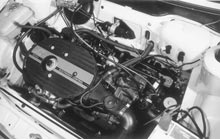
Maestro engine bay with ‘A+’ series engine
Restrictions on developing a brand new engine, plus the time constraints placed by the approaching new model launches, meant that either a bought in engine or modification of an existing unit was necessary. Perceptions at the time generally precluded a bought in engine, although the stopgap Triumph Acclaim, a re-badged Honda Ballade, proved that there were sufficient customers prepared to buy a Honda with a Triumph badge.
From here, the development of a 1.6 litre engine gets interesting, or just plain weird! No money for completely new engines meant that only ‘developments’ of the old engines was possible. The projected ‘S’ series engine could easily be regarded as a new engine, when compared to the ‘E’ series, and so would probably attract negative political attention. I expect that any attention would not ultimately have resulted in a stop, but it would have certainly added significant delay. I wonder if this, in fact, was the case or whether the E and S series engines were nothing more than political footballs.
Developing a 1600cc ‘E’ series to sit in between the 1500 and 1750cc engines involved a different crank with a stroke between the two E series capacities. Other internal changes were done, but outside the distinctive ribbed alloy cam cover of the ‘E’ series and chain driven overhead cam remained and provided a perfect visual connection that even Blind Pew could not fail to recognise. Such a development under normal circumstances would perhaps be an interim step within the internal development process, rather than a production engine, but this time it was released as a production engine. Enter the 1598cc ‘R’ series.
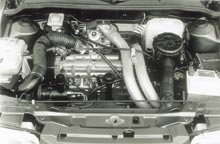
MG Montego Turbo engine bay
Thus, the Maestro arrived in March 1983 with 1300 ‘A’ Plus and 1600 ‘R’ series engines with, interestingly, 4 and 5 speed VW gearboxes bolted onto the end of the engines. The MG Maestro 1600 featured a tuned 1600 ‘R’ series with two Weber down draught twin choke DCNF carbs, a first for MG, and a close ratio 5 speed VW box. Press reports show this to have been a less than successful set up, but the reality of these negative aspects was nowhere near as dramatic as claimed. My own sourced information at the time indicated that the MG version was not initially intended to be available from the launch date, but that the resounding sales success of the MG Metro brought forward the MG Maestro 1600 launch. I was also told that this decision was taken in September 1982, only six months before launch and that this was probably the single reason why the MG 1600 had some initial problems.
The 102bhp output was a little short of the 1600cc class norm of 105 to 110bhp, and whilst the torque was certainly on a par, the extra weight over the Escort and Golf competition meant that this was not enough to provide fully competitive performance. There was also a clear indicator from those looking to tune these cars that in production form actual power outputs seemed around 5 to 7 bhp less than the quoted specifications.
However, it was another issue that really stole the headlines, and this is described by using a simple four-letter word – HEAT! Essentially heat was able to pass too easily into the fuel system leading to problems with hot restarts and poor low speed running in traffic, something today’s classic MG owner is becoming increasingly familiar with. Whilst most of the problems were solved by production changes, the public perceptions had been cast in stone and this was to affect the model for years.
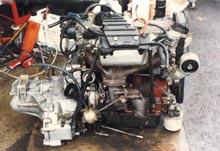
O Series turbo engine and gearbox
Thirteen months after the Maestro came the Montego with the visually quite different 1600 S series engine, still with 1598cc. The head was the most changed with a very narrow cam cover, and manifolds on the opposite side to the R series. Then there was a move to a flexible timing belt rather than chain drive for the overhead camshaft. Additionally the engine featured a then leading edge use of digital technology with no distributor, just a rotor arm and cap to distribute the spark, the calculations on when the spark was created being completely under the control of a memory chip.
In the Montego the new ‘S’ series engine would have no MG application, but the Maestro was to adopt the new ‘S’ series engine to replace the ‘R’ series three months later. Here an individual MG specification was created retaining the use of the twin Webers, with some development to avoid the heat-related problems of the initial MG spec ‘R’ series engines. Power was quoted as the same, but the engine was clearly much stronger, a fact borne out by comparative rolling road testing. The real oddity here is that within three months of the ‘S’ series MG application being introduced, its replacement in the form of the 2.0 litre injected’ ‘O’ series from the Montego was shown at the October Motor Show! I have always wondered, with the similarities between Maestro and Montego running gear, why they bothered with an MG spec ‘S’ series, especially since it was an open secret that there would soon be a 2.0 litre injected version? These facts no doubt went some way to ensuring that a total of only 2762 ‘S’ engined MG Maestros were built.
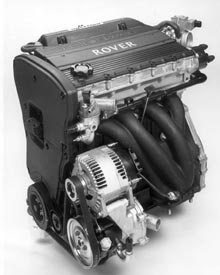
Naturally aspirated T16 two litre 16 valve twin cam engine
Additionally, for Montego the ‘O’ series engine had been developed into the ‘O2’ series, with as much detail difference between it and the original ‘O’ series as was seen between ‘E’ and ‘S’ series engines, a point missed by many as the engines retained visual similarities. Even so, within 12 months of the arrival of ‘O2’ in the Montego the engine had a minor redesign. The ‘O2’ was also the basis for two further avenues of development, one was the 150bhp Turbo and the other was the then ‘cutting edge’ twin overhead camshaft design, using 4 valves per cylinder technology. This was to become the 2 litre M16 used in the Rover 800, which then gained further development to become the T16 series engines, which became the standard 2 litre petrol Rover car engine for the 1990s.
Certainly, the development hack ‘A’ registration 1.6 HLS badged Maestro I experienced in mid 1984 with an early M16 development engine left a deep impression. Just think what a production twin cam 16 valve MG Maestro with digitally controlled injection and ignition would have done to the models perception had it arrived around the same time as the Rover 800. Anyway, leading edge 16 valve MG Maestro’s were not to be, until owners like myself built them.
The need to justify the creation of a new engine to replace the ‘A’ series remained a high priority. Remember that Austin Rover had to convince Mrs. Thatcher’s ministers, and perhaps the Iron Lady herself, that investing in a brand new engine to replace the ‘A’ series was both necessary and desirable. This was circa 1984 when the then Government’s position was very well known and this was at the time Mrs. T had a very strong thumb on industry and the Unions. The fact that some £250m was the estimated budget for the new engine means that Harold Musgrove (Austin Rover boss) and his team did a very good job convincing the Government.
K series, birth of a legendary engine
The ‘K’ series was conceived in 1984 when its designers anticipated the future need for drastically lower emissions coupled with high performance, good fuel economy, allied to a need for a high degree of lightness, reliability and cheapness to build, a daunting task at any time. A number of possible design routes were seriously examined during the period starting with the ‘A’ series. This would have needed a new head with an overhead camshaft, bigger valves, which in turn demanded wider bores and this resulted in the need for wider cylinder spacing. In other words, a new engine that would still be restricted by being an old design. A 1.4 litre version of the then ‘new’ ‘S’ series engine was also considered, but it too would suffer weight penalties and other design restrictions.
It is interesting to note that Austin Rover also looked to buy in a suitable engine, or enter into a collaborative deal to build with another manufacturer, and whilst the initial scope seemed wide, the options were soon whittled down. This only left the clean sheet of paper new build option.
Initially three concept engines were developed, two 4 cylinder engines in 1.1 and 1.3 litre capacities, and a 3 cylinder 1 litre. At this time the company’s ECV3 project vehicle, dating from 1981 (now at the Heritage Museum at Gaydon) had a 3 cylinder, 12 valve lightweight low emission prototype engine that provided much useful data to the ‘K’ series design team. Remember that at this time fuel injection and the ‘i’ badge on the back of a car was still a status symbol and rare in cars for the masses. The concept of 4 valves per cylinder engine was pure ‘racing technology on the road’. This route in a small mainstream volume production engine for mass market small cars was a very forward thinking, but the way emissions and legislation were heading it was seen to be the only logical route. How right they were.
As the new engine was being put forward its first application was already being penned, in the form of AR6, later becoming R6, the Metro replacement. However, the engine was actually first seen in the Rover 200/400 AR8/R8 programme. Initially it appeared in 16-valve form with single point injection and full engine management control. It was to be mated to a modified and torque uprated Longbridge produced version of the Peugeot MA series gearbox with either 4 or 5 speeds. This gearbox was to receive the designation of R65 and be a common fit in many later Rover and MG Rover cars. The gearbox was mounted ‘end on’ in the same way as a rear wheel drive gearbox does, on the end of the engine. This type of gearbox also has an integral differential so that there are two drive shaft connections to connect straight to the front wheels.
Certainly the concept of a super efficient twin cam 16 valve MG Metro with close ratio 5 speed gearbox was very attractive and would have had a massive impact on perception and sales. I also recall being told about this and thinking that the sooner this appears the better. Of course, ‘Roverisation’ as it was to be later termed saw the MG badge dropped in anticipation of it being reserved for ‘only’ two seat sports cars. However, at this time, this was seen as a way of discontinuing the MG as a brand on a permanent basis following Morris and more recently Austin. I do still wonder if the Rover Metro GTi 16v, as the sporting model was to become, would have sold better as an MG? It would have been worthy of the badge, being so much more advanced than the still successful Metro Turbo. Anyway, back to the K series history.
No more 3 cylinder..
The ‘K’ series design team was soon concentrating on just the 4 cylinder units as several issues including refinement and legislative matters saw the 3 cylinder development cease. Changing legislative and market conditions also saw the 1.3 engine capacity grow to the now familiar 1.4, with the smaller one remaining at 1.1 litres. Development also continued on two cylinder head designs, one with a single overhead cam operating 8 valves and the advanced twin cam head operating 16 valves.
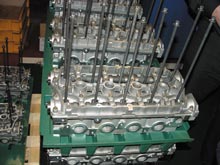
K series cylinder heads awaiting assembly complete with long bolts
There are many advanced features in the K series starting with an overall dry weight of around 100kgs. For comparison the MGB engine weighs about 165 kgs. Eye opening these figures may be, but probably the most advanced feature is the use of very long bolts that pass from the top to bottom of the engine and hold the main engine castings together like a big sandwich. This sandwich consists of four main aluminium castings rather than the conventional block and head castings that usually make up a traditional engine.
The top casting is a ladder frame unit commencing under the familiar black cam covers. The ‘rungs’ of this ladder form the upper halves of the six camshaft bearings per cam. Next down is the cylinder head casting which contains the lower half of each cam bearing then into the expected ports valves etc. The next down is the cylinder block that carries the separate liners for each cylinder, and the top half of the crankshaft main bearings. The final casting is a lower ladder with its ‘rungs’ containing the lower half for the crank bearings. This lower ladder provides considerable strength when compared to the conventional individual main bearing cap set up usually seen.
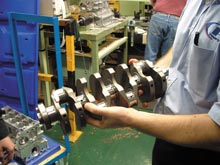
K series crankshaft
These four castings are located together correctly by the use of dowels and are then clamped together with very long ‘through bolts’, approx 410mm long, with their heads bearing on the top casting and their threads winding into a compact ‘rail’ at the bottom. The benefit of this design is that it is very strong, light and capable of withstanding high rpm. In fact, it is very much a design associated with high spec competition engines, so as a volume production engine it was light years ahead of ‘the pack’.
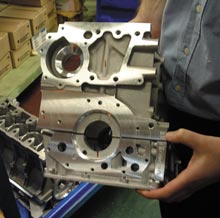
K series block, very lightweight
There are ten of these ‘through bolts’ holding the engine together and surprisingly these are not tightened to a high torque, 18Nm, plus a further 360 degrees of turn applied in two separate stages. This base clamping load creates a sound seal between the four main castings and is then aided by the different expansion rates between the alloy and steel. In fact, the full clamping loads are only seen once the engine has reached normal working temperature. The length and slenderness of the ‘through bolts’ allow them to stretch as the materials around them expand and thus the clamping loads increase. This helps illustrate why it is so important when working on ‘K’ series engines to ensure that used bolts meet the minimum check standards stated before being reused, and for that matter that the threads into which they fit in the lower ladder frame are not damaged otherwise initial torque settings will be wrong.
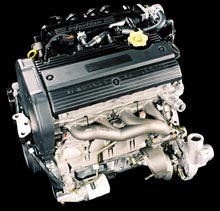
Turbocharged K series 1.8 litre engine
Another leading feature of the design was the very small amount of coolant that is contained within the block, initially set at 1.2 litres. Again, for comparison an MGB has between two to three times that amount. The reason for this can be obvious if you use a kitchen comparison of boiling a kettle. Fill the kettle with enough water for six cups and it takes an awful lot longer to boil than would be the case with just enough water for one cup, it also uses much more energy. Our engine works most efficiently in a given temperature band so the sooner it gets there the better in terms of overall efficiency. This is also one reason why regular checks of the cooling system should be made, otherwise the design for fast warm up can see faster than average overheating.
The ‘K’ series was such a ground breaking design it is recognised by a British patent taken out on it. Rumour was that it was one of the Jewels in the Crown when Ford took a serious interest in the possible purchase of the company in one of the frequent times when business that should be done behind closed doors was done in the media spotlight.
The first true ‘K’ series prototype engine was run for the first time on 6th July 1985 and whilst this shared design features of the now familiar engine it was not what we would immediately recognise. The design then progressed to the engines we first saw in the Rover 214, 414 and Rover Metro.
Along the way it is interesting to record some of the milestones the ‘K’ series achieved.
- 875 prototype engines were made during the development made up of 487 sixteen valve and 388 eight valve engines.
- Durability testing covered just under 2 million miles with an additional 73,000 hours of high and low speed bench testing.
- During bench testing many engines habitually ran to 800 hours which is the equivalent to 100,000 miles.
- Interestingly 72 Montegos were fitted with development engines for normal road condition testing and were issued to a wide range of users, not test drivers, with the performance of the cars closely monitored. I experienced one of these cars with a 16 valve unit in the hands of a friend who was an employee at the time. It was more impressive than the 1.6 ‘S’ series engine even though it was a development car with ‘rough edges’.
Following this very extensive development on Wednesday 30th August 1989 the ‘K’ series was officially announced to the world, with the press release information proudly proclaiming the engine to be ‘the most advanced of it’s type ever developed in the UK’. Note specifically that this was an ‘in house’ design and not copied from another manufacturer as some less than generous commentators reported.
Launched in the two previously mentioned capacities, 1.1 (1119cc) and 1.4 (1396cc) with a single overhead cam and 8 valves in both capacities (K8) and the advanced twin cam 16 valve head for the 1.4 only (K16). This was also the time before catalysts were a universal requirement and lean burn was still a strong contender for future high efficiency, low emission engines, which the K series excelled at. The 8 valve engines were fed by a KIF carburettor, a developed SU, and ignition was via a familiar distributor with electronic internals.
The original K8 and K16 designations pointing at the number of valves, with engine numbers prefix using 11K2 or 14K4 to identify capacity and cylinder head type. With the dropping of the 8 valve head design some years ago all engines are now referred to as K4 followed by capacity and or further specific model designation.
The 16 valve version featured throttle body fuel injection and mapped ignition all controlled by Rover’s own MEMS (Modular Engine Management System) developed in house with partner Motorola. Computer buffs note that this system was created around the Intel 8096 processor with a whole 8kb of memory.
Power was set at 60ps for the 1.1, 76ps for the 8 valve 1.4 and 95ps for the 16 valve. These power outputs compare very well with larger engines; specifically the 16 valve almost output of the then multi point injected 1.6 ‘S’ series engine used in the old Rover 200, but with nearly 15% less capacity. Three years later the K series would match the S series, when a similar multi point injection system was added to it, but the K series was burdened with a catalyst. Even today, whilst the power remains at 103ps, it is still very competitive in spite of ever tightening emission regulations.
Roger Parker