Nitrous Oxide V8 part 1
I had discovered MG’ing by accident in 1998. A friend had a guy working with him who drove a 1975 BGT. I had often looked the car over when I visited his workshops and eventually the car was offered for sale at £750 but I was unsure about buying a classic without doing a bit of research. Three months later I noticed it stopped appearing at my friend’s yard, when I asked where it was he said that the GT had failed the MoT and the owner didn’t use it anymore. Excessive play in the steering had been found and the owner had been quoted £400 to fit a new rack. I offered him £100 for the GT and he accepted. After a few hours of looking over the car I noticed that it was just a worn steering UJ. Soon the MG had a new MoT, was back on the road and I was hooked.
Three years on I had tweaked, modified and improved the BGT no end, complete with a home re-spray in cellulose. Now I’d finished it, what next? A V8 perhaps. I started to look around and found many for sale but they were all quite rough and overpriced. Then a friend asked me if I would like to buy his MGB Roadster. It was tidy and the price was good, so I sold the GT for £1000 and spent a few hundred on the Roadster. I wasn’t too impressed with the low windscreen and the generally light feel of the car, but decided to stick with it but then four months later another of my colleagues mentioned that a friend was selling his MGB GT V8.
I went to see it in an isolated barn/garage in Hampshire, it had been stored for seven years and was in a sorry state. I offered him £3000 and the deal was done. Having looked closely at the V8 I was surprised to find that the body was in a very good condition, but the brakes were all seized and mechanically it was quite untidy.
The following year saw a gradual clean up of the interior and exterior, all the usual stuff, seat covers, carpets, walnut trim. By this time I was having regular fun going to shows and meetings but as usual I started to get that ‘what next’ feeling, she was a good clean car, not a show winner but still quite nice. Then I went for a day out to Santa Pod raceway to see how it had developed since my last visit as a teenager. That’s when it hit me, I knew what I was going to do with this car, make it unique, the best of both worlds, both classic and custom.
I started to re-visit some of my old haunts and was pleasantly surprised to find that the custom car world was still alive and well.
My first mod was to fit a 4 barrel carb kit from MGOC, what a difference, she drove like new. I quickly realised that the brakes needed attention so fitted new callipers and disks. Then a top end overhaul which was quite easy. She was performing really well now and I had a few cautious runs at the drag strip and put in reasonable times of around the 16 second mark for the standing quarter mile.
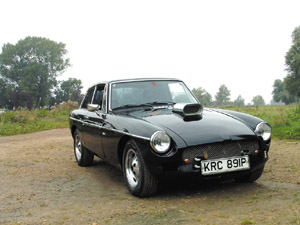
She got lots of attention whenever I took her to the strip, so I started to carry out minor performance mods like fitting electronic ignition, some decent Silicone leads and good quality spark plugs. Then I started thinking about the induction system, ‘I need fresh air I thought, but there’s not much room to fit an induction kit’. Best to get the air straight into the carb via the shortest route, through the bonnet; I tried a couple of options before I settled on the classic Hilborn scoop. It looked great but the problem was I needed to cut a hole in the bonnet to accommodate it. I decided that although I wanted to retain as much originality as possible I would have to sacrifice something in the looks department. I just couldn’t bring myself to cut the steel bonnet, so I enlisted the help of Smith and Deakin who supplied a fibreglass bonnet and frame. It didn’t take much work to get a good fit. Then I proceeded to attack it with the jigsaw. After two evenings of cutting and trimming it was at last ready to try, it closed over the scoop and settled into position first time. That’s it, I thought, this car is going to be a 70s Hotrod, the one I couldn’t afford back in the 70s.
I then treated myself to up-rated and lowered front suspension, and new track rod ends, then I overhauled the original lever arm dampers, fitted braided brake hoses, blue poly bushes all round, new bump stops and a 7/8 front anti-roll bar. The uprated front end was now steady as a rock, what a great improvement for not a lot of money.
I started to regularly attend the racetrack to tweak and twiddle and by late 2004 she was returning regular 15 second runs. I made up and fitted an exhaust system for a Hotrod with Chevrolet mufflers and side exhausts. The exhaust looked nice but I had to have the tips chromed to finish the effect.
Now I was very pleased with the look of the car but performance was still not what I had imagined. I spent a lot of time practising my technique at the drag strip, doing start after start to try and improve my reaction times, learning little tricks of the trade like running the rear tyres down at 15psi for more traction from the non LSD axle. All this proved worthwhile as I had cut another 0.5 of a second off my run times, but she still had more to offer.
Next I had to plan how I was going to radically improve the times, after all, my friend was only running a second behind me using the same engine in his SD1 tank.
Many weeks were spent on the BBS getting advice and ideas from the other members, knowing that some of them must have considered me bonkers and also being concerned that they thought I was ruining a perfectly good car. I wanted to retain originality as it’s a Factory V8 and not a conversion, but then I went on to talk about radical modifications, a bit of a contradiction in terms.
I talked to many people about possible performance mods both on the BBS and within the drag racing world. I was advised to upgrade the V8 to 3.9 or 4.6 litres, fit roller rockers, high lift cams, solid lifters, superchargers, titanium push rods, EFI, turbochargers, forged crank, chrome moly components by the score, STOP!
What I really wanted was a car that would be recognised as an MGB GT, not a hybrid super car that’s had £30k thrown at it.
Back to basics, I wanted a car that would give me reliable transport for days out and MGOC meetings as well as giving me a quick boost of power when I needed it at the track. Nitrous Oxide I thought, that should give me what I want, but will a 30 year old engine take these shock loads? Only one way to find out, so off to Real Steel to buy a basic plate injector kit. The Nitrous kit for carburettor cars is an easy fit for the 4 barrel carb, just remove the carb, fit the plate and bolt the carb back on. Then fit the plumbing and wiring along with a microswitch on the throttle linkage to engage the Wet Nitrous system at wide open throttle position. I spent a whole weekend installing and testing before being ready to take it to the track for a trial run. There are many types of Nitrous injection systems to suit the type of engine set up you have. The WET system simply means that you inject Nitrous Oxide along with extra fuel via a second fuel solenoid. This is a great system as it means you don’t have to fiddle with your carb settings, you simply match the fuel and Nitrous jets for the amount of boost you want.
By this time the guys on the BBS were starting to take real interest in what I was doing, albeit a little radical for an MGB. The car was starting to look very unique with 70s alloys, plus a lowered front and a polished alloy scoop poking out the bonnet like a mouth wide open demanding more and more air. When the exhausts were purring like a V8 should they combined with a strange noise from the scoop best described as sounding like a car dealer sucking air in as he tries to tell you that your part exchange vehicle is not worth much.
The first day at the track with the Nitrous was nerve racking. I was only running with a 25HP boost and after three or four trial runs, my times were not that impressive. Gradually I increased the boost to 50 and then 75HP. A noticeable difference but the times were only coming down to the 14.3 bracket and the Nitrous system seemed very erratic in operation. An increase to 100 HP jets didn’t appear to make any difference. The common theme was to hit the floor with the pedal. The car would chug and splutter for a couple of seconds, then burst into life with a great feeling of being pushed back into the driver’s seat but why was I still finishing the run with the same time, again and again?
I decided that if I was to start to push this car to the limits I might break something so I built another block to use and put the original factory block into mothballs. A block was found on eBay and I rebuilt it with standard components. I didn’t want to run anything other than factory spec as far as the engine was concerned. During the early part of 2005 I spent all my spare time putting the new block together with a rebuild kit from RPI engineering, who were very helpful. So it was rebuilt engine, block huggers and new clutch.
I was disappointed when she only returned the same sort of times, albeit much smoother. I then enlisted the help of the ‘How to Tune Rover V8 Engines’ book and got some useful information. I realised that my biggest problem with the Nitrous system was vapour and not liquid in the feed line. Nitrous behaves just like a refrigerant whereby the liquid always migrates to the coldest part of the system (the cylinder in the boot) my problem was the hot engine bay and the time between runs allowing this migration.
After explaining this to the guys at the Hotrod shop they informed me I needed a purge kit. The purge kit consists of a second Nitrous solenoid, mounted just before the main solenoid, which feeds the carburettor, this additional solenoid is fitted in a tee piece with its outlet connected to a vent pipe that runs to atmosphere. This is connected to a push button which I mounted under the dashboard which is live when the Nitrous system is armed. When you pull onto the start line you purge the system until you see a white plume of Nitrous vapour coming from the discharge pipe (which I mounted just under a bonnet vent). It looks quite impressive when you purge on a hot day, as the Nitrous system pressure can creep up to around 1200 PSI. I added to the Nitrous mods by treating the rear tyres with a tyre softening fluid.
So, off we go again, fuelled up, purged and on the start line, pre stage lights on, full stage lights on, green stage light on, and waiting for the three amber lights to come on before the green, and off we go. Oh no! Another 14.2 at 97mph. There must be something else wrong, this can’t be right. Back to the drawing board for some serious thinking. I was beginning to think I’d have been better off with a stage 3 1800, then I started thinking about the obvious. Weight, the MG’s not mine. I knew rubber bumpers were heavy and decided to remove them along with the spare wheel and tool kit. I also decided to save more weight by fitting a 1.5 gallon aluminium fuel tank and draining the main tank. This equated to around 170lbs in weight.
Next the exhaust, over the previous six months the tailpipes always looked a little sooty, even though the plugs seemed fine. I fitted a clean pair of mufflers in case the old ones were getting a little coked up. This did help, and on a nice sunny day at the track when some BBS members had turned up to see me run, I came out for my first run against a modern MG, a ZS 220.
We both got staged at the lights, but, as I staged the car rolled back a little putting me slightly off stage, but still legal for a run. The lights went green as I was rolling back. I had set my hopes for this day to beat the 14 second barrier. The ZS 220 took off quite quickly and as I let the clutch out, the driver’s side rear wheel on the B started to spin so I came off the gas a little before flooring it. As my foot hit the floor she launched madly, giving a sound that made my spine shiver. She was flying. I quickly made up some ground and took the lead to bring in a time of 13.9 to his 14.3. I met up with the chap after the race for a chat and to look around his car. I didn’t know at the time, but all this was recorded on video by a BBS member and posted on his web site.
I returned for a second run, this time making sure I wouldn’t make the same mistake on the start line. I returned a new time of 13.8 seconds at 103.4 mph. I was delighted to return this time, as this put me in the time bracket that saw me regularly disposing of many modern performance cars.
I had fun with this set up for a while but decided she was still not giving me her all. Returning to the track a few weeks later I had a few modifications to try. After three runs I said to my son “I’m still not happy with this exhaust system”. “Let’s take it off dad,” he said. So it was up on the jack, and after about 20 minutes, the two sets of pipes were laying on the floor. As I started her up and she roared like a monster, the throttle response was more like a modern Japanese motorbike, the engine stabiliser was working overtime now. We lined up for another run and she launched really well (calculated 0-60 for this run was 4.88). As I hit 3rd gear it was pushing me back into my seat like never before. That’s when the overdrive clutch let go. Oh no, not another problem. So we let her cool down and pulled out the Nitrous jets to replace them with the 50HP jets. An hour later we were running again. She pulled another 13.9 with only half the nitrous boost I had used before. All this on standard road tyres, non LSD differential and all the original running gear.
This car is destined for stardom, I thought. This brings me to the conclusion of this episode, this car is capable of 12 second runs but I cannot bring myself to ruin the factory V8 gearbox so I have decided to spend the winter of 2005 -2006 installing an automatic gearbox.
The auto box when set up correctly should gain me valuable 1/10ths of a second. I have opted for a General Motors gearbox which is not too expensive. Parts and service are fairly cheap and it’s good for over 400 HP.
All I have to do is make the 3 speed gearbox fit the Rover V8. This, along with a rear brake line lock and a Phantom Grip diff locker should hopefully see me breaking into the 12 second arena sometime in 2006.
The car is presently running with 2″ straight through cherry bomb mufflers to keep resistance down. I will probably end up running with the RV8 exhaust manifolds through the inner wing, terminating to open ends for race days.
I am grateful for the ongoing support from the guys on the BBS and the MGOC. I have made some new friends on this project and hope to make some more over the next few years.
The other people I need to thank for help and support so far are, Summit MG, Real Steel, RPI engineering, my good friends at Twistedsanity, who supply me with a lot of help, advice and Nitrous Oxide equipment to feed my need for speed. Also my children for their help in the garage and in the pits and last but not least, my long suffering wife Gill who puts up with my madcap ideas of a 30 year old MG being a real contender on the Dragstrip, and for being so forgiving when she finds engine parts in the dishwasher.
Drag strip BGT
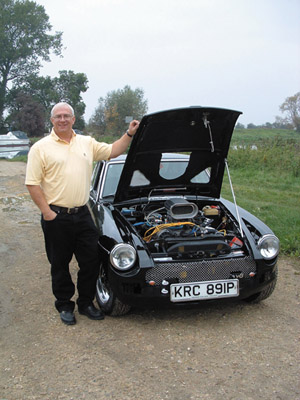
Perry with his Nitrous injected BGT V8
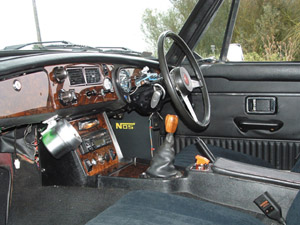
A few interior mods
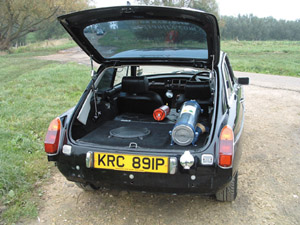
Hot hatch
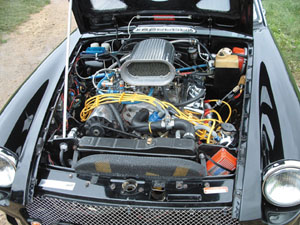
Engine bay
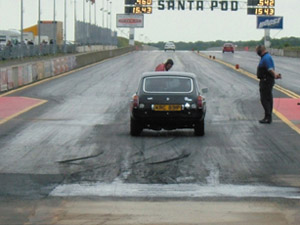
Before a run at Santa Pod
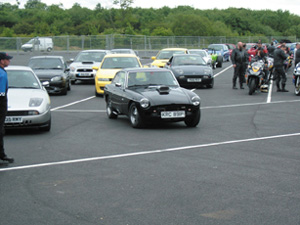
Among friends at Santa Pod
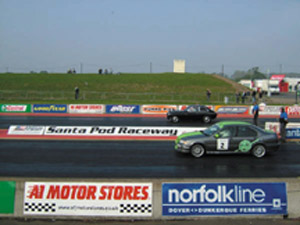
Duelling MGs
Perry Stephenson