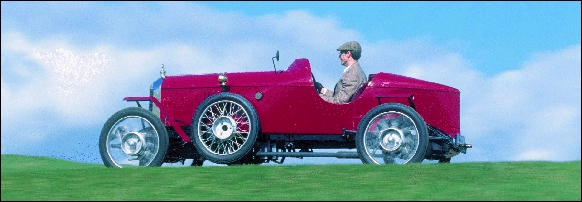
OLD NUMBER ONE
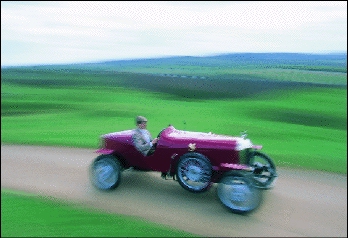
| OLD NUMBER ONE Malcolm McKay takes the wheel of a motoring legend: MG’s first true sports car |
|
 Cecil Kimber:
Man behind the Marque
The marque MG owes its very existence to Cecil Kimber: without his enthusiasm Morris Garages would have remained no more than a successful network of car sales outlets. The foresight and tolerance of William Morris shouldn’t be understated, either. Morris had established both his car sales network and his car manufacturing business in 1910 – the last thing he needed was some upstart sales manager turning the car sales operation into another manufacturer, yet he recognised Kimber’s ability and allowed him free rein. He was amply rewarded.
Kimber, born in 1888, started work in his father’s printing ink business, but his early enthusiasm for motorcycles – despite a serious accident that left him with a permanent limp – soon saw him turn to the motor industry. He passed through several small car manufacturers like a tornado – Sheffield-Simplex, AC, Angus-Sanderson and Aston Martin all saw the young Kimber’s influence. His driving was as wild as his work, but finally he secured a post of more stability as sales manager of Morris Garages in 1921.
 Kimber’s life wasn’t destined to settle down, however, as the General Manager committed suicide in 1922 and Kimber was appointed to run the business. Aged 34, he relished the task and very quickly he and his wife Irene began designing special bodies for the cars they sold. Rene’s influence was considerable, as she added a feminine eye for style that was generally lacking from car designs of the 1920s, which were very much a male preserve.
Unlike modern car dealerships, Morris Garages was not restricted to selling Morris cars: other British marques including Arrol-Johnston, Belsize, Humber, Hupmobile, Singer, Standard and Wolseley graced its showrooms too. However, it was the Morris cars that attracted Kimber’s attention and before 1922 was over he had arranged to buy Morris Cowleys in rolling chassis form. This was by no means uncommon at the time; in fact, it was generally only the larger manufacturers of popular cars which sold them fully built, others preferring to send chassis to professional coachbuilding firms to have the bodies constructed.
Kimber’s choice for the Morris was a simple two-seater with space behind to squeeze in extra passengers or luggage: the Morris Garages Chummy. A further modification was made to the rear suspension, lowering the chassis to compensate for its normal very high build. They sold well, and in March 1923 Kimber won a Gold Medal in the Land’s End Trial driving his own Chummy.
He moved on to rebodying the more powerful Morris Oxfords, with each attempt becoming bolder in modifying the chassis as well as supplying a more sporting body.
 1924: the MG badge appears
In May 1924, the MG motif enclosed in an octagon appeared in print for the first time, and the history of this great marque really began. Cecil Kimber now had a clear ambition to create a distinction between MG cars and their humble Morris base: the cheap and unsporting nature of Morris cars was not helpful to his attempts to sell high-class sporty cars at, often, twice the price of the basic Morris-bodied machine.
Kimber’s new Morris Oxford-based car for 1924 became the first to be advertised as just the MG Super Sports, rather than the MG Super Sports Morris, and its modifications included flattened springs, raked steering, better shock absorbers, higher final drive ratio and repositioned accelerator and handbrake. These cars were a great success, receiving excellent reviews in the motoring press.
Meanwhile, in the spring of 1924, Kimber had authorised work to start on a very special car indeed. A Morris Cowley chassis was the starting point, but there soon wouldn’t be much of it left. The rear end was sawn off and two new side rails were hand-made to sweep up over the rear axle, providing mounting points for semi-elliptic springs. Kimber wanted serious performance for this car and the Morris engine couldn’t offer enough, even in tuned form. He therefore acquired from Hotchkiss, Morris’s engine supplier, a new overhead valve version of the 1548cc Cowley engine.
Work progressed in fits and starts on this car; in late 1924, it was fitted with the larger Morris Oxford brakes; then in March 1925, it went to Carbodies of Coventry to receive a narrow and extremely rakish two-seater body.
After hasty repairs when the chassis frame broke, Cecil Kimber and Wilfrid Matthews took the car on the 1925 Land’s End Trial, easily collecting a Gold Medal. Having achieved its purpose, the car was sold to a friend of Kimber, but it was reacquired by MG in 1932 and has been used by the company for publicity purposes ever since.
 For years it was claimed to be the first MG and all sorts of exaggerated stories built up about its history. It has been fashionable in recent years to discredit this car, arguing it has no right to its name “MG Old Number One”. That’s unfair. It was not the first MG car, but it was certainly the first uncompromised, out-and-out sports car MG produced. It was a toe in the water for Kimber, showing the way he wanted MG to go, and it must have played a large part in giving Kimber the confidence to develop MG into Britain’s leading manufacturer of two-seater sports cars.
Old Number One: Driving the Legend
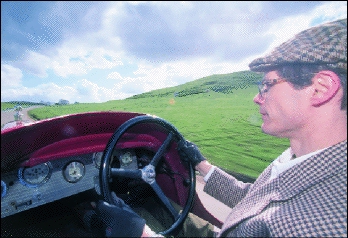
No seat belts. No doors. No windscreen. No starter motor. Now, this is sports car motoring at its most primitive – and its most exciting. Driving Old Number One, THE original MG sports car, is a rare privilege, and it involves procedures long forgotten in these days of turn-key cars.
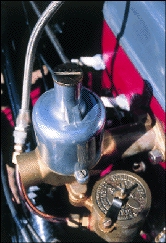
The starting procedure begins outside the car. First, you have to retard the ignition: there’s a simple lever for this just inside the body, to the right of the steering wheel. Turn the mixture knob on the dashboard to RICH. Flick the chrome-plated magneto switch to ‘on’. Another switch controls a concealed electric fuel pump: not original, of course, but much more convenient than pressurising the fuel tank with a pump between the seats that looks as if it would be happier inflating bicycle tyres. Now move to the bonnet, and open up the right-hand side; depress a small button on the top of the carburettor float chamber until petrol spurts out. Finally, it’s time to swing the starting handle.
 Anyone who’s tried to start a 1960s car on the starting handle and failed miserably would be relieved by the MG. By the 1960s, starting handles were for emergencies only and high compressions combined with advanced ignition timing made them difficult and painful to use. In the 1920s, most cars were started by handle and low compression with easily-retarded ignition make it simple. Locate the handle in the front of the crank-shaft and give one firm upward tug: the old long-stroke four-cylinder engine bursts into noisy life.
It’s a deep-throated roar that sounds rather agricultural today, like a tractor; it’s also virtually unsilenced, the exhaust a one-piece welded construction from manifold to tailpipe, with a barely distinguishable swelling for the ‘silencer’.
You climb in from the passenger’s side, carefully sliding your legs between the gearlever and the large steering wheel. It’s a relief to find both the gearlever and the accelerator located in the now-conventional positions – in the case of the accelerator, this was an MG modification.
Turn the mixture knob back to its normal position, advance the ignition and the exhaust note hardens. The clutch is not too heavy; there’s no synchromesh, but gear selection is surprisingly easy. Gears are in a straightforward H-pattern, with reverse where we might now expect to find first, but otherwise it’s as you would expect. Anyone used to driving small Fords from the 1950s is immediately at home with this 3-speed layout.
 First and second gears are low, and acceleration is surprisingly brisk, especially with the ignition further advanced. The lightweight car really flies, a sensation enhanced enormously by the driver’s totally exposed perch. There’s just room for a passenger in the offset seat, a few inches behind the driver to give both some shoulder room, but it’s certainly a cosy cockpit. Forget luggage – this car wasn’t designed to carry any.
Changing gear proves to be amazingly hassle-free: going up the gears, the lever simply slots into the next gear without complaint, provided you leave a pause in neutral for the heavy flywheel to slow down. There’s a big gap between second and top gears, so top is a better cruising ratio than you might expect. Changing down, double-declutching is obligatory but again, the little MG rewards the amateur with an unusually easy change. Slip it into neutral, blip the throttle and the gearlever gently slots into place; the lever’s long travel probably helps.
Old Number One’s rev counter reads to 6000rpm but, in deference to the 75-year old power unit, we stay well below that.
The engine seems very willing to rev, however, its overhead valve layout giving so much more power than the Morris Cowley’s sidevalve version could dream of. This unusual version of the engine seems only to have been used in the rare Gilchrist car, made in Glasgow in 1920-23.
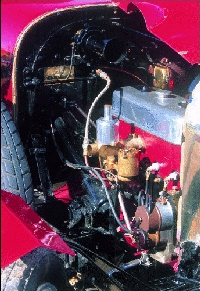
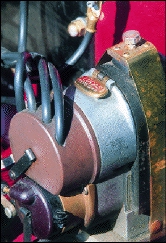
Looking at it, you can see why it is so much more willing than the sidevalve. The carburettor side is simple enough, the carb simply bolting to the side of the cylinder head, a plain-faced slab of metal on top of the tall slab-sided cylinder block. Spark plugs sprout horizontally from the block. The exhaust side looks far more efficient. Only the centre two ports are siamesed, and a very efficient-looking tubular three-branch exhaust manifold sprouts almost horizontally from the side of the cylinder head. Beneath the manifold, a plate bolted onto the block conceals the pushrods; bolted to the plate is a 6 volt dynamo, driven via a long shaft from a pulley, belt driven from the crankshaft. Also driven off the same belt is a ridiculously over-engineered mechanism to drive the rev counter. Above the crankshaft pulley, the oil pump sprouts from the block, a necessity to keep the overhead valve gear from seizing up.
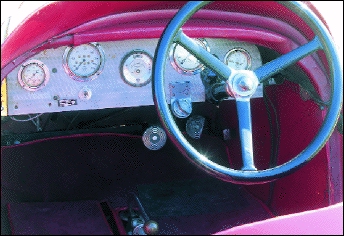 This car is reputed to be capable of 80mph, a claim I would never have believed until I drove it. Naturally we didn’t try to match it, but I’d certainly estimate 70mph to be well within its capabilities – though you’d need to be wearing a full-face helmet to prove it. I found that anything over 40mph left me totally breathless: my eyes streaming in spite of wearing glasses, I just had to slow down in order to see and to take another breath.
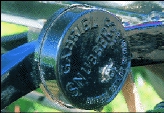 Braking is better than on most 1920s cars, the foot pedal operating the front brakes and the hand lever (on the outside of the body) the rears. The mechanism is fascinating, a blend of rods, levers and universal joints that’s beautifully and solidly engineered, designed for much heavier Morris Oxfords. It’s only failing is a disturbing tendency for the brake pedal to drop to the floor when the steering is on full lock! That steering is near-impossible to turn when the car is stationary but, once moving, it’s perfectly easy and more precise than you’d expect; with less than one and a half turns from lock to lock, it feels as direct as a go-kart and must have been ideal for trials driving.
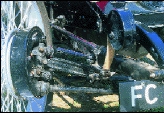 On rough tracks, Old Number One bounces along wildly, its dampers struggling to have much effect – despite the use of ‘Gabriel Snubbers’ front dampers, as fitted to other MGs of the time in preference to the standard Hartfords. Long straight semi-elliptic leaf springs support an I -section beam axle at the front, while at the rear, two more semi-elliptics support the live axle which is located by a torque tube and triangulating bars. It’s all heavy duty stuff, with lots of unsprung weight, but it seems to keep the lightweight car on the road effectively enough.
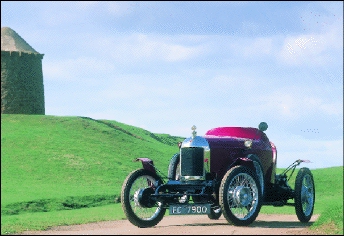
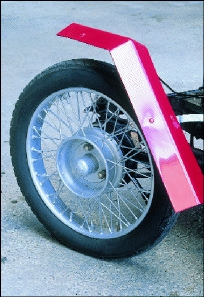
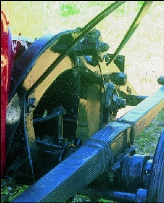 High off the ground, to give good clearance on rough tracks, Old Number One is a purposeful rather than beautiful machine. Its bullnose radiator and incredibly abbreviated mudguards give it a very determined stance. Its deep-throated bellow and the exposed driving position have me grinning widely even though I can’t breathe and I can’t see where I’m going. Ease of use where it matters – gearchanging, pedal positions, braking – helps to make this a very drivable car even today, despite its age. Cecil Kimber certainly knew how to build a sports car.
Heritage Motor Centre: preserving MG
Old Number One is a prized exhibit at the Heritage Motor Centre at Gaydon, just off junction 12 of the M40 motorway south east of Birmingham. Open 10am-6pm April to October, 10am-4.30pm November to March, the Centre incorporates a stunning museum built by Rover in 1993 plus a Land-Rover off-road course, quad bikes and go-karts in the grounds. Admission fees are: adults £6, senior citizens £5, under 16s £4, under 5s free; family ticket (2 adults + 3 children) £17.
The museum contains over 300 cars from the 14 manufacturers that make up Rover, including rare early examples and unique prototypes, as well as cars from other marques.