Playing the Right Tune
Last month covered the basics and started to move into an overview of the complex area of engine modification. To choose the best modifications needs an understanding how the engine works and from that what actually needs to be improved. We started to look into the basic working principles of a 4 stroke engine, which applies to all MG engines, and carry on from there. It will help if you re-read just the right column on page 19 of last month’s issue, ‘Engine tuning basics’, then continue below.
Now we move back to volumetric efficiency, (VE as mentioned briefly in the reference to the 100cc single cylinder engine) which is the singular most important factor we can influence. Filling a cylinder with more air and fuel means that when it is burnt a higher pressure is acting on the piston and so the torque developed on the crankshaft is greater. More torque means a higher power output. Incidentally, engine torque is what is always measured and then mathematically converted to power. Power is commonly represented as Brake Horse Power – BHP.
Filling a cylinder has to be completed in a very, very short space of time. To put some perspective on this let us see what happens at an idle speed of just 600rpm. As there are two crankshaft revolutions for each (4 stroke) cycle means there are 300 induction, 300 compression, 300 power and 300 exhaust cycles per minute. This equates to a leisurely five cycles per second or two tenths of a second to fill each cylinder. Now if the revs are increased to 6000rpm then we see ten times the frequency of each element. That results in just two hundredths of a second for each of these elements to occur!
To improve VE we need to remove restrictions to airflow but before we can do that we need to know where these restrictions are and what form they come in. The simplest way I find to illustrate this is to take a length of water pipe. If water enters at a flow rate of 20 litres per minute then with no restriction you would expect to see the same flow at the other end. If this were substantially wrong then you would have problems washing the car with a hose!
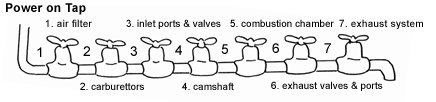
Now the flow rate through an engine can’t be compared to a length of plain water pipe, but if a number of taps are added to provide restrictions then this does become more accurate.
Now the best flow will only be achieved if the taps are all fully open. If each tap is closed by a different amount then the flow at the outlet will be much less. The main restriction will be by the tap that is closed the most, although the other taps will create some additional restriction.
Now lets ‘tune’ our water pipe, and for best results we should open up all taps, but let’s say that we can only open one at a time, which do we open first? Ideally, this has to be the tap that is closed the most, but then flow will only increase to the rate dictated by the next tap that is closed the most, and so on up until all taps are fully open. However, if some taps are more difficult to get at and we choose to open the tap that is easiest to get, then if this is only slightly closed we can’t expect a great increase in flow.
Now let’s rename the taps as different parts of our engine.
Tap 1 relates to the air filter,
Tap 2 the carburettors,
Tap 3 the inlet ports and valves,
Tap 4 the camshaft,
Tap 5 the combustion chamber,
Tap 6 the exhaust valves and ports
Tap 7 the exhaust system.
Now prioritizing the degree of restriction each tap has in relation to the engine part it represents will vary from engine to engine. Ideally that means identifying the degree each is closed for our specific engine, fortunately the majority of classic MG engines follow a very common theme. So the following order is often found, starting with the most restrictive and working to the least restrictive.
- Inlet ports and valves
- Exhaust valve and ports
- Combustion chamber
- Air filters
- Exhaust system
- Induction system (Carburettor/injection)
- Camshaft
- Distributor
Cylinder head
The reality is that the cylinder head area provides the biggest single area of restriction and potentially the best results from modification. If we once again look at the K series engine, it provides another good illustration. The 1396cc engine can be found with both single overhead camshaft and 8 valves, and with twin overhead camshafts and 16 valves. When installed in the same chassis, and being fed by similar multi point injection and exhausted by similar systems with a catalyst, the 8 valve version produces a peak of 75bhp and the 16 valve version gives 103bhp, or over 37% more! Torque on the other hand sees a rise of less than 10%. The point being that the use of a head featuring more valves, and therefore greater valve surface area, allied to a better head design drastically increased the airflow potential (VE) and as a result greater power is achieved. It is also obvious that there is far less scope for improvement if we are starting with a twin cam 16 valve head already on our engine, but there is scope which I will show in a future episode.
It is worth mentioning at this point that the use of a classic twin cam head design provides the ability to angle the valves so that they sit in a straighter port, which itself tends to be angled down towards the combustion chamber. This also allows a better combustion chamber design where the spark plug sits right in the middle of the combustion chamber so when the mixture is burnt it is able to evenly move from the centre of the chamber outwards to the bore walls. Overall, this design offers many advantages as ably demonstrated by classic twin cam engines from Alfa, Lancia, Lotus and perhaps one of the best known is the Jaguar XK engine.
MG was not blind to this significant design advantage and twin cam B series engines were developed in the 1950’s. The MGA Twin Cam of 1958-60 sported the production version of the B series engine and it displayed all the positive attributes expected of this design. Unfortunately a series of initial problems, all soon overcome, created a too negative perception of the engine and so it was dropped. It is unfortunate that the senior BMC management didn’t have the foresight to persevere with this engine, as it could have become as much a part of MG folk law as the Twin Cam did for Alfa.
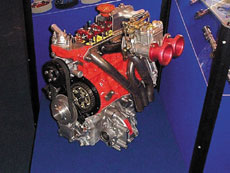
Metro engine, heavily reworked
It also clearly illustrated the benefits of this design in VE terms. The pushrod 1588cc B series MGA engine gave 79 bhp and the initial high compression MG twin cam gave 108 bhp, over 36% more power. Even the later (sorted) version of the twin cam with the same low compression ratio as the pushrod engine gave 100 bhp, which is still over 26% more power than the pushrod B series!
Compression ratio
Having just mentioned compression ratio with the MGA twin cam engine it’s time to look at this in more detail. The original twin cam engine had a 9.9 to 1 ratio and the later version used an 8.3 to 1 ratio. That difference (and some alteration of distributor advance curve) was the reason for the 8 bhp difference between the two versions.
Compression ratio is the ratio between the swept area of the cylinder (the area that the piston travels through) against the area above the piston when it is at its highest point in the cylinder, which includes the combustion chamber. A simple fact is that if the mixture of fuel and air is compressed before being burnt then the resulting rise in pressure on the piston is actually significantly increased. Thus, if you compress the fuel and air even more before burning then even more work is achieved from the same amount of fuel and air. This is where diesels score so heavily as they tend to have ratios that are often double that of a petrol engine. Unfortunately, the ceiling for petrol engine compression ratios has a ceiling beyond which it is impractical to go, well for our engines it is although some pretty advanced engines are going to push the current ceiling quite a bit.
Compression ratio is always shown in numerical terms based on the simple calculation explained in the last paragraph. This is the theoretical ratio as the actual compression ratio seen in a petrol engine controlled by a throttle varies very considerably depending on the VE at that time. I will try to make this clearer in the next few paragraphs.
Theoretical ratio can be simply expressed by using that single cylinder engine again with it’s 100cc cylinder and a 10cc combustion chamber. This gives a ratio of 10 to 1 by comparing the one figure against the other. Theoretical ratios are quoted when we read the specification of our engines, but the reality is that we do not reach these levels with our naturally aspirated engines. (i.e. no turbo or supercharger) This is because the VE is less than 100% and the cylinder can’t fill completely. Assume that our single cylinder engine has a 75% VE, and with that we see that 75% of 10 is 7.5, so the actual compression ratio is 7.5 to 1. Note that this level of VE is only achieved with a wide open throttle so when that closes we will see a varying degree of VE dependant on the throttle position. Diesels and some leading edge direct injection petrol engines do not have a throttle so the VE is a constant. The amount of power generated depends on the amount of fuel injected into the cylinder, another long standing diesel advantage.
Two specific points arise here and the obvious one is can our engines ratio be increased. Well there is usually a degree of scope to do this with standard engines, except perhaps the modern ones which are already operating at very high ratios, otherwise an increase of about 0.5 in the ratio is usually well within the scope of the classic engine and how it burns current fuels. Going higher is quite practical as long as the many conflicting aspects of combustion are accurately calculated and the octane rating of the available fuel is high enough not to cause detonation. (Detonation = Premature, spontaneous and violent uncontrolled combustion that will if unchecked destroy your engine)
The second point is that we alter the actual compression ratio when we alter the VE. Therefore, if we raise the previous 75% efficiency to 85% then we will see an effective rise of 1.0 in the compression. If other modifications are also done to increase the theoretical ratio (e.g. head skimming to reduce the combustion chamber volume) then whilst the on paper ratio may still be within an expected acceptable level, the actual increase is much higher and problems may occur. This illustrates again why we need to research or plans properly. Clearly, the use of a super or turbo charger is a sure way of drastically increasing the VE of an engine and it’s actual compression ratio. This should also explain why it is necessary to lower the compression on an engine that is going to be fitted with such a device.
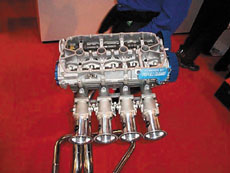
K Series cylinder head with multiple throttle bodies for ultimate breathing
Head modifying
Creating a replacement twin cam head in either 8 or 16 valve form for our classic engine is not a viable proposition. (Easier to fit the complete 16 valve engine.) Living with the original head and simply boring out the ports and dropping in dinner plate valves will not work, although the theory will show that the flow capacity is raised high enough. No, the development of modifications that provide a raft of improvements that work at different engine speed and loads is a very specialised operation and those who have achieved a high profile for this work have done so through damned hard work, over very long periods and using some pretty accurate and expensive testing and measuring equipment. Thus to expect you can go and buy a selection of grinding stones and a flexible drive attachment for your Black and Decker, then achieve the same results is unrealistic. Gains can most certainly be achieved, but these are usually modest and always remember that it is far easier to make things worse (or damage a head beyond further use) than see gains.
Obviously, the best course has to be to buy this work in from a professional who has that long and proven track record and always plenty of glowing testimonials. It is also unreasonable to expect them to furnish you will all the hints and tips on how to achieve their best work, but be very aware that even if you were to receive guidance, it takes a skilled hand to ‘feel’ the right profiles to ports. Peter Burgess’s books on ‘How to Power Tune an MGB 4 Cylinder Engine’ and his ‘ Power Tuning cylinder Heads’, provide some of the best guides on how individuals can effectively modify their heads. The bottom line is that most pushrod MG engines will see between 15% and 35% more power achievable through head modifications done properly, but don’t expect that to be a simple bolt on and drive off into the sunset. Such returns are significant and will require the engine to be set up on a rolling road. Carb needles will certainly need to be changed and distributors may need a change to get the best too. Remember the references in last month’s issue on rolling roads and note the benefits for a modified engine are much greater. Next month we will look in detail at air filters, exhaust systems, carburation, camshafts and distributors.