A Tale of Two Extremes
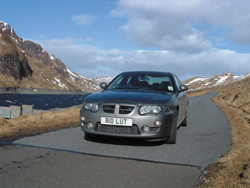
Petrol and diesel engines are as different as chalk and cheese, but here the opportunity to drive a supercharged ZT 260 over some splendid Scottish roads contrasts with the practicality and economy of driving to Scotland and back in a new ZT CDTi 135.
Forced induction and MGs have gone hand in hand for decades, not least because adding an air pump (compressor) to force more air into the cylinders is a proven method of raising power. In past decades the emphasis was to use a mechanically driven compressor, commonly called a supercharger, driven by a direct connection to the engine crankshaft or an auxiliary belt. In recent times the emphasis has been to use the exhaust driven compressor, commonly called a turbocharger.
Supercharged ZT 260 with SHM graphics (Sean Hyland Motorsport)
The current MG range uses only turbochargers for the diesel powered ZR and ZS models, but with the ZT there are boosted diesel and petrol models, the CDTi diesels and the 160 1.8T petrol. Both sell very well because they have performance and efficiency on their side, a characteristic of most road going production cars with forced induction. Adding a compressor allows a relatively small displacement engine to perform like a much bigger capacity engine, yet most of the time when that extra performance is not required the small engine runs more efficiently.
Making small engines mimic larger ones was not the historical purpose behind fitting compressors. It was quite simply in the search for more power. There is a huge market for modifying existing forced induction engines away from the ‘factory’ standard to increase power. There is also a growing trend to add compressors to engines not originally fitted in the search for more performance.
In the US larger displacement engines are common and whilst tuning through changing various engine components is still applied, there is a much bigger demand to ‘cut to the chase’ and bolt on a compressor to achieve a very large increase in power and torque. This is helped with some engines being designed and made with low pressure forced induction in mind, and the Ford 4.6 litre (SOHC 16 Valve) as fitted to the MG ZT 260 is a one such engine. With 302 lbs ft and 250bhp many would say that it doesn’t need any boosting, but having to haul around 1750 kgs plus, does dent that performance potential. This engine also powers the iconic Ford Mustang and with literally thousands of them having been fitted with superchargers it has proved to be completely reliable.
Canadian based Sean Hyland is one of the best exponents of modifying Ford’s modular range of V8 engines, that includes the 4.6 litre 16 valve engines used in the ZT 260, and also the 32 valve 4.6 litre engines seen in the SV. Indeed the production MG SVR uses a 5.0 litre (32 valve) engine specifically developed and built by Sean Hyland Motorsport, and other products have and are being actively investigated by MG. With over a decade of experience with Ford’s ‘modular’ range of engines comes a detailed knowledge and ability to extract very serious and reliable power.
Supercharging
Supercharging is a much more common owner conversion in North America than Europe and a wide range of conversions are marketed, including some by Sean Hyland, but MG ZTs are not sold in North America so here is a local route for those wishing to achieve a supercharged MG ZT 260. An enterprising company in the small Scottish town of Callander, located, geographically very roughly, mid way between Glasgow and Edinburgh has matched a Mustang supercharger conversion to the ZT 260. The company, Dreadnought Garage, is the UK agent for Sean Hyland Motorsport and an approved repairer for MG Rover and TVR. Dreadnought is run By Brian Luti, his daughter Claire and son Paul. They are all very skilled and extremely enthusiastic, with many years of accumulated racing and competition experience behind them. As a result of their invitation Richard Monk and myself, both ZT 260 owners, drove to Scotland not in either of our 260s but in an MG Rover loaned ZT 135 CDTi, a model that we had not previously experienced but which is the most popular ZT model by sales. The visit provided us with the opportunity to experience the diesel in its element of long distance cruising, a world away from supercharged V8 petrol engines.
Dreadnought is one of those small centres of excellence and focused activity of a type always expected to be somewhere else, never where it actually is. Here is a well-established family business and an integral part of the local community whose expertise happens to be with high performance cars including MG amongst the regular TVR and Ferrari models seen at their spotlessly clean premises. On the day of our visit the brightly lit workshop was occupied by a number of vehicles undergoing anything from service and repairs, to the brand new ZT V8 race project car Paul will compete in this year.
The reason for our visit though was their 2004 model ZT 260, to which Claire had fitted a Sean Hyland supplied twin screw supercharger kit as developed by Kenne Bell in the US. The kit is essentially one intended for the 1999 to 2004 Ford Mustang GT and since it sits in the Vee of the engine and replaces the original inlet manifold means there is not a huge amount of work to make it fit the MG. Although that doesn’t mean it’s a weekend fit in your garage with a socket set and a roll of spanners. Not only are these kits complete, the fitting is not that intrusive on the engine. If a turbo is fitted onto an engine it has to be tapped into the engine oil supply and have a return fed back to the sump. In addition, because of the heat that is handled by the modern turbo, they are also connected into the cars cooling system to keep the core temperatures under control. Then of course there is the long air pipe run that has to take in the intercooler, or when a charge cooler is fitted there is the additional self-contained cooling system for that. Quite a degree of extra complexity!
Increasing the power of an engine by anything up to around 50% means the standard engine mapping and some fuel components will immediately be unable to provide the correct, and importantly reliable service. It’s comforting to know that a new set of injectors are also included which flow nearly twice the weight of fuel than the standard injectors, plus a new engine map. The new injector’s flow rates demand re-mapping to ensure they don’t imitate a storm drain in a monsoon when the engine needs only the flow of a drainpipe. The engine management is a Ford EEC V management system; a well understood system in tuning circles. In a Ford its map can be accessed reasonably simply through the car’s diagnostic port, but in the MG there is no direct access with communication via other modules. However, once remapped the engine management operates perfectly normally with the new spec.
One obvious engine bay mod is the odd back to front position for the alternator. Looking closely at the drive belt shows the direction of rotation for the alternator is reversed, but as it generates alternating current this doesn’t matter. The rectifier then converts the AC current to DC. This made packaging the alternator in the engine bay so much simpler because original space was taken up by the supercharger.
Intercooling usually involves long runs of induction pipe in the engine bay, but here there is just the normal run of induction hose running from the hidden air filter, through the airflow meter and then straight into the throttle that is bolted to the inlet of the supercharger. Indeed these systems are supplied in road going certified form with 6 or 9 psi boost levels, the boost being controlled by the diameter of the drive pulley on the nose of the supercharger. In fact boost can be varied between 6 and 14psi in 1psi jumps from the range of (off the shelf) pulleys, but 6 and 9 are the standard levels. However, the 6 psi kits are not intercooled, whilst 9 psi kits are.
Intercooling in this case is achieved by an internally mounted heat exchanger contained within the internal volume of the inlet manifold. There is a specific additional fluid cooling system with the coolant circulated to a conventional air/liquid heat exchanger (radiator) in front of the main cooling system radiator seen behind the front lower grille, a very space efficient means of providing reduced inlet air temperatures.
The rest of the engine remains standard and here the benefit of the engine being built with low pressure forced induction in mind pays its dividends. There is no need to reduce the compression ratio (9.4 to 1 in standard form), already low by European standards and low enough to comfortably live with mild boosting. The cooling system is also man enough for the job. With the performance potential of one of these engines you won’t find many roads that would allow the throttle to be wide open for long enough to generate sufficient heat to cause the cooling system to go beyond a gentle canter. Then there is the fuel supply system and here the fuel pump output has been measured by Sean Hyland to confirm it has more than enough capacity for the power, indeed it can flow enough fuel for up to approximately 450 bhp.
Then there is the transmission where adding a potential extra 30 to 40% power and 25% torque can reveal weaknesses. Once again the over engineered approach of the standard car means the gearbox and transmission is rated to well above the engine and fuel systems upper power potential.
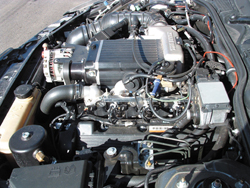
Supercharger neatly fitted in crowded engine bay
Lastly there are the brakes, which in standard 260 form were uprated over the ZT 190 models by virtue of a larger diameter rear vented disc clamped by a twin piston AP Racing caliper very similar to that fitted on the front of the Lotus Elise. The original 190 model’s front brakes at 225mm diameter vented discs with single piston slider calipers were certainly over engineered for the 190 and perfectly adequate for the 260. However, adding an extra 100bhp plus does lend some thought to increasing the front’s capability, but more on this when discussing driving aspects.
Driving the Dreadnought ZT
Trying a car on unfamiliar roads, especially a high performance one is never the best recipe for accurate assessment but fortunately arriving the day before allowed a good recce of the surrounding area looking for venues for photos and driving. The normal roads have obvious limitations as well as speed limits that can be easily breached by the standard 260, so finding some suitable private and secluded tarmac where some repeated measurement could be made of the acceleration was difficult. Nevertheless this was accomplished.
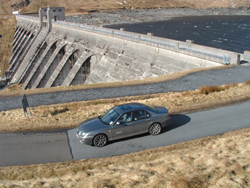
By the Lochan na Lairige Dam
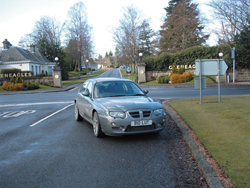
Outside Gleneagles the international golfing centre
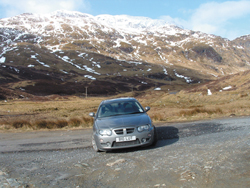
Good roads to test traction
Normal driving was exactly the same as the standard 260, as was throttle response, only a slight hint of the latent power was felt in normal driving. This was good as it allowed acclimatisation to the very slightly different characteristics of this 260 compared to my own. Indeed one positive difference was with tyre grip as this car was equipped with non standard Toyo Proxes T1-R covers of the same size as standard. These gave noticeably better grip than the standard Continentals fitted to the ZT range, and which we used to drive round the same roads the day before, the Toyos giving a noticeably high level of grip on patch damp surfaces.
Once a few miles of familiarity had passed, and being directed by Brian to less busy roads, I was able to start to extend the throttle travel and tap into the engine’s reserves. This provides a very smooth, almost disappointing mild increase in speed until the last inch or so of throttle when you compress the pile of the carpet. That final movement added a noticeable urgency to the blurring of passing scenery and a marked increase in the travel of the tacho and speedo needles. This was not anything like turbo lag and not quite the response I was expecting, but it was completely smooth and progressive. Indeed it was benign enough to be invisible when that suited, so it is just the sort of conversion that husband can have done to the car without wife knowing and still allow wife to drive the car and not to notice. The extra performance needing the driver to command it, the car didn’t volunteer it.
When you did command it, the performance showed how well it could move a 1750kg car with three people aboard to speeds clearly a notch above the standard 260. It was also clear how the upper rpm area had become far more urgent than standard and it was there where the extra performance lay in spades. Using the last inch of throttle and keeping the rpm above 3000rpm made progress very rapid, but accessible in short burst only because of road limitations. This also reinforced the initial views of the Toyo tyres, as not once was traction broken unintentionally and the traction control was switched out.
Traction control switched off? Do I hear ‘hooligans’ from the crowd? Well far from it actually. The traction control as I have mentioned in previous report is quite sharp in the way it operates on the 260, plus it cuts fuel supply. Sean Hyland makes mention of the influence of traction control quite graphically in his book when describing his experience with a supercharger kit fitted to one of his new Mustang Cobras. I quote from his book, “The engine lasted six miles. The first time I launched the car from a standstill the traction control system shut off the fuel and the engine went poof. Since then we disable the traction control.” Quite a low key way to describe the destruction of a new engine I think.
Whilst this provides the reason behind our operation of the car with the traction control switched off, this would be disconnected in customer conversions (only applicable to 2004 model year on). It seems a contradiction to have traction control on the 260, but disconnect it on more powerful conversions. This I fear may prove to be disconcerting to many prospective purchasers.
I earlier raised a question on brakes being unmodified from the standard 260. In use the brakes always provided more than enough reserve to haul the car’s speed down from instances where the power had raised speed far higher in a short section than would be the case with the standard car, and repeatedly so. The feeling was that brakes were more than adequate for road use and only for track day use would there likely be a need for some upgrading of the friction linings.
From a manufacturer’s perspective, 325mm diameter is a mighty size for a brake disc, and adequate for both standard and this uprated car. However, clamping pads to it via a 4 pot caliper would add more feel and bite to the brakes as well as some more pad surface area and added reserve. Not to mention that it sends a positive mental performance message. Look at what 4 pot calipers does for the TF when the bright red caliper ‘grin at you’ from behind the wheels of Sportpack 2 equipped models. They wouldn’t have to be red, but the message can still be made.
Overall one point to make is that the conversion in no way impinged on the standard car’s abilities or refinement. Some of our drive involved snaking through dense conifers on a narrow winding road at steep angles until above the tree line and then above the snow line of nearby mountain roads. The engine torque made light of any inclines and indeed was not unhappy when coming back the other way on a training throttle for some distance. At the other end of the scale when we demanded that the engine had do some work for its living the supercharger added a very faint and somewhat distant background hum. Most people would not actually hear it.
Measured Performance
It is all very well glibly saying how much quicker the car accelerates but without some form of measure there is no real perception of performance until you can actually drive both modified and standard cars. With this in mind and without any fancy equipment beyond a stop watch I attempted to provide some approximate means of quantification.
Having found that suitable section of road, repeated acceleration runs were done. Not in the traffic light GP style though, as that is not just a measure of the car’s performance, but of the driver’s ability to change gear with slick and fast co-ordination. No, a true and reasonably accurate method of measuring the cars performance comes from full throttle acceleration in a single gear between two speeds and measuring that.
Because of distance limitations the speed ranges selected were from 30mph to 90mph firstly in third gear and then in fourth gear. Full throttle was applied from approximately 25mph so that the engine was responding well as the car accelerated through 30mph. At the other end the throttle was released after the car had passed through 90mph. Numerous runs up and down this section were done which cancelled out any wind and gravity assistance. At a later date I repeated the same process with my own car which with around 2500 miles difference on the odometer should be as representative as is needed.
The averaged results are in the table below and essentially show how quick the Dreadnought car is. It also shows how the power is delivered with the acceleration times dropping as the engine revs and speed rises, emphasising how the standard cars slightly peaky power delivery for a large displacement V8 (US readers – this is large for us) is carried through into the supercharged version.
Rolling Road
After returning to Dreadnought Brian was able to show the results of the rolling road power runs the car had done. Very importantly this wasn’t just a single power run after all had been changed, but several runs that encompassed before and after and the figures provide some interesting reading. Such as 103 bhp more at the rear wheels, but unfortunately I am not able to agree with the 405 bhp conclusion the rolling road print outs gave for the flywheel output.
The car in standard form recorded 211.5bhp at the wheels, a very credible and expected result. Why? Well the losses suffered between the engine flywheel and the tyre contact patches on the road are quite predictable (ask the manufacturers of rolling road equipment like Bosch and Clayton). This means that some pretty accurate estimates of transmission loss can be made. To help correlate for this in any cross reference calculation it has been found that adding 10bhp to the recorded figure and then dividing by 0.88 provides accurate results for a wide range of engine capacities and power outputs. In the US there is a more simplistic approach of dividing the wheel bhp by 0.85 (converting the opposite way means subtracting instead of adding and multiplying instead of dividing).
It is also worth noting that these losses will remain fairly constant and only vary significantly if the speed varies. So where the same rev range and gear is used the losses will be fairly linear. Tyre pressures are important as variations here will affect the amount of power they absorb, but huge changes would actually see them melt.
So with a recorded 211.5bhp at the rear wheels of the standard car adding 10 and dividing by 0.88 gives 252 bhp (251.70 for those tapping the calculator keys!). Close to the quoted 256 bhp for a standard engine. Reversing that equation with the standard quoted power of 256bhp results in 216.4, very much in the same ball park and as this is not an exact science it is close enough.
When tested in supercharged form the results showed an impressive 314.5bhp, so using the same equation that transposes to an estimated flywheel output of 369bhp. Using the common US calculation method arrives with 370bhp. This is some way short of the 405bhp the rolling road software transposed and way beyond the effects of air pressure, temperature and humidity changes. To see 35% differences in transmission losses between power runs for the same car with no changes to transmission or rotational speed, does generate questions on how the figures have been reached!
However, I have no issues to raise relating to the measured wheel power, and 103bhp rise equates to just short of a 50% power increase, a most impressive result. Finally I shall finish by saying that these figures are those given to Dreadnought by the company operating the rolling road. Let’s not lose sight that this is a car with a very serious power output.
How quick can that ultimately make the car? Well maths helps once again in being able to predict the potential top speed of any vehicle when you know the coefficient of drag and the frontal area. That enables you to calculate the air resistance and the power needed to overcome it. Then you have to account for the rolling resistance that includes aspects such as wheel bearing and tyre drag. From this you can say that if the maximum engine power is matched to ideal gearing the max speed potential should be in the region of 175mph at nearly 5900rpm. Gearing isn’t ideal though as peak power was measured at 5300rpm, which with standard gearing equates to 157mph. Power doesn’t just stop there though, but does start to tail off, so the actual terminal speed would be somewhere between 157 and 175mph. Hypothetical it is and even the lower figure is fast enough for most people, but it is still an interesting discussion point.
Power costs money of course, and initially that would be just short of £6000 and a week’s work for Dreadnought to fit, calibrate, test and sign off. Running a car fitted with one of these superchargers will cost you more in fuel bills, but that will be proportional to how you drive the car, just as applies with the standard car. In normal use it would be reasonable to expect cruising and normal traffic conditions to see little change, but when the extra power is used then so will extra fuel. It is also reasonable to expect anyone buying this conversion will want to use that extra power so expect sub 20mpg as an overall average compared to the standard 21.7mpg overall official average. Servicing cost is little affected with just a periodic change of the superchargers separate and integral oil. Being an efficient supercharger there should be no appreciable wear differences with the main drive belt either.
In conclusion the Dreadnought car is very good as a conversion and subject to the couple of smaller issues identified, could be mistaken for a factory fit. Where we can’t measure is in the longer term ownership aspects including reliability, but a very good measure can be drawn from the high number of kits fitted to US Mustangs and the good feedback that comes from them.
Dreadnought Garage is located on the Stirling Road, Callander, Perthshire. FK17 8LE Telephone 01877 331099, Fax 01877 331535, e-mail enquiries@dreadnought-tvy.co.uk
For a wider view on what can be achieved with these Ford V8 engines I can recommend reading Sean Hyland’s book ‘How To Build Max Performance 4.6 liter Ford Engines’ (ISBN 1-884089-78-X as it’s not a book that MGOC Regalia currently stocks).
Roger Parker