The TD-2000
The TD-2000
|
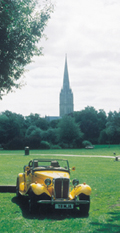
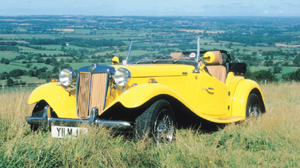
The first TD-2000 to arrive in the UK rolled off a Japanese ferry in Bristol docks on June 14th 2001, it was a lone yellow roadster among a consignment of Proton Impians. Eight days later, the custom duties paid, I drove her home, with the hood down and bathed in hot sunshine. She’d come off the production line, in the TD Cars factory west of Kuala Lumpur, only 10 days after I’d emailed my order, chosen the colour and paid for it.
The drive to Dorset was the first of several without number plates. The next was to Taunton for the obligatory SVA (Single Vehicle Approval) test. A major selling point of the TD-2000 is the long list of sophisticated specifications that have enabled it to satisfy the stringent Australian Design Rules: in terms of safety and pollution, it is up there on a par with the streamlined, airbagged, mass-produced new cars. I’d alerted the TD people to specific British requirements, such as the rear fog lamp, even sending them the official list of ‘the most common reasons why imported cars fail the SVA’. The SVA inspector broke the bad news that she would fail on several counts half an hour into the 4-hour test and I was wondering how I’d put this to the people in Malaysia. However, by the end, after enthusing about the car while driving it himself in the steering and mirror test, he’d given me cause for optimism that there was nothing that couldn’t be easily remedied with ‘cosmetic surgery’. |
 |
Brakes, emissions, steering, speedometer accuracy etc. were all fine; the main sticking points were non-collapsible knobs and lots of under-rounded edges (plus the absence of a rear fog-lamp warning light and the presence of too many front indicator lamps).
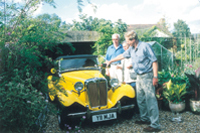
So, I added soft trimmings to the bumpers, various lamp housings, number-plate holders and headlight adjustment nuts and my next journey was to Bournemouth for Roger Taylor Classic Cars to put smart leather wrappings over side-mirror nuts, door hinges, windscreen wiper-ends and steering-wheel spokes. Even the circular rim of the side mirrors had too sharp an edge and required O-ring material to be glued on. TD Cars, were of course embarrassed and not a little angry but paid for the alterations. Then it was back to Taunton for the successful re-test and to Bournemouth for registration, as Y11 MJA. Only an ’11’ (or a more expensive single number) would have fitted on the plate holder horizontally at the back, so it had to be a personalised plate. TD Cars also footed the bill for the champagne at the christening: I called the car ‘Canna’, after the bold, brightly-coloured, subtropical plants that I used to admire on my biological excursions in South America and which I now grow at home. |
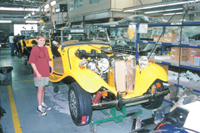
| It was our 14-year-old son who persuaded us to take the plunge, when we saw the TD-2000 on show, both in the Kuala Lumpur airport and in the hotel lobby in April last year. In our hired Proton, we braved the heavy traffic on and around the expressways west of KL and struggled with our sketch map to find the Glenmarie industrial estate where TD Cars share a large hangar with a production line of hand-built executive Protons. By chance we met Roland Funk, the production director, and his cheerful assistant Mr Sivalingam. My wife, Jennie, Stephen and I were given separate rides in the 30 degree heat, the air conditioning blasting out cold air. I took one for a brief test drive (and another one a fortnight later), over sleeping policemen but with a few short straights to try out the acceleration. The exhaust, despite its catalytic converters, emitted a lovely throaty roar when I put my foot down, yet the only noise when cruising at speed was from the wind in our ears. Cornering was so easy, you’d think it had power steering. Only the brakes were a little soft, but we were assured that a new servo system was to be fitted to new cars from then on (and it was). I was transported back to childhood in Singapore in my mother’s white TC and university days with my YB. TD-2000 advertising talks quaintly about bringing back memories of ‘yesteryear’ but the 130 bhp under the bonnet this modern TD was a new experience for me.
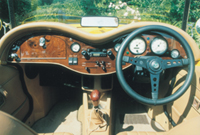
The exterior bodywork is as close to the original as you can get, given added extras like automatic radio aerial and with fibreglass everywhere except the bonnet: the original MG-TD jigs and moulds went from America via Australia to Malaysia. The leather bucket seats are supremely comfortable, much reducing the impact of the stiff suspension. The pedals are close but adequately spaced for my wide shoes and, at just over 6 feet tall I fit perfectly with the seat on backstops. The two soft curves under the windscreen, covered in the same tan leather as the seats, contrast nicely with the walnut burr dashboard and its retro circular dials, black on white. The absence of airbags means a sleek, comfortable steering wheel. The safety belts are attached to the anti-roll bar, just behind the headrests, and behind that there is a low, carpeted parcel shelf and a narrow but quite deep, lockable compartment. The dashboard’s glove compartment is also lockable. Visibility in the rear-view mirror is very good, especially with the hood up. The whole vehicle is well finished and looks nothing short of superb. |
|
 |
Purists would disapprove of the wire wheels and of their chunky width, the three windscreen wipers, but they would be happy with the low-cut ‘suicide’ doors and the colouring of the vertical grille bars. How would they respond to the 10-inch disc brakes all round and, above all, the 2-litre Toyota 3S-FE engine, with its 4 cylinders in line, 16 valves and DOHC? Not to mention its computerised Engine Control Unit which automatically alters the timing in response to water temperature, intake air temperature, manifold pressure, knock and exhaust oxygen levels. Transmission is Toyota’s W56 manual, 5-speed gearbox and very smooth and easy it is too. |
 |
A Malaysian would have to pay nearly £35,000 for the privilege of owning a TD-2000. For a foreigner, however, the official price for a solid colour TD (a ‘Silverstone’) is just under US$26,000 and for a ‘Gatsby’ with two colours just over that figure. The raw price for a ‘Silverstone’ like mine is, therefore, about £18,500. To that you need to add the costs of freight and insurance during the three or four week journey. I had the brainwave of asking Proton for help, and everyone from Mark Surtees at their Bristol office to Khusairi Ismael in KL was extraordinarily friendly and cooperative. I paid US$700 (£400) in total for the ferry costs and insurance, plus £63 to Harrison Logistics at the docks. Then the UK Customs & Excise takes 10% of all the costs plus 17.5% VAT on top, so the total price would be about £24,500. Leather seats, radio cassette, wire wheels and air conditioner are now standard issue, with a luggage rack as an optional extra. Also standard are the tough, zipped, fabric cover for the hood when down and a tonneau cover which fits neatly over the headrests and zips down the middle.
|
|
 |
|
|
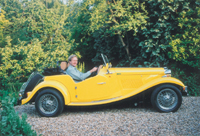
The standard side curtains are attached front and back by Velcro, to the top of the door by press-studs and to the hood by Dzus fasteners. They’re quite awkward, as three sides have to be disconnected before you can open the door. So, I asked Parkstone Trimming Company to make a pair of metal-framed windows, attached to the doors by wing nuts on L-shaped brackets and Velcroed to the sides of the windscreen. So getting in and out is much simpler, and there’s less side-buffeting when the hood’s down. The heating is efficient and controllable and can roast the lower half of your body if you turn it on full, no matter how sub-zero it is outside! The de-mister is diffuse but isn’t often needed as the vertical windscreen gathers no frost or dew. |
|
 |
Official fuel consumption and acceleration figures don’t yet exist. I’m averaging 30 mpg, but most of my driving is of the stop-start variety: it’s four miles to work including 7 speed bumps. Ground clearance is generous for a sportscar at 122 mm so the main problem on the bumps is avoiding hitting my head on the hood bar. The stainless steel fuel tank holds 61 litres. As for the 0-62 time, I guess it must be quicker than the 2-litre Toyota Celica, which had the TD engine, and that’s 8.7 seconds: the TD is lighter at 910 kg (just over a tonne with a full tank and a driver on board). Top speed is 112 mph; I’ve been into three figures and she felt both stable and eager for more. |
| As yet there is no dealer franchise in this country, but that should be no bar to any enterprising individual who’s prepared to risk the vagaries of the SVA regulations and who can organise a garage to do the servicing. Bodywork parts (in my case, a door catch damaged in transit and an experimental new side curtain) are sent by next-day carrier from Malaysia. Two services (the first at the manufacturers’ expense) have showed up no problems. The TD Car Company appears to have secure financial backing and is doing good business in Australia, Singapore and Hong Kong and looking to break into the Japanese market. It’s also seeking Low-Volume Type Approval in the UK, which would obviate the SVA. Classic car insurance specialists can be persuaded to give comprehensive cover. ‘Canna’ has a sister-car now in Sussex: another privately-bought TD-2000 arrived (by the same route) late last year. No-one could fail to be delighted by this beautiful and spirited marriage of the old with the new: it needs no cosseting and is meant to be driven, whatever the weather. The risks I took in going for this relatively untested sportscar were thoroughly worth it and I’m enjoying every minute of it. | |