Technical Tips
Technical Tips
| Switching Over
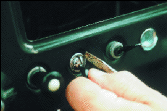
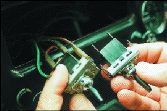
After many years of use the control switches of the car will have been turned on and off many thousands of times. Not surprisingly this will eventually lead to their downfall. This will hopefully not happen at an inopportune moment, such as your wipers failing during a shower on the M25. Replacement is quite straightforward. Depending on the year of your car you will need to either remove the radio or the air vents from the centre opening in the dashboard. Different radios have different fixings so it will be necessary for you to check with the instructions on the removal method. The twin air vents, if fitted; are held in place by plastic spring clips. Try pushing the vents to one side, this sometimes releases the clips and then the vent can be pulled out. If this does not work, you will have to use a small thin screwdriver. Once one vent has been removed the other is much easier to take out. With either the radio or air vents removed you can now peer through the open hole to see the switches. In this case we are changing a flick switch. From the front of the switch undo the securing ring. This has to be done very carefully with a small screwdriver, one slip and you will scratch the dash! With the ring undone you can now push the switch into the dash and bring it up and out of the hole made by removing the air vent/radio. |
|
| Place the switches side by and methodically change the wires over one by one. Once all of the wires are changed over, switch the ignition on and check that the device that the switch operates works correctly. Once happy the switch can be replaced back in the reverse procedure of removal, again taking care not to scratch the dash in the process.
For those cars fitted with later square rocker type switches the procedure is the same except that the switch has two catches to be released on each side of its body. Once released the switch can then be pulled out of the dash and the wires changed. If you are very lucky you could try to pull the switch out before you carry out any other task. If it comes out it will save you the task of having to remove air vents or radio. Jonathan Kimber |
|
| Traces of Oil
Only when the dust, litter and leaves on my garage floor reaches the stage where it might be hiding a tin tack, do I reach for the broom. That is when I am likely to notice, for the first time, new drips from my, generally oil tight MGB. My investigation of new floor patterns is very technical. Is it oil? If so, is it thick or thin? Or is it, water, petrol, antifreeze, battery acid, or even Dot 5 hydraulic fluid? If it is not battery acid I may have to resort to the taste test, in which case it is more hygienic if the floor has been swept first! Last week I found that hydraulic fluid had been dripping from my Differential. Very Odd! I was already aware that my Clutch fluid needed a 20ml top up each week, but after further grovelling amongst her underpinnings. I soon realised that the slave cylinder had seen better days, and the bellows although still intact, were a perfect shape to store up to 70mls of leaked fluid without releasing a single drop directly onto the floor. It only needed me to change gear in overdrive with enthusiasm at 5,500rpm to explode this mini bomb. At such enormous speeds this would liberally coat hydraulic fluid over the underside of the car to drip mischievously on my garage floor as soon as ‘B’ was safely tucked up for the night. I swear that this car has a life of its own, throwing down a new diagnostic challenge like a slap with a gauntlet, every so often, just to keep me on my toes. So we have started jousting have we? I only hope I win. Colin Brown. |
Tonneau Cover Support
To achieve a waterproof interior using the tonneau cover is probably impossible as water always leaks through the zip. The best method I have found is to make up a “ridge pole” using a couple of lengths of plastic water pipe joined with a piece of doweling. This “ridge pole” is supported at the front on the dashboard top and at the rear on the tonneau support rail. Placed under the length of the zip it will hold the zip up so that the weight of the rain will not make the tonneau sink and form a puddle in its centre. The further addition of a towel on the tunnel under the zip will absorb and drops that come through the zip. I have successfully used this method on the several open cars that I have owned over the years.
Jeremy Burr