A Twin Cam called Ratty – two years on
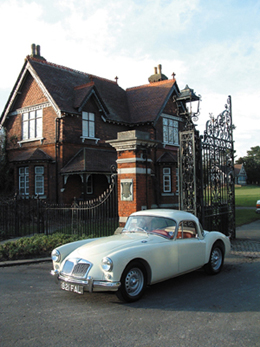
Two years back on the road
At the time of writing it is exactly five years since I bought the rusty remains of the MGA Twin Cam Coupe now affectionately known as “Ratty” and long-term readers of Enjoying MG will perhaps remember seeing the original photographs I took just after I got the car home. These were published in April 2001 with a short account of how I found the car and how it had been covered in straw and left to rot in a barn for thirty years. I have restored several corroded MGs over the years but Ratty needed so much work I nearly abandoned the project and scrapped the car. Fortunately I had some well-informed friends who pointed out that only a dozen or so Twin Cams have survived with the Coupe body and this car was definitely worth restoring. The decision was therefore made to go ahead with the work as a home restoration project and this was published in 15 instalments over the next two years.
Ratty back on the road first finished in March 2003
Ratty has now completed 2500 virtually trouble free miles and it seemed a good time for an update on how the car has been performing. I have not driven as many miles as I would have liked but that is because of other things happening in my life, mainly catching up on a three-year backlog of decorating. It is certainly not the fault of the car, which is an absolute joy to drive now that the engine is run in and well developed, but more of that later.
The only failure to report has been with the water pump which started leaking profusely after only two hundred miles. Fortunately when this occurred I was quite near home and I limped back under my own steam, literally! The water pump on the twin cam is special to that type of engine and new replacements are unobtainable. There was no alternative but to restore the existing pump by fitting a new shaft and gland. In an attempt to give the new gland the best chance to seal I refaced the gland seat on the impeller with a brass insert but after only a short time the gland seal had cut into the brass and caused a severe leak. I refaced the impeller again, this time using naval bronze, a higher specification material which is better suited to the sealing duty required. I also changed the cooling fluid to the synthetic ‘For-Life’ type that is ideal for engines manufactured from cast iron and aluminium alloy. Since this remedial work I am glad to say the pump has remained completely trouble free.
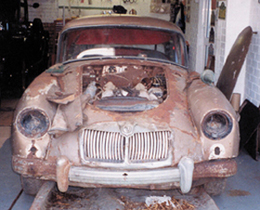
Ratty as found in March 2000
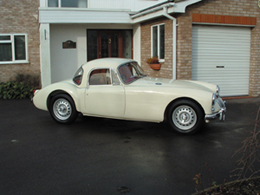
Regular use improves a classic
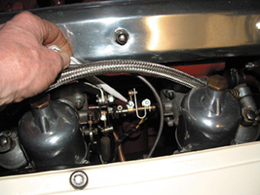
Twin cam engine, the throttle spindle nut to be released before adjusting slow running
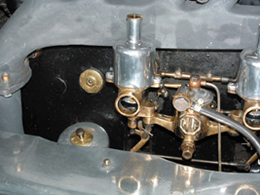
Pre-war MG SU carburettors operate on virtually the same principle to those on the Twin cam and are more easy to see for demonstration purposes
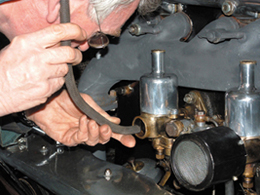
Listening to the carburettor ‘hiss’ to balance the slow running of each carburettor
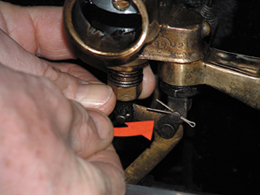
In this photograph the fuel-air mixture is being adjusted by screwing the nut up. Screwing the jet adjusting nut in this direction makes the mixture weaker
Talking of cooling, one thing I have changed for the better is the thermostat. The engine still had the original ‘bellows’ type fitted which I decided to reuse after checking it functioned correctly. I placed it in a pan of water on the cooker and noted the temperature at which it opened. In use I found that temperature response was too slow with this original thermostat and I changed it for a modern wax filled type. Now the temperature rises quickly to the set temperature of 185 degrees F and rarely moves more than a few degrees above or below even in hot weather or after aspell of running at high speed.
For me the best part of restoring a car comes after it is back in use and properly run in and I can begin tuning the engine to obtain its full potential. When I say tune I am not talking about radical modifications to the engine but making fine adjustments to the ignition system and carburettors to produce the best all round performance. I find this work very satisfying because you can use the car and at the same time develop its potential to give the best compromise of power, fuel consumption and driveability. This type of development work is by its very nature an iterative process and the starting point is to set the engine to run using the workshop manual. However these settings may not be optimised for your particular engine because so many variables have to be considered, not least that modern petrol is very different to that available when the car was new.
Tuning the SU carburettors is a relatively simple exercise on all MG engines if you follow some simple procedures. The technique I used to set the carbs initially was to fully wind up both mixture-control jet nuts and then wind them down 9 flats or one and half turns. It is difficult to show this clearly in the cramped engine bay of an MGA with a twin cam engine so I have included a photograph to show the direction of rotation to wind the jet control nut up on the SU fitted to a pre-war MG. The engine started first time at this setting and the fuel mixture was near enough to need no further adjustment until the engine had settled down after a hundred miles. For the first engine run I left off the carb air cleaners and loosened one of the nuts which lock the throttle spindles of each carburettor as shown in the photos. The idle speed of each carb was adjusted by listening through a short length of pipe for an equal hiss from the two intakes. If one intake sounded louder than the other I unscrewed the throttle stop screw until the sound changed. This is not as difficult as it sounds and if you have not tried it before, have a go at altering one throttle idle screw and listen to the effect of making a small change. After a little practise the technique will allow very close synchronisation of the carb airflows on idle. Once I set the idle speed to 800 rpm the throttle spindles were locked together again.
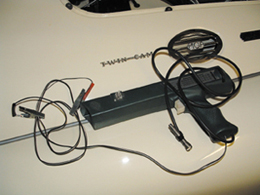
Stroboscopic light enables ignition timing to be measured whilst engine is running
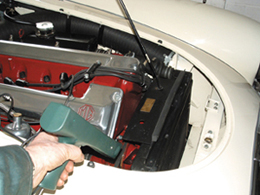
Strobe used to measure the ignition advance curve. One lead is connected to cylinder number ignition lead. In use the strobe lights up the engine pulley and ‘freezes’ the position of timing mark to show the amount of advance at any given constant engine speed
Another important check on the carburettor set up was to ensure the choke mechanism was working correctly. I got my wife to sit in the car and pull the choke in and out a few times and I could then see how it was meant to work. The first part of the choke travel increases the engine rpm by moving a cam attached to the throttle spindles and there is a screw adjustment to allow fine-tuning of the fast idle. The next stage of the choke travel pulls the jet tubes down to enrichen the mixture. One final check was to ensure that both jet tubes sprung to the fully up position when the choke was pushed right in. If this does not happen it is impossible to reliably set the mixture control.
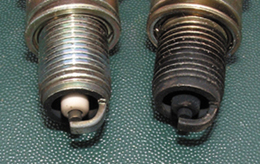
Example of using a hotter plug. The plug on the right is a Champion N3 cold running plug as recommended by MG for use on the Twin Cam with high compression ratio pistons. The plug on the left is a modern equivalent of Champion N5 ‘hotter’ plug. Both were run on Ratty which has low compression pistons under high speed conditions with no other changes to mixture or ignition settings
After about 100 miles I made some fine adjustments to the fuel mixture by removing the air cleaners and first checking the idle rpm and throttle synchronisation with the ‘hiss’ test. The next step was to check each carb mixture by slowly lifting the throttle slide by about a millimetre using a thin screwdriver. I found that lifting one throttle slide caused a slight rise in engine rpm followed by a fall as I continued to lift the slide. This meant that the carb mixture was set correctly. The same test on the other carb however caused the rpm to drop suddenly and this meant that the mixture was too weak. To rectify this I wound down the jet mixture control nut in the opposite direction to that shown in the photograph. If the engine speed had increased and continued to increase as the throttle slide was lifted this would have indicated that the mixture was too rich and the jet nut would have needed to be raised to weaken the mixture as shown in the photograph.
There are many horror stories about the unreliability of the MGA twin cam engine and especially the risk of burning holes in the pistons by running the engine too advanced and with the incorrect grade of spark plugs. All the advice I have read suggests that the distributor contact breaker points must be set statically to open at top dead centre and any attempt to advance the ignition from this point will rapidly lead to burnt pistons. It does not help matters that the distributor on a twin cam engine is fiendishly difficult to even see, never mind work on, so you can tell straightaway that there is a perfect recipe for disaster. I therefore spent a lot of time in setting up the ignition timing on Ratty according to this advice and ran it this way for a few hundred miles. However as the engine began to loosen I became aware that the acceleration was very flat until the engine rpm was above 2500. I then discovered that the advice I had used to set the distributor timing was for engines with 9.9 to 1, high compression pistons and Ratty had a set of 8.3 to 1, low compression pistons. MG Service memorandum 325 suggested that when the low compression pistons were used the ignition should be set up 8 degrees advanced before top dead centre.
I reset the static ignition timing using this advice and the difference in performance was noticeable with more torque at low engine rpm but now the engine felt too harsh between 2500 and 3000 rpm. It was present in all gears under acceleration but was most annoying in top gear. I therefore decided to carry out a bit of development work of my own. Using a stroboscope light as shown in the photographs I measured the ignition advance at various engine speeds recorded on the graph. This confirmed that the whole ignition curve was 8 degrees advanced and I tried a compromise setting around 5 degrees and I plotted these measurements on the graph. Over the critical band of rpm the advance is now limited to a maximum of 24 degrees and the harshness has been eliminated. During road trials the car still pulls well at low rpm and I am very pleased with the outcome.
After I made the adjustments to the ignition and fuel mixture as listed above I carried out one more final check on how the engine was running at cruise conditions. For this test I drove the car on our local by-pass at a steady speed of around 60 mph for at least five miles and then pulled off into a lay-by. I let the engine cool for a few minutes and then removed all the spark plugs to inspect the colour of the electrodes. This is a really useful test that will show if the fuel mixture and ignition timing are set correctly for cruise conditions. Ideally the plug electrodes will appear a light straw colour but if they appear black the mixture is too rich or very white indicates the mixture is too weak. I was puzzled to find that the plugs on Ratty were much darker than I would have expected but I was sure the fuel mixture was not too rich. I then remembered that the spark plugs fitted were Champion N3 as specified by the factory which is a colder grade than would be fitted to a say a push rod MGA or MGB engine. The term ‘colder’ plug refers to the length of the path from plug electrode to the plug thread and the shorter the electrode the quicker heat can be dissipated. It seemed to make sense that the N3 plug specification was aimed primarily at engines fitted with the high compression pistons and would be too ‘cold’ with the low compression pistons in Ratty.
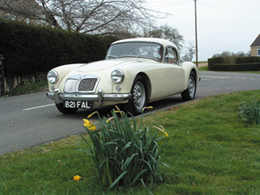
Ratty enjoying the spring of 2005
I changed the plugs to those specified for an MGA 1500 cc push rod engine and you can see the difference in the photograph of the two grades of plug. With a ‘hotter’ grade of plug the car immediately felt much more responsive, starting almost instantaneously and giving better fuel consumption.
I started off by saying I have completed 2500 miles and lately the fuel consumption has been around 29 mpg with the engine performing well. I believe the changes I have introduced to the ignition system are a real benefit. The low compression pistons fitted to Ratty’s engine were introduced by the factory late in the production of the twin cam engine to try and stem the rising tide of warranty claims associated with burnt pistons. Forty years on it would appear that the factory spent insufficient time on properly developing the changes to the ignition settings and plug grades. I also accept that the fuel available at the pumps today is very different and this may have been a contributory factor in my findings with Ratty.
Now that the better weather has started I am looking forward to getting out and about a bit more in Ratty and I hope to meet other owners at the various shows and gatherings arranged this year to celebrate the fiftieth anniversary of the introduction of the MGA.
John Day