Performance without Consumption – Variations on the Theme
My first feature under this title highlighted how good the standard MGF and TF are in respect of fuel economy, and with the right road and driving conditions, aided by appropriate driving style, they can be outstanding. Then how carefully chosen engine modifications can offer an additional fuel economy bonus, yet with greater efficiency comes the option of more performance if desired, but this a straight choice between one or the other, not both.
Whilst the focus was on the MGF and TF, the same good fuel efficiency applies to any model using the four cylinder K series engine which obviously includes many models in the Rover and MG saloon ranges over nearly two decades. Applying the same conditions and modifications allows these cars a similar benefit.
Recent volatility in oil prices generated rapid and huge fuel price increases, then some equally significant falls. What this indicates is how unstable oil prices are today and a reasonable assumption is that we will see future volatility affecting fuel prices. Whilst taxation, economic and CO2 emission issues were already enjoying a high profile, the clear impact of high petrol prices has been to put fuel economy top of the list.
Downsizing their car
One official international Governmental response is car downsizing, something many drivers will do, or want to do if they can. Many car owners in the UK saw the residual values of their current less efficient vehicles collapse in the weeks following the Budget 2008, when the massive taxation increases were announced. However, since then these forthcoming tax rises have been temporarily softened by the Chancellor’s announcements in November 2008.
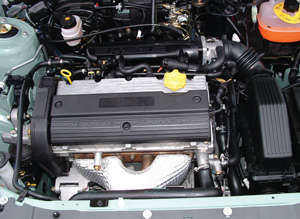
Example 16 valve K series engine but can you tell whether it is a 1.1, 1.4, 1.6 or 1.8? It is in fact an 84ps 1.4.
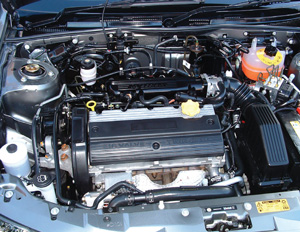
MG ZR came with 1.4 105ps and 1.8 litre, non VVC and VVC engines; only the latter is visually different.
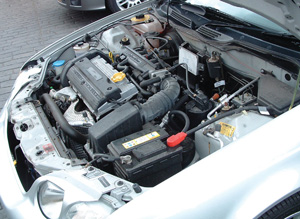
MG ZS 110 and 120 engines are visually identical and visually the same as most Rover 25/45 and MG ZR models.
More importantly was that in the period between those announcements massive fuel price rise spikes had a huge impact on every car owner. While rising fuel costs aggravated the drop in car residual values, the onset of a recession caused those remaining values to just vapourise. All this has left many owners locked to their current cars for very much longer than they normally would, so what is left for them to consider?
Downsizing with an engine change
Looking from another perspective, as cars age and engines wear there will at some stage be a need to consider an engine rebuild or change. Obviously a new or rebuilt engine should be considerably more efficient that a worn higher mileage one, but changing to a smaller capacity could also enhance economy.
Generally the usual question related to an engine change is, ‘Can I replace my K series 1.4 or 1.6 litre engine with a 1.8 or VVC engine?’ The answer has been a resounding ‘yes’, so now people may be starting to think about going the other way and downsizing their engine with a view to gaining economy and saving money. This too is quite viable but very importantly you must use the correct mapping to get the best efficiency. However, the results may not be that different to the original larger engine, so look at contemporary road test results and published economy figures of the smaller engined model to see what difference could be expected.
Swapping a four cylinder K series engines for another four cylinder K series engine is relatively simple, except perhaps in the MGF and TF due to the engine location. Swapping from a KV6 to a four cylinder K is not simple as there is far more to do than just an engine change and I wouldn’t go there. Neither would I be looking to fit a 2 litre KV6 in place of the 2.5, or consider changing a 190 engine to a 160 spec in the search of economy as the results will be disappointing for the effort and cost.
At this point I would also emphasise the need to contact your insurance company with any projected changes, and I suggest this be done by letter so you have written replies to be able to refer back to in the future, should the need arise. Clearly I expect everyone would appreciate that any performance enhancing changes will alter the insurance risk and usually attract a premium increase.
However, many drivers may regard economy or performance reducing changes in a different light not demanding contact with the insurance company. This is a very wrong assumption as any change to the original vehicle specification can affect the risk and as such you have to advise the insurance company of the changes. Genuine economy based changes will probably not see any premium changes but this is a matter for the individual insurer to decide. Even when changes are done professionally with standard factory parts, the car still becomes a conversion as it is not what it originally left the factory with, and converted cars often worry insurers.
Another question that will arise is, ‘If I fit a smaller engine can I get my tax at the lower rate that applied to cars originally built with the smaller engine?’ NO is the short answer to that question, as the car is homologated and registered with the engine size originally fitted, and whilst you may alter the engine capacity and engine number on the DVLA vehicle files and the V5C, the taxation class and CO2 rating is ‘set in stone’ and will not be changed.
Viewed from another angle that ‘set in stone’ taxation group can work to our advantage when looking to increase engine size, and is something that I have done several times in the past. The principle is simple and in some cases more applicable now there is a wider margin between the taxation groups. If you want to have the performance of the top range model without its tax burden, then buy a smaller engined version and fit the engine and running gear of the performance model.
A perfect example of this is the ZS range with the UK entry level 110 1.6 litre version CO2 rated at 168 grams per kilometre, whilst the ZS 180 comes in with 227 grams per kilometre. Confirming the CO2 variations is the wide knowledge that the KV6 engine in the 180 is nowhere near as economical as any of the four cylinder K series engined models, so it is no wonder older ZS 180s are being almost given away. However, there remains a strong demand for the performance and charisma that the ZS 180 delivers.
The follow on question is how you would get ZS 180 performance from a ZS110 or for that matter the more common ZS 120 (the 120 sits in the next group up from the 110 with 174 grams per kilometre). Looking at the number of ZS 180 cars being sold for little money, the obvious answer is to buy one of these and transfer all the running gear from the 180 into the 110 or 120, thus enjoying the 180 attributes in a lower taxed 110 or 120.
A less complex alternative is to fit a 1.8 VVC engine, and a perfect example of this was covered in the July 2006 edition of the Enjoying MG. Fitting the VVC and ECU can be a pretty simple bolt in job, needing just the VVC engine wiring loom and ECU security matched to the cars alarm system along with a brake and suspension upgrade. In fact fitting VVC engines in places previously occupied by other four cylinder K series engines is a popular pastime and quite a few different cars have had such a conversion via my driveway.
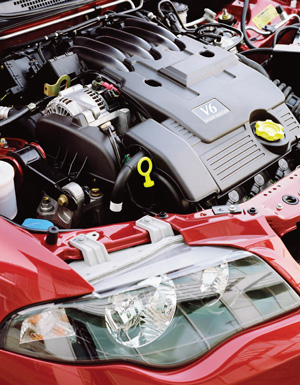
MG ZS 180’s much larger and strikingly different 2.5 litre KV6 engine is easy to identify against the 4 cylinder K series.
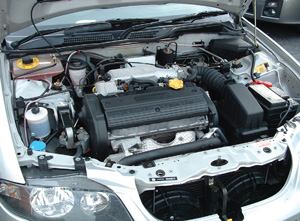
This VVC engined ZS appears to be factory spec, but is a very competent conversion.
Most VVC conversions have been full engine changes, but a couple have been essentially head conversions, a perfectly acceptable route. That means fitting a complete head to a sound bottom end like a modern day ‘stage 2’ conversion. You only have to use the VVC timing belt, inlet manifold, engine wiring loom with aforementioned ECU.
Manual gearbox clutch and flywheel need consideration when swapping engines as there are a number of variations. In very basic terms 4 cylinder K series engines used in MG and Rover models up to and including 1600cc used a Rover R65 series gearbox up to 2003, then replaced by a Ford (Fiesta type) IB5 gearbox. One exception is the MGF and TF 1600cc models, which retains the common PG1 series gearbox as seen in all other manual MGF and TF models, but with a smaller clutch. All 1800cc K series engines are mated to a PG1 gearbox except those used in Rover 75/MG ZT and auto applications, which I am excluding from these considerations.
Suitability of flywheel, clutch and gearbox varies from model to model, the new engine and projected use. Typically the smaller the engine then the smaller the clutch fitted and so for example upgrading a ZR 105 with a ZR 160 VVC engine with the car’s original gearbox would require the 105 flywheel and clutch to be fitted to the VVC engine and then it would work. How long it will remain operational is an open question as someone fitting a bigger and considerably more powerful engine is hardly likely to pussyfoot around. The ideal is to also upgrade to the VVC car’s PG1 gearbox which demands changing many other components, but reliability would benefit.
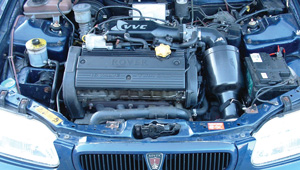
Shoestring budget VVC conversion in a Rover 400
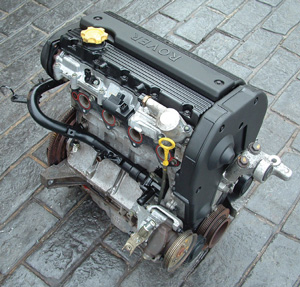
VVC engine awaiting new home.
A point of interest here is that overall vehicle weight has a direct bearing on the amount of stress in the transmission. Put simply the heavier the car, the bigger and more robust the transmission and especially the clutch needs to be. For example the Rover Metro weighs in at about 800 to 850 kgs, and when they are converted with VVC engines attached to their original clutches and R65 gearboxes, it’s remarkable that these components manage to survive as long as they do before breaking. As a ZR or ZS weighs between 250 to 300kgs more this is why these MG models really need to have the stronger PG1 gearbox, clutch and flywheel if being fitted with a VVC engine.
Some years ago my son Matt and I fitted a spare VVC engine into an early 1995 five door hatch Rover 400. Interestingly the car was ‘payment’ to Matt for removing the original 1600 engine and R65 gearbox that was being fitted to a Rover Metro. The ‘payment’ needed to be either broken for spares, little value, or given another engine and gearbox and gain some use. Our spare VVC engine came with wiring loom and ECU, but was a late MEMS3 spec. A breaker provided gearbox, drive shafts and a gear linkage. New brake parts and good second hand ZS suspension, Streetwise optional 17” wheels and ZS seats made for a very cheap but surprisingly rapid and effective package.
Aside from a surprising number of small differences, and omissions, in respect of engine and gearbox mountings, subframes and even seat fixings, the changes were otherwise reasonably straight forward, with some splicing of wiring harnesses to allow the integration of the MEMS3 into this originally MEMS 1.9 car. An ITG Maxogen air filter and a modified ZR 160 exhaust manifold, downpipe and cat married to a Piper stainless sports system liberated a little more power, which was further increased by an extra 2 degrees of ignition advance configured using normal dealer T4 diagnostics (this is a largely unknown option for late VVC engine management systems).
About 18 months daily use showed that a 1.8VVC in this 400 body delivered not only the surprisingly good performance but also very impressive average fuel efficiency. It made an interesting comparison against my former standard ZS 180 and in most aspects was as quick, but driven in the same conditions at like speeds the VVC 400 was significantly more economical. Looking at the power side of things this standard VVC engine, from a 145ps Rover 25GT1 but with the minor additions mentioned, put the engine at least on a par with the 160ps VVC engine. In addition whilst the gearbox had the same intermediate ratios, the VVC 400’s performance benefitted from slightly lower gearing than the ZS 180 (4.2 to 1 final drive against 3.9).
The one big problem with this car was that it wasn’t an MG, and no amount of tarting up would alter that. Consequently there was a desire to change it, a decision that was significantly assisted by the collapse of second hand values of ZS models following MG Rover’s demise, so at that time a virtually new condition 10k mile 2003 MG ZS 120 hatch was purchased, with the intention to focus upon this and transfer the VVC from the 400. However, with the passage of time apparently fixed and sensible plans are often modified and in this case the question raised was why put in the VVC; why not fit the 1.8 K series turbo as found in the Rover 75 and MG ZT 1.8T models. Why not indeed.
There then followed a very much longer conversion period than expected, but boy was it worth the wait. Read about the long and winding road followed to turbo the ZS in the next instalment in this series.
Roger Parker