Performance without Consumption
History is like fashion, often repeating itself, and the general response tends to be a repeat also. Look at the follow up to the 1973 oil crisis and the sales slump for anything perceived as a ‘Gas Guzzler’. In MG history the MGB GTV8 was a clear casualty because it had a V8 engine and was therefore labelled as a ‘Gas Guzzler’, although it was only slightly thirstier than the 1800cc version when driven sensibly.
Today with pressures from various different directions there is a more focussed move on the part of car makers to downsize their engines, introduce various new technologies and lighten their vehicles to make them more economical, ecologically friendly and ultimately more acceptable to enable them to sell more. Much of this pressure now comes from customers using their buying power to choose models that offer these features, and from an opposing direction comes the spectre of legislation and punitive fines should planned CO2 emission targets not be met.
For most of us though, the primary consideration is the cost related to running our cars, with the cost of fuel being high on that list and many more of us are now taking the issue of CO2 emissions very seriously. Recent increased volatility in the oil and financial markets has done nothing to ease pressures, only amplifying them.
Many of these pressures are contradictory, for example, pressure to reduce our fuel consumption and downsize to some modern eco box means having to effectively give away the current car and invest heavily in the new eco version. Difficult to do if that car has to be bought on credit and credit is not available. Throwing away our current cars is also pretty wasteful and brings forward valid arguments in respect of the carbon footprint with such an approach.
Economic driving is available to all
Modern MGs with 4 cylinder K series petrol engines have always been much more efficient than many people give them credit for, and most have untapped efficiency potential that is within reach of us mere owners. In these disturbing economic times with many pressures on the household budgets the cost of fuel is a significant element so here is a list of simple things anyone can adopt to improve their cars fuel consumption.
- Change up ‘early’ through the gears, just before the ‘peak-torque’ rpm
- Ease your speed. Driving at 70mph uses around 15 per cent more fuel than at 50mph
- Accelerate smoothly and avoid wide open throttle when possible
- Anticipation: to avoid unnecessary braking and stopping
- Use the air-conditioning sparingly as it increases fuel consumption
- Switch off the engine when stationary in long standing traffic if it is safe to do so
- Check tyre pressures regularly
- Remove unnecessary weight from your car
- Reduce aerodynamic drag whenever possible, e.g. removing roof racks when not in use
- Follow the recommended servicing schedule
- If your car has a trip computer with instant fuel consumption or range facility have it on, as it helps develop economic driving techniques
Members of the Institute of Advanced Motorists will recognise many of these driving features as basic aspects of advanced driving that have been around for many decades and I would add other basic advanced driving techniques to further enhance the economic advantages, advanced observation and anticipation.
Stretch your observation limit beyond the car in front to as far ahead as you can see and note everything possible in between. This also applies to more sensible use of the mirror to see not just the vehicle immediately behind, but way back and note all you can there. With this longer range view, anticipation now comes to the fore.
Knowing the layout of the road and monitoring the movement of vehicles allows more time for you to anticipate what may be about to happen and for you to adjust your speed and position smoothly and safely, thus avoiding any need for unnecessary braking or harsh acceleration, both of which are damaging to fuel economy. Having held an advanced driving qualification for over 30 years with periodic refresher courses leaves me in no doubt as to the benefits for any driver and something I can wholeheartedly recommend others to pursue. www.iam.org.uk
I would also point out an additional comment in respect to soft top sports cars, which seems to have passed by many owners for a very long time. This is the simple fact that when the hood is down the drag goes up quite noticeably. This should be obvious by the buffeting that occupants receive when travelling at above about 30mph, but take that a stage further and drive at more than around 50mph with the hood down and that drag will be sucking much more fuel from the tank. Even with side windows up and windstop raised that drag will continue, so you and your passenger may be more comfortable when travelling at 70mph, but the drag will still be draining the tank that much faster.
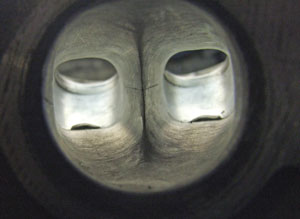
Porting in head shows little difference to standard but the devil is in the detail
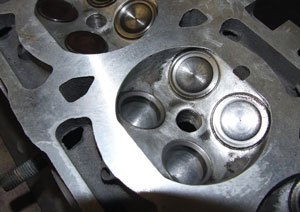
The area between just before and just after the valve seats dictates how good a head works. Exhaust valve seats are kept wider to transfer more heat and be more reliable
Economy driven modification
Having mentioned that there is untapped potential to make the car more economical the question is, how much potential is there? There is no clear answer to this so I thought I would try and find some answers with my own current run around MGF 1.8i, the 179th EU3 spec car made by MG Rover, so it features the later MEMS3 engine management and the use of both a pre and post catalyst lambda sensor. This is a more complex system, although in theory it should be more flexible and so remain more accurate.
Whilst non of my cars remain standard this was mechanically pretty standard aside from a favourite of mine, an ITG Maxogen air filter conversion, expensive but I believe it to be the most effective available, and a 52mm alloy throttle to replace the 48mm plastic one. With these there was a stronger mid range pull commensurate with what I have felt and then measured on other cars with the same items, so read up to around 10% improvement in power and torque.
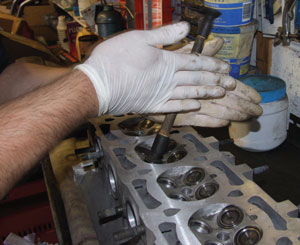
Valve grinding is no different here than an older engine
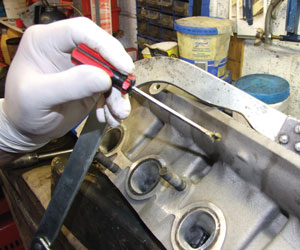
K series collets are small, fitting using a dab of grease on the end of a screwdriver makes the job much easier. Note the home made cut out in the spring compressor tool to clear the edge of the head
As I have mentioned in other features I keep records of fuel and mileage, for the purpose of noting if a problem is developing as dropping fuel efficiency is always an advanced sign of a problem developing with the engine, or mechanical issue such as a dragging brake. It is also useful for retrospective comparison of fuel consumption following changes and this is how I would use the records here.
I also have quite a deep file detailing the changes and results I have made previously to many MGFs and other cars using the K series engine, so where cars have similar changes similar results can usually be expected and ‘felt’ when driving. Many direct experiences do tend to ‘calibrate’ your ‘seat of the pants’ feelings to more accurately assess the changes, so a rolling road session is then only needed to accurately quantify the changes when figures are needed.
Years of modifying older MG engines with Peter Burgess has shown that standard cylinder head castings are often pretty awful quality, with not just lumps and bumps, but porting variations in position, shape and size. In some cases it is a wonder that engines ran as well as they did, but also explains why when looking at MGB engines, 30% power improvements, or more, from only a carefully modified head have not been unusual.
However, such improvements have to be tempered with some reality as the older MG engine was relatively low powered and inefficient. Take an average 1800cc MGB delivering 65bhp at the rear wheels and then add 30% to reach around 85bhp. Compare this with a standard base 1800cc MGF K series engine that delivers around 100bhp to the rear wheels on the same rolling road and you immediately see that the modern engine is way ahead of the older engine. This also extends to the comparative fuel economy, even though the cars weigh much the same.
It has also been noted that when modified, and in general driving conditions, the older MG engines often deliver better fuel consumption, sometimes quite markedly. The reason is related to the word ‘efficiency’, and in a modified form the engine is producing more power for each pound (in weight) of fuel consumed. If the driver wishes to cruise at a given speed then this requires the engine to deliver a specific amount of power needed to drive the car at that given speed. In modified form the engine needs less fuel to make this power, so the same cruising speed uses less fuel.
Up to this time the emphasis with modified heads I have used has been to improve the engines power, with fuel economy a secondary consideration. With the modern K series engines, efficiency is still way above that of a modified MGB engine so there is far less scope to expect either big power gains or leaps in economy, however standard head castings display some volume production induced shortcomings, so I still felt that there was scope for improvement, but now with economy being the primary aim.
Over many years Peter has found a strong demand for older MG heads to be done with very mild modification that delivers useful power increases, unleaded capability and an ability to improve economy. He sells these as his ‘Econotune’ range which is clearly aimed at only the older engines. (www.peter-burgess.com) Using the same principles that are applied to the older heads, but now on a K series head has been done before, but not with fuel economy as the primary target, so I decided to have Peter try the Econotune principles to a spare new K series head I had in the garage (as you do).
Peter did the quite detailed mods and then I finished with valve grinding and reassembly; always good fun with fat fingers and collets the size of K series collets. As this head was new I decided not to skim the face, although I did consider this because I now only use the thicker MLS gasket. Factory engines using the MLS gasket have an additional 12 thousands of an inch removed from the face to maintain the same compression ratio. Not skimming means my engine compression is very slightly down on what would be seen with the original SLS gasket, but since I had been using the MLS gasket on the engine up to this point with no compensating skim, it would help provide a more accurate picture of the effect of the head mods higher compression does provide greater efficiency.
Immediate driving results showed the engine was very noticeably smoother, the careful porting work clearly providing more even volumes of air to each cylinder resulting in more even combustion pulses. Idle was almost imperceptible with the standard MGF super silent exhaust, and can actually make smooth starts in noisy stop start traffic difficult, as you lose the feel and sound of the engine and have to rely on just the tacho. My previous MGF gained a Janspeed cat back silencer to add a little extra sound to overcome this issue, and this time a nearly new TF cat back silencer was used as I had it in the garage, the TF exhaust being just that little bit louder and all I needed to return that lost dimension.
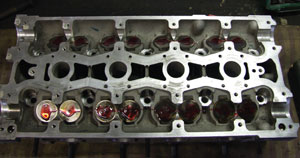
Cam lube gives better protection when starting a newly assembled cam/follower set up
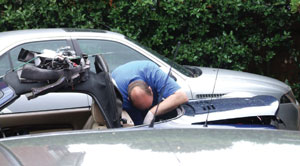
Even big people can work in the MGF/TF engine bay
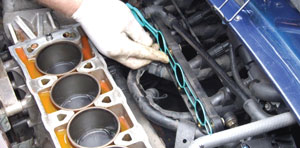
The head fit is like any head gasket replacement. Here a new inlet manifold seal is fitted whilst there is room to do it easily
There followed a period of use where the increased power and performance was felt to be similar to that of a VVC. However, a surprising but clear slight misfire on a slightly positive throttle, which completely cleared with a wider throttle opening and not felt on a steady throttle, was present. Also fuel economy didn’t seem to be as good either.
Chasing this misfire proved to be a pain, with many simple items changed, others checked and much use made with my diagnostic equipment to monitor very closely what was happening within the engine management system. There was no obvious fault, other than perhaps what appeared to be a slightly sluggish to respond after cat lambda sensor. As the car sailed through the MOT without a hint of any emission issue with this fault, I wasn’t thinking of any cat issues but I was thinking of a lambda sensor fault. Having a couple of spare lambda sensors meant I could easily eliminate them by fitting these known good units, but nothing changed. This left the cat with a small question mark over it, but the cost of a new cat was not something that I was then prepared to absorb, especially based on a slight suspicion rather than a known fact.
A couple of months later a chance bargain Ebay purchase from an ex MG Rover dealer cropped up with a genuine new cat for the late MGF/TF, and provided an unexpected economic means to check out if the cat was the problem.
Aside from the usual rusted to hell studs and nuts that afflicts all modern MG cats, the replacement was a simple unbolt one and bolt in the new one, including the post cat lambda sensor that had previously been removed and refitted.
Immediately the car lost that background misfire and became even smoother and sharper, and frankly this was a surprise. The smoothness was more evident after a few hundred miles, which I interpret as the engine management adapting to the new operating conditions, as reported via the post cat lambda sensor.
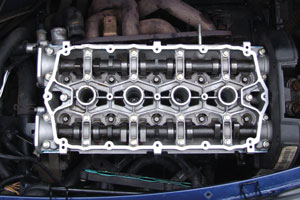
New head in place and only needing a few more parts to finish
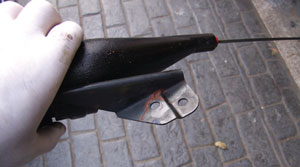
An un-related issue, but what has become a common problem, is cracking of the oil filler/dipstick bracket. Out with the MIG welder for this
The ‘calibrated’ seat of the pants assessment fed back that the car was sharper but also ‘seemed’ to be better on fuel, whereas the period with the misfire seemed to show a worse return than before the modified head was fitted. Looking at the actual returns over many brim to brim full tanks, mainly from the same pump at the same petrol station, over many thousands of miles would confirm or deny this.
Before getting into those returns it is useful to describe the normal driving conditions, which involves a one way journey of approx 90 miles, the engine starting cold at around 5.30am for the morning run, and from another cold start some 12 hours later for the return, but not every day I hasten to add. The roads covered are approx 65% rural dual carriageway with some sections affected by stop start traffic near several towns. Around 25% single carriageway ‘A’ road, half of which is semi urban with 40 and 50mph speed limits, plus 10% winding country roads. Overall a good range of junctions, traffic lights and islands have to be negotiated but there are no economy busting urban commuter queues or motorway driving.
A clear display of the fuel consumption is shown below. Over 2385 miles before the head was fitted, but with the ITG and the 52mm throttle, I recorded an average of 43.12mpg with a best one tank peak of 46.38mpg.
Then looking at the 2618 miles covered following the head change I recorded an average of 42.15mpg with a one tank peak of 46.72pmg, which I had to work hard to get!
Finally, the results since the cat change has shown that over 1420 miles covered, the average consumption has improved to 45.67mpg with a one tank peak of a staggering 49.41mpg. That was not a fluke as the tanks before and after were over 47 and 46mpg respectively, this rate of consumption has been maintained since.
The other encouraging thing is that to achieve those results was not hard work, where some of the previous 45 and 46mpg returns were. I do have to make a point here and say the driving doesn’t involve any super slow creeping about getting in everyone’s way, but using an average indicated cruising speed of between 60 and 65mph where possible. Overtaking the inevitable lines of trucks meant accelerating to the speed of the traffic flow in the outer lane so not to cause any queue, so this was not a true 100% economy based approach. I noted that on the 2008 MPG Marathon competitors vehicles displaying big warning signs on the rear of their vehicles, which to me seems to encourage driving habits that are somewhat removed from the normal traffic flow, and as such could create an added hazard.
Whilst my results are not scientifically gathered, I feel there is enough commonality, control and mileage, with the results displaying sufficient difference to show a definitive trend. I also feel that it is reasonable to attribute the different results to the changes within the engine. One thing is also quite clear, if the continuous journey distance was doubled from the base 90 miles then a genuine 50+mpg would be seen, even accounting for any inaccuracies.
On the face of things these are pretty impressive results when this is reflected against the official overall average fuel consumption for the 2001 model year MGF 1.8i of 37.1mpg. However, when you look at results from the strictly controlled economy driving competitions, such as the 2008 MPG Marathon where all 40 competing teams saw an average improvement of 23 per cent over the vehicle manufacturer’s official combined figures, my gains are realistic. In fairness, over 40mpg should be available to any manual transmission MGF or TF with this type of road and traffic conditions, once again reinforcing an often lost message that the MGF (and TF too) is a very economical car.
MGF Fuel Economy Comparison
| Average MPG | Improvement over standard | Best MPG on one tank | |
| Standard 2001 MGF 1.8i | 37.1mpg | N/A | N/A |
| 1.8i with ITG and 52mm TB | 43.12mpg | 16.2% | 46.38mpg |
| As above but with Mod head | 42.15mpg | 13.6% | 46.72mpg |
| As above but with new catalyst | 45.67mpg | 23.1% | 49.41mpg |
Roger Parker