Revamped Midget
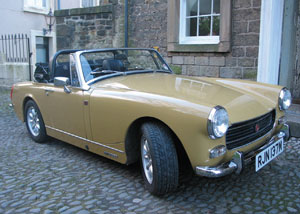
The Midget was my first car restoration project and might be my last, as I can’t imagine selling this car in a million years.
I’ve always been involved with design in my work and at home, and I’ve loved the shape and scale of the Midget since my uncle owned one in the sixties. I wanted to emphasise the shape and my aim was to make the car look and feel like a hot prototype. It’s very clear to me what the car is but it’s funny that the lack of badges and detail has confused some people who sometimes ask what it is – one person asking if it was an early Porsche. Maybe it’s the colour? To me it looks 100% MG.
Midget as bought in 2004
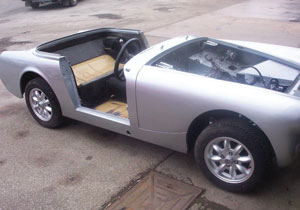
Body after spraying the interior was left to be finished by hand during the rebuild.
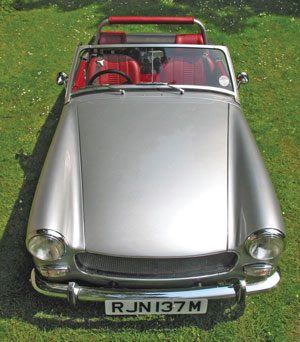
All badges and decals removed
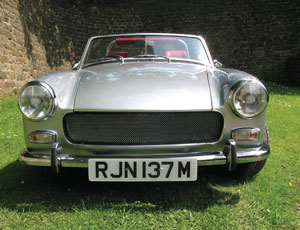
Custom grille
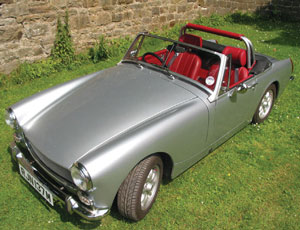
Silver paintwork contrasts effectively with red trim
The firewall is still in place from its early sprinting and a recent test clocked well over 100 bhp from the rebuilt engine. The lowered suspension gives it pretty good stability at speed and it certainly goes like the clappers although I’m not going to race it. I just couldn’t bear the responsibility if I pranged it.
I purchased the Midget on 9th August, 2004 through classic car dealer Martin Johnson, it was registered 24th May, 1974. The original colour was Harvest Gold but it was re-finished in Jan 2006) with Alfa Romeo Grigio Sterling Silver 694 MET.
Modifications to the Midget had been undertaken by Philip Broadhurst of Macclesfield who had owned the MG previously. During the twenty years of his ownership the upgrades included: a sports cam (possibly Cooper S), tubular exhaust, straight through system, K&N air filters, Aldon competition distributor, alloy rocker box, oil cooler, Kenlowe fan, Minator alloy wheels, 176/60 Bridgestone radials, Aley rollover bar, Corbeau racing seat, Willans harness, competition fuel pump installed in the boot, competition lowered suspension, and competition specification firewall bulkhead installed behind rear shelf. During its time with Philip the car participated in some sprint competition.
When the car was acquired it was clear that it had been a lucky vehicle. Close to 100,000 miles on the clock and with eight owners the car must have been looked after well and must have been garaged for most, if not all, of its life.
The previous owner had the car for many years and was responsible for the lowering of the suspension, the basic racing modifications, the firewall bulkhead, bucket seat, roll bar and the new alloy wheels, it had obviously been used in competition.
The car was remarkably sound but in need of TLC. The engine bay had suffered from fluid spills and had started to deteriorate, some general painting was necessary, the interior was looking shabby after thirty odd years and the engine, although quite hot, really needed a thorough overhaul.
Work began with a wholesale strip down
The Midget’s suspension, steering rack, gearbox, differential and wiring were all found to be in pretty good order. The strip down revealed very few unanticipated problems and continued to be encouraging. The engine bay was blasted and work began on rust removal and body preparation. From underneath the floor pans were revealed to be original and in very good order. The engine was removed and taken for a complete rebuild and upgrade. All the Midget’s components and interior were retained for restoration or replacement while the shell was taken for work on the body and a respray.
The decision was made to remove all badges; decals and the thin chrome trim strips from the sides of the car. All holes were first welded and then fine filled. The boot was taken back to bare metal because of some signs of bubbled paintwork. The seams that traditionally run between the bottom of the door openings to the rear wheel arches were filled before the whole car was painted. A high build primer was applied, flatted down and followed by another coat. The silver was then applied followed by several coats of clear lacquer. The cockpit interior was left for me to finish off by hand during the rebuild.
The engine was completely stripped and rebuilt to high performance standards. It was rebored, gas flowed, flywheel lightened, new Kent MD276S camshaft, cam followers, +03 slipper pistons, main bearings, big ends, and a new oil pump. The compression ratio was 9.4:1, the head fitted with bronze valve guides and Tuftrided rocker shaft. New carburettors and AH2 needles were fitted. To bring the little MG to an effective stop, new ventilated discs were installed and the callipers fitted with green pads.
Whilst the car was being sprayed I stripped cleaned and, where necessary, repainted all the components. Replacement items are new and genuine MGOC spares. The doors were rebuilt using reconditioned winder mechanisms. The door cavities were completely covered by a generous coat of Waxoyl before completing with the new trim. A Red vinyl interior was chosen in the original style. Door cappings and dashboard trim were stripped of their old vinyl and then recovered by hand. The old plastic window winders were replaced with stainless steel and, of course, all seals/gaskets were replaced with new. The original door mirrors were later replaced with ‘torpedo’ style versions.
Before rebuilding, the interior metalwork of the car was rubbed down, treated for any rust and then painted with two coats of black Hammerite. All floor pans had anti-vibration pads fitted as did every other conceivable part of the car. I then tackled the interior using the best quality carpet sets and trims available through the Club. The chosen interior colour is Tartan Red. The old seats were traded in against new factory-covered versions in the right colour and design. New inertia seat belts were fitted. The dash was overhauled. A new vinyl hood was found and all components of the car were painstakingly installed using new seals everywhere.
When the body was complete, the gearbox and engine were refitted together with a new clutch, new clutch master and slave cylinders, braided hoses were fitted where practical, then brand new hose kits, engine mounts, cables, radiator, heater matrix, water pump, starter motor, coil, and battery etc. After spending approximately 1,000 hours of my own time the car was finished.
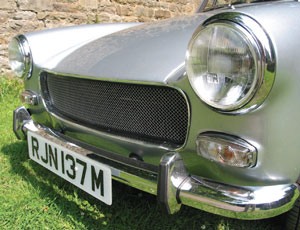
Absence of badges gives front end a smooth and clean look
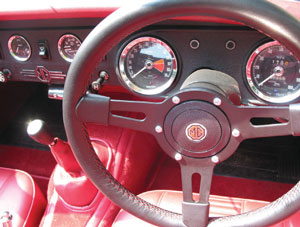
Refurbished dash
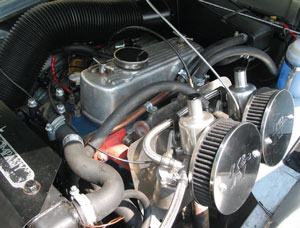
Extremely tidy engine bay
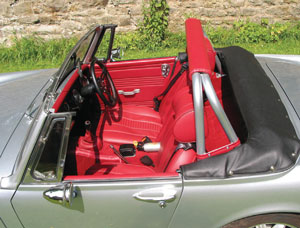
Roll bar integrated into colour scheme
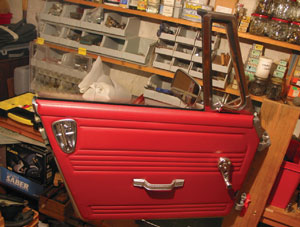
Doors built up on home jig
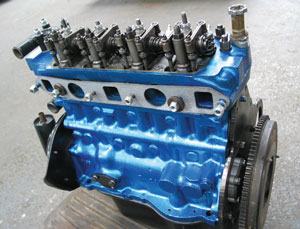
Engine extensively overhauled
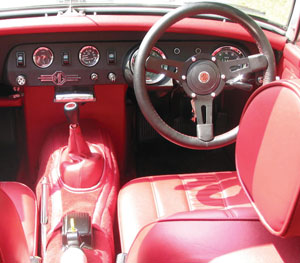
Red interior
James Mackie