The Ultimate Front Wheel Drive MG? – (Part 1)
Who can remember in the late 1970’s when the revolutionary Saab 99 Turbo was released, with an astounding 145 bhp from it’s two litre turbocharged engine. About the same time knowledgeable pundits were pronouncing that 150 bhp was the maximum that could be transmitted through just the front wheels. My, how times and technology has changed all that, with many front wheel drive road cars producing around the 250 bhp mark!
Where Saab started the modern acceptance of small capacity, high power output turbo engines, most other manufacturers have followed. Rover, nee Austin Rover, was no exception, first delivering the Metro Turbo followed in 1985 by the 150 bhp Montego Turbo. At the time it represented the fastest production four-door saloon available, but 150 bhp through the front wheels produce ‘interesting’ habits, a fact was well documented by lead footed journalists!
Time and development helped to restrain this wayward behaviour, but not before the model was given a bad name, a not unfamiliar situation affecting many a British Leyland/Austin Rover model. This and internal politics effectively canned a Turbo version of the Maestro, even though it was to have been a non-intercooled version with about 130 bhp.
Changing circumstances finally saw a limited run of 505 Maestro Turbo’s produced during 1989, with Tickfords assistance. The limited production Maestro Turbo used a complete Montego Turbo engine and drive train, and as was the case with the EFi’s performance was better than the equivalent Montego. Also surprising to some, was the fact that the quicker Maestro, with apparently an identical set up to the Montego, was so well behaved compared to its sibling.
Exposed Eskimo
Launched and marketed from the 1988 Motor Show, with about as much exposure as an Eskimo gives an Arctic wind in winter, it came as no surprise to see virtually nothing in the motoring press. Over time several road tests were done and these drew the conclusions, some reluctantly, that there was no better ‘performance per pound’ package available. Sales were slow which resulted in some cars being stored for over eighteen months before being registered. As a general rule cars that were quickly registered and used regularly tend to have suffered from less corrosion. This explains why many cars with ‘newer’ registrations have suffered more.
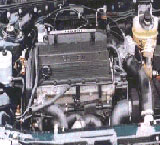
The superb 200 PS Din ‘T” series Turbo in it’s original home, a 420 GSi Turbo
Half Price Turbo
The standard Turbo provides a genuine 130-mph, backed up by sub seven second to 60 mph acceleration. My ownership of number 325 happened by accident during 1992, and I have to thank the Hot Hatch insurance scare. I wasn’t looking to change the M16 (Rover 820 16 valve engine) engined EFi at that time, but a couple of adverts for Turbo’s at what was then ‘silly money’, drew my attention. I eventually found my car for £4200, then, when reading through the wad of service papers I found that nine months earlier the previous owner had paid £8995!!! That was how much effect the general hike in insurance premiums had.
Disappointing
Performance was certainly one of the big plus points but there are areas I have always been disappointed in. One is the distinct lack of go when the engine is not in boost, no problem when operating in normal traffic, but demand power when the revs are too low and…yawn!
The different power delivery can be overcome by a change of driver style. However, the poor fuel consumption is something I have never acclimatised to. The M16 EFi was regularly returning around 34/35 mpg around town and well over 40 on a run. With the Turbo around town 25/26 was the norm and extreme patience and restraint was required to even get 33 on a long run. These returns are about average for the model! On top of this was the need to use leaded, and if I didn’t, consumption on unleaded dropped so far that the savings at the pump were more than used up on the road.
The other poor aspect was in the general roughness of the engine, typical for the 8-valve ‘O’ series and a reflection of being spoiled with smooth 16 valve power. Changing to the Turbo returned me to the coarser 8-valve engine, although the turbo did help offset these negatives.
These limitations were clearly coming from two areas, the basic design of the 8-valve head and the limited capability of the Turbo and engine management combination. These factors and questions were uncannily like those raised some ten years before, when having reached the end of reasonable development with the old EFi engine, I made the decision to go to 16-valve power.
With the M16, improved head efficiency provided the extra power and smoothness, but it was the flexibility of the engine management that made the conversion so effective. With the Turbo I knew from experience that achieving the correct fuelling with the carburettor, whilst simpler than injection, would actually be awkward. Not only that but the already poor fuel consumption could suffer considerably.
Nevertheless I still went down the conventional tuning route to finally end up with about 190 bhp at the engine, without hurting the fuel consumption too much. I have to say that this was easy to achieve with just an increase in boost, a change of exhaust and a rolling road session to set it up. From this point I did consider further modifications, but as these would almost certainly have only enhanced top end power, accentuating the Jekyll and Hyde character, I decided that this wasn’t what I wanted.
16 valve progress
With memories of the ultra successful conversion of the EFi to 16-valve M16 power, it seemed logical to follow the same route with the Turbo. There was also the considerable benefit of the development carried out by Rover with their excellent model range, several of which were using 16 valve turbo engines of considerable effectiveness.
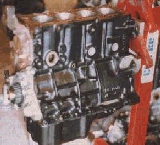
Early build stages of T16. ‘O’ series owners will see the familiar lines of the common block
1991 saw the introduction of the current Rover 800 range with its chrome grille. Under the skin the M16 engine had undergone a significant redesign and appeared as the T16. Once more the new engine was still using the same basic ‘O’ series bottom end, meaning continued compatibility with earlier ‘O’ engined cars. Of note was the fact that now the Vitesse model sported a turbo version of the T16, replacing the old Honda V6, with better power and torque. Many observers reported that the new engine felt like a 3 litre, and even stronger than the previous M16 turbo, which had the same quoted power, 180 bhp.
Two years later the 200 and 400 models benefited from an improved version of the same ‘T16’ turbo engine, with power raised to 197 bhp. This specification was later fitted to the excellent 620Ti, and later still to the 800 Vitesse Sport. In the 200/400 models the spectre of wayward handling under power once again surfaced, even though the gearbox benefited from the inclusion of a limited slip differential known as the Torsen (Torque Sensing). The extra bulk of the larger models helps contain these characteristics.
For me the main attraction of the T16 Turbo engine was not the maximum power figures, which I think has maximum relevance in bar conversations and Max Power fairy tales, (sorry, I mean ‘editorial features’) but the wide power band and torque delivery. This is where Rover’s development shone to maximum effect, resulting in what I believe to be a far better installation that many of the so-called leading Turbo 16 valvers. When it is compared to the old 8 valve Turbo then I’m afraid it’s R.I.P. for the old engine.
Torque about flexibility
To illustrate the point compare the standard factory quoted power and torque figures for the 8 valve with the ‘T16’ Turbo. The 8 valve produces its maximum power at 5100 rpm and peak torque at 3500 rpm. This gives a 1600 rpm ‘power band’ where maximum performance will be achieved. The T16 Turbo on the other hand has a 6000 rpm power peak along with a 2100 rpm torque peak, giving a huge 3900 rpm power band! Even the EFi, which was a class leader, can only muster a 2700 rpm band! Do you get the picture?
Advantages don’t stop with the power and torque characteristics. The fuel consumption is a league ahead with the T16, and for normal use is on a par with the standard EFi. Use the power though, and you can soon see consumption dip to the high teens! When this happens you at least have the consolation of being able to fill up at the cheaper unleaded pumps. Finally the sheer power of the modern management system ensures that the car is totally tractable from anywhere in the rev range and at any throttle position, whatever the weather.
This shows clearly why an engine change for just a projected extra 7 bhp is such a meaningless fact. On the road the same car with the new engine would have an insignificant 2-mph top speed advantage, but it would be there a decade before the old engine. When the performance was not being ‘used’ then the significantly reduced fuel consumption and tractability make it so much easier and pleasurable to drive.
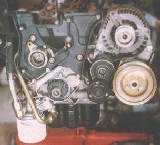
T16 frontal view during build up. Note width of engine with fitted alternator PAS pump etc. Note: also pipe ‘Take offs’ for oil cooler
With all these positive considerations, the only damper to the whole situation was the comparative lack of second-hand T16 Turbo units, together with all of the necessary parts needed to complete the conversion. Where there were a few units prices were too high to consider, until fate stepped in and provided a solution.
Racing engine…
Rover supported a one-make series, The Rover 220 Turbo Cup, with something in the order of 26 competitors running. The series was aimed at obviously enhancing the image of the car for sales purposes, and in order to keep the cars connected to the showroom products, modifications were very limited. Engines were all production standard, non air-con versions, controlled by a supposedly standard ECU, which was sealed by the organisers. (The organisers would often swap ECU’s between cars to discourage ‘fiddlers’).
During the first two seasons the standard hydraulic followers gave problems, and so for the 1996 season special engines with solid lifters were prepared for the series. That left 26 low mileage but heavily used second-hand engines at Rover Sport. An advert in Motoring News led to a visit to Rover Sport with full pockets and empty trailer. A short while later it was empty pockets and full trailer but at least the engines were fully dressed and complete with ECU, and ‘just’ £352.50 inc. Naturally there was no guarantee, but at that sort of money there were certainly enough good parts to recover costs if the engine proved beyond redemption.
In fact the internal condition of my engine was very good, which has been the case with five other of these engines that I have connections with. As a precaution the engine was stripped down and inspected. A number of items were replaced as a matter of course, including conrod nuts and bolts, all bearing shells, piston rings, gaskets and seals and of course the hydraulic followers.
Fits like a glove…
The next stage was to fit the engine, which required just a little preparation to the engine and body. In the original Rover application the engine has a mounting that emerges from the centre of the cam covers, and which connects to the offside inner chassis rail. The Maestro uses a mounting that bolts onto the back face of the block, which then goes to the same chassis rail. On the T16 the modifications to use the standard Maestro mounting are quite simple, consisting of removing a small section of the plastic cam cover, and manufacturing a replacement piece to exclude dirt and debris. The mounting will now bolt to the block, but the chassis mounted bracket has to be trimmed slightly on one side to clear the front of the cam cover.
As all Turbo models and many later 2.0i’s which have power steering room has to be created for the steering pump, which hangs off the front of the engine. As this is the same configuration as found in most M16 engines, the modification used on these conversions, i.e. relieving part of the front member, is carried over to this conversion. Additional strengthening was added inside the modified member before welding on a new closing panel. Whilst the angle grinder and welder were still hot, further minor modifications to the front member and bonnet locking platform were done to allow fitting of a Rover 620Ti alloy intercooler.
This cooler has a pipe fitting either end, unlike the Maestro one that has both pipes at one end. This allows the cooler to be mounted vertically next to the radiator, leaving that item free to be moved forward approximately 65mm, which provides much needed clearance for the power steering pump. There is the significant advantage that the intercooler is no longer mounted in front of the radiator, so that now it has a clean, uninterrupted supply of cold air to provide cooling. Also the intercooler also still has a clean air supply, so ‘heads I win tales you lose’ applies.
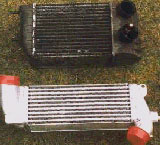 Maestro/Montego Turbo standard intercooler (top) note thermostat protuding from lower pipe. Rover 620 Ti all alloy, intercooler (bottom)
Now was the time to lift in the engine, which was boringly simple, almost following the original route. The clutch on the 200 bhp spec Turbo engine is larger than all other 2 litre cars, at 228mm diameter. (215mm normally) Even so it still fits the standard gearbox clutch housing and uses the same release bearing and mechanism. This set up transmits the power to a standard Maestro/Montego Turbo gearbox. (K7AR or K7AO series)
Once bolted into place the actual difficulties arose with all of the ancillaries. Not that these were particularly bad, more time consuming and thought provoking. Packaging all of the extra and differently shaped items was the main problem, especially all of the hoses and pipes. More about that next month!
Roger Parker