The A, B & C of Motoring
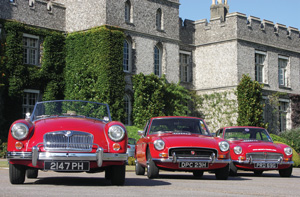
Its not often you get the chance to drive two of the most iconic post war MGs. But that is just what happened to me when James and Blanaid Mason very kindly agreed to let me drive their beautiful 1960 MGA Roadster and 1969 MGC GT for the day. And just for good measure, I brought my own 1969 MGB GT along for the ride. My mission was to compare these three very different cars; essentially a road test of each car back to back.
Line up of MGA, MGB GT and MGC GT at West Dean College
I will start with the MGA. Here is a brief history of the model: The MGA replaced the older T-type cars and represented a complete styling break from any other MG up until that point. The car was officially launched at the Frankfurt Motor Show of 1955. Through its production life, The MG Car Company sold 101,081 units, of all types. The vast majority of which were exported, mainly to the USA, with only 5,869 cars sold on the home market. Incidentally this represented, and I think to this day, still holds the highest export percentage of any British made car.
James and Blanaid’s car is a 1960 1600 Chariot Red example. They have owned the car since 2006 and it is simply superb and has been rebuilt to a very high standard by the previous owner. I believe this car is very close to concours condition. I’m not sure what I was expecting when given the chance to drive an MGA. There is no doubt the MGA is one of the prettiest cars of its time the lines to this day still look right. Getting into the A is the first clue to how different this car is from the B, you sit much closer to the dashboard and steering wheel. I just loved the pull button starter and how different that 1588cc B-Series engine sounds when started compared to the B’s very similar but slightly bigger 1798cc engine. Rather more of a higher pitched rasp then a lower dense thrum in the B. Both very appealing nonetheless; anyway it was time to stop comparing the engine notes and to get underway, my first impressions were stirring. The first thing I noticed was how much sharper the throttle response was compared to my B. This three bearing engine certainly revs far more freely than five bearing B, in fact I’d even go as far to say that you really have to rev this engine to get the best from it. I commented earlier on how I found the dashboard and steering closer to the driver, however, any thoughts I may have had that this would hinder the experience were soon forgotten as the cockpit is actually very cosy and everything all comes to hand easily.
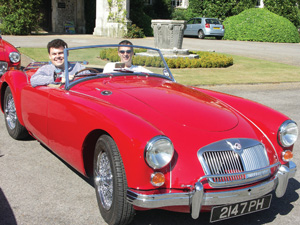
Jamie with James
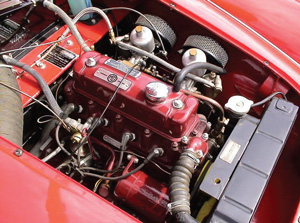
MGA 1600 Mk 1 engine bay
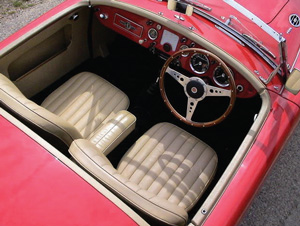
MGA cockpit
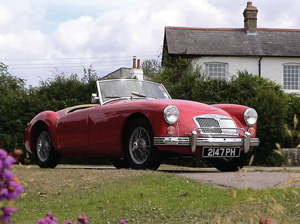
MGA
James and Blanaid’s car has a smaller ‘Moto-Lita’ steering wheel as opposed to the much larger ‘QE2’ style wheel the original cars came with. I must say that I felt this was very much an improvement and aids the driving experience. James had said to me prior to driving the car that the MGA was the best car he had ever driven and I must say the chassis is absolutely top class, developed from the earlier EX175 race car, it’s very fluid, controlled and forgiving and despite being a separate chassis car there was precious little scuttle shake. This is a car that loves to be driven and although it’s only modestly fast by modern standards, this does not matter at all, because just driving it is an event in its own right. We got back from our all too short drive and I must say I was mightily impressed by this little car. MGAs share with many other MGs that indefinable quality of being great fun to own and drive. Additionally, it is one of the prettiest sports cars of its time and attracts the sort of attention that drivers of far more exotic machinery may never experience. In my opinion MG deserved to sell every one of the 101,081 MGAs that they produced.
Technical Specification:
MGA 1600 1959-61
Bore x stroke 75.41 x 89mm
Capacity 1,588
Power 79.5 bhp
Max speed 100 mph
0-60 mph 13.3 seconds
MPG: 27
Numbers built: (coupe and roadster)
31,501
The MGA was replaced in 1962 by the MGB, the MGB does not really need any introduction. It was until recently the most successful sports car ever made. Originally the MGB was introduced as a convertible and later in 1965 a coupé, the hatch-back “GT” was almost a shooting-brake version, with 2+2 seating. The MGB used the same “B-Series” engine featured in the MGA, but by 1962 Abingdon had stretched its capacity to 1798cc. Later there was the MGB GT V8 which was fitted with the 3.5 or (215 cubic inch in American terms) Rover V8 engine and this was made from 1973 to 1976. Combined production volumes of the MGB, MGC (I will describe the MGC later) and MGB GT V8 models totalled 523,836 cars. Of course this does not include the “revival” RV8 model made in the years 1993-1995 with 2,000 units finding homes mostly in Japan. Despite the similarity in appearance to the B Roadster, the RV8 had less than 5% parts interchangeability with the original car.
Obviously the MGB GT in this article is my own car and I will not go on about it too much as the point is to review James and Blanaid’s cars. However, since having its new engine last summer my BGT has really been a joy to own other than the few gripes you get with any classic car. The MGB is a great car to drive, being very predictable, but fun at the same time, perhaps a little under-powered but generally you cannot fault its good looks, brilliant parts availability and cheap running costs. I’m pretty sure you can get every part for this vehicle. Does it have any downsides? Well, in my opinion, I would say it would be the brakes; without servo assistance (this did not become standard fit until 1973) they need a pretty good shove to slow you down (no tail-gating with this car then). As mentioned above the car and chassis was certainly capable of more power and Syd Evener and his designers must have had this in mind when planning the car, just think how lonely that B-Series looks under the bonnet in the B (great for home mechanics though with loads of space).
Technical Specification:
MGB BGT 1965-80
Bore x stroke 80.26 mm x 89 mm
Capacity 1,798
Power 95 bhp
Max speed 108 mph
0-60 mph 12.8 seconds
MPG: 28
Numbers built: 125,282 GT’s (The Roadster was made between 1962-1980 with 399,070 made)
That potential for extra power came in 1967 with the MGC. To many observers, the MGC was a 3.0 litre straight-6 version of the MGB. However, it was far more complex than that; the body shell needed considerable revision around the engine bay and to the floor pan, it had different brakes from the MGB, 15 inch wheels, a lower geared rack and pinion steering system and special torsion bar front suspension with telescopic dampers. Externally the differences were a distinctive bonnet bulge to accommodate the relocated radiator and a teardrop for carburettor clearance. Like the MGB, it was available as a coupé (GT) and Roadster. It was sold from 1967 through to 1969 with some sales running on into 1970. However, annoyingly, poor press reviews and internal politics killed the car before its revised version could become a success.
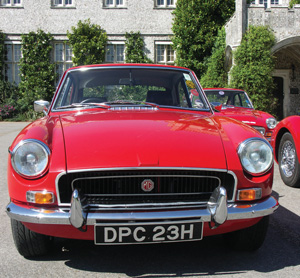
Jamie’s MGB GT
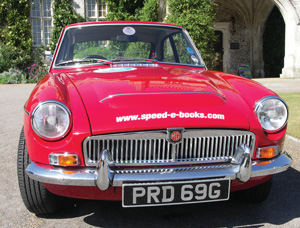
James and Blanaid’s MGC GT
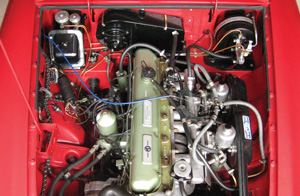
MGC GT straight six engine bay
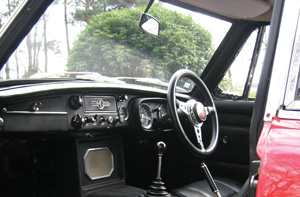
MGC GT interior with leather seatsJames and Blanaid have owned their 1969 Tartan Red MGC for approximately a year now and are absolutely delighted with it. James uses the car to advertise his business and I’m sure he gets many enquires with such an impressive example. Regular EMG readers may remember that I briefly wrote about this vehicle in my Goodwood trackday article published in April this year. PRD 69G is without doubt one of the finest MGCs I have ever seen, like James and Blanaid’s MGA, it has been restored to an exceptionally high standard but most significantly it is still very original. This latter point was very important to me as I wanted to see how a standard MGC drove and handled and determine for myself if the MGC deserved the hostile response that it received from the motoring press in 1967.
Firstly, getting into the C and you would be forgiven for thinking that you were in an MGB. The only differences I noticed where the speedo which went up to 140 mph as opposed to 120, a re-calibered rev counter and a raised bonnet bulge in front of me. However, you certainly know you are not in a B when you turn the key and that lovely 6 cylinder C-Series engine fires up. Just as we got moving I was able to tell immediately I was going to like this car. The one thing that struck me very quickly about the MGC was just how good the brakes were, maybe not up to a modern car’s standards but having the servo assistance is so much more reassuring than in my B. Once out onto the road, I was once again very impressed with how smooth the big engine was. Progress is brisk rather than fast which is no bad thing because you would not be driving this car to burn other vehicles off.
Let’s now move onto driving the car and I must say that I found the ride quality to be particularly impressive for a GT car. Both the MGA and B are not bad at all but the C to my mind offered saloon car levels of comfort coupled with some very impressive leather seats. So let’s move onto the most important aspect from my point of view, the handling. Well there is no doubt the C has to carry some serious extra weight over its front wheels, with a power plant that’s more than 200Ib heavier than the MGB’s. However, this was not that apparent when I was driving the car, yes it is heavier than an MGB but not obsessively so. Obviously, I did not “gun it” as I’m sure James would not have appreciated that. But overall the C is a very nice car to drive and one that I would generally love to own. My opinion was that the MGC would be an excellent touring car to cover large distances, say to the South of France, given its combination of effortless motorway performance and smoothness would make it a great choice for this task.
The real question would be, do I prefer the MGC to the MGB and was it a success as a performance derivative? I found it hard not to love the MGC, I have always really liked the look of it and driving the car only confirmed my thoughts. What I would have to do is try to find £20,000 from somewhere, then spend £5,000 on extending my garage and £15,000 on a mint MGC. Then I would have the MGB, very apt for the B roads and the C for long distance driving, then that really would be the best of both worlds.
Technical Specification:
MGC GT 1967-69
Bore x stroke 83.3 mm x 88.9 mm
Capacity 2,912
Power 145 bhp
Max speed 120 mph
0-60 mph 10.0 seconds
MPG: 22
Numbers built: 9,002 (4,544 MGC roadster, 4,458 MGC GT)
Well there you are, three great cars, and in my opinion each guaranteed to give you superb classic motoring. It would be great to hear from other members and owners on how they rate their cars; do you agree with my thoughts for instance? Letters and e-mails to the editor please.
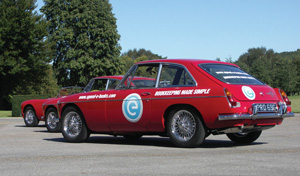
James uses the MGC GT as an eye catching promotional vehicle
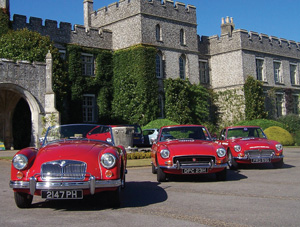
MG grilles distinctive
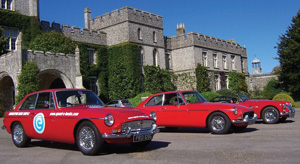
Stately setting of West Dean College
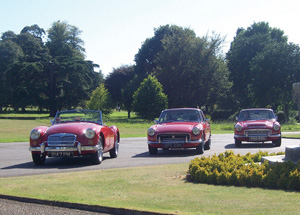
MGA, MGB and MGC GT
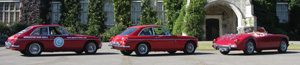
MG evolution with straight six of 2912cc, 1798cc four cylinder, and 1588cc four cylinder
My grateful thanks must go to James and Blanaid for bringing the two such stunning cars a long way on their bank holiday weekend for me to view and drive, I hope they both enjoyed the day as much as I did.
Finally, a big thank you must go to West Dean College, near Singleton (just north of Chichester in West Sussex) where the cars were photographed. West Dean College is home to an exciting range of year-round short courses in arts, crafts, creative writing, photography and music and full-time postgraduate study in Conservation, Making and Visual Arts. The West Dean Gardens would also make a great destination for a day out in your MG, as they are open throughout the year, entry just £6.75 (plus concessions). For more information go to: www.westdean.org.uk.
Jamie Brown