MG News
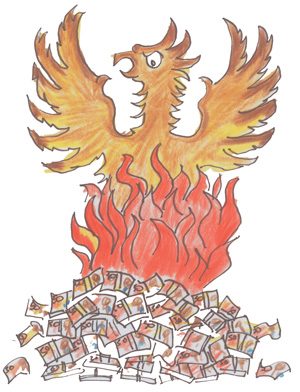
Of course the headline news since the 11th September is the Government ordered report on the collapse of MG Rover. Those who have an interest will have been able to download the two volumes of the report from the UK Government’s Department for Business Innovation and Skills website, www.bis.gov.uk/mgrover-report and it does need some time to wade through.
We need to make mention of the report and its content, but we do not want to dwell too long as it is more important to look to the future. However, there are some interesting details deserving a mention.
Overall there is no revelation that fundamentally changes what has been reported, we have already had the view of a person in silhouette so we know the outline well. The report has effectively moved the spotlight around the body so that now we can see the persons face and detail in some clarity.
The reports inspectors have as expected been very critical of the levels of rewards that the members of the Phoenix Consortium (John Towers, Peter Beale, Nick Stephenson and John Edwards, the group that bought parts of the former Rover Group from BMW in May 2000 for that famous £10) plus later joined by Kevin Howe, the Chief Executive of MG Rover.
Indeed from the layman’s perspective the rewards are quite unpalatable and some speculate whether they considered that their chances of success in keeping MG Rover going long term were so low that the levels of rewards reflected their chances of future employment at director level. Following the collapse of MG Rover, opportunities were also so low that they had to secure their very attractive financial futures before that happened. Certainly the report highlights a number of moneymaking schemes, some that succeeded and some that didn’t.
One interesting project involved buying the lease on two Boeing 767 aircraft and using the tax losses from MG Rover to gain tax relief to offset the borrowings, which netted something approaching £10.5M for the benefit of a Phoenix company, later repeated with a second lease purchase for another Boeing 767 aircraft that netted another £3.2M, a proportion of which the Inspectors indicated found its way into the notorious Pension fund.
The whole Group structure present during the period between 9th May 2000, when the Phoenix Consortium took over the Rover assets, to the collapse on 8th April 2005 was very complex, illustrated by the Inspectors remit investigating a total of 33 companies. The report highlights aspects where companies were ‘ring fenced’ with assets that would not be accessible by creditors of MG Rover or directly connected companies in the event that MG Rover collapsed, yet those assets would be accessible by Phoenix and the only benefiting directors were you know who!
One well known fact that has been in the public domain since the formation of MG Rover was that its long term survival needed the help of a bigger partner to help shoulder the cost of replacement models, and owing to the age of the mainstream models they had, except for the Rover 75, this was needed to be achieved sooner rather than later. What the report highlights is the depth of effort that the company went to in trying to achieve the needed partner or partners. High press attention meant that we knew about the first Chinese partner venture, China Brilliance, but the report does shed more light on this and its ultimate failure that was not a failing from Longbridge.
There is also coverage of the tie up with Tata of India, and lesser-known negotiations with a view to operations with Proton in Malaysia, and others in Poland and Iran. Only the Tata deal delivered some results but the product, City Rover, was flawed from the start and was offered at far too high a price to compete with far better products from other European makers, a contest with an obvious conclusion. Interestingly some twenty-two negotiations with potential joint venture companies were started, some were for limited co-operation others were full co-operation.
The biggest attention was the ultimately stillborn tie up with China’s SAIC, a company of considerable size and resource, and what many do not realise that NAC, the company that eventually won the tangible Longbridge assets for the Administrators, was a third partner in the deal. It is interesting to note that the report does indicate that there was some delays caused by SAIC and NAC having some difficulty in reaching agreement between themselves.
Nevertheless the first agreement on the road to a deal started in mid 2004 and this rapidly led to sufficient progress for the IPR (Intellectual Property Rights) for the Rover 25, 45 and K series engines being sold to SAIC, that provided much needed money to keep MG Rover afloat, such was the hand to mouth need for cash by this period. Ultimately it was the pending insolvency of MG Rover that caused SAIC to not finalise the deal and it is worthy to note that SAIC’s advisors did advise them before MG Rover collapsed that it was not in their best interest to consider buying MG Rover out of Administration.
One very, very pertinent section defines the company structure that would have been present AFTER the successful conclusion of the negotiations and cementing of the joint venture. This indicates a massive slimming of the Longbridge site with just the MG TF remaining there and the MG brand name being sold to SAIC. Today in 2009 what has actually occurred is quite similar to this proposed company structure.
One thing that is stated in plain language by the inspectors is that the deal between SAIC and MG Rover would almost certainly have succeeded but for the financial situation of MG Rover. It is clear that had that joint venture been underway perhaps as little as six months earlier it would have come to fruition as the financial issues that came to a head in early 2005, and caused the negotiations to stall, would not have been present allowing the deal to have been completed.
What the report doesn’t cover are many questions people, especially many of the former workers, have related to issues that were outside the remit of the Inspectors. The UK Government’s actions in the closing days of the company are given some detail, but only in respect to a very narrow viewpoint and with specific detail over the issue of a possible £110M bridging loan to help facilitate the completion of the deal. The fact is that by this time the sand had run out of the timer and the patient was terminally ill!
What the layman sees from outside is a wider view and this generates wider questions. Many question the Government’s role over the longer term, something that has been brought so vividly into focus with the billions of pounds used to bail out the banks and financial institutions.
Whilst the failure to support banks would have had much greater impact to very many more, the recent Government involvement with the General Motors sale of its European arm to Magna, and the apparent enthusiasm to provide financial support to the new owners to maintain the 5500 UK jobs, which at the time of writing is not guaranteed beyond 2013 (the same lifespan as MG Rover) is in stark contrast to 2005.
The other point to make is that over 6100 jobs went down the tube when MG Rover failed, plus the added jobs from failing supplier companies, and a layman’s view is that the MG Rover workforce received relatively poor treatment by comparison.
There is also another missing element from the overall picture following the release of the report, which is that the MG TF is in production at Longbridge and on sale around the UK. It is noticeable that many recent TV interview and reports have been done outside Q gate at Longbridge, showing MG Motor signage and the TF LE 500 on static display outside the gate as the background for the reports on the failure of MG Rover. The same situation applies to many newspaper and website reports too.
This negative publicity immediately connects the current MG Motor and the current MG operation with a high profile failed company, yet it is unfortunate that we have not seen any public response from the company to make the clear simple point that they are in business and not connected to MG Rover as most of the press reports have failed to make this point.
One thing that was positive from the MG Rover period is that MG benefited from three saloon car ranges that would not have otherwise occurred, and that they were actually very effective models and stood head and shoulders above the Rovers from which they were developed. We also saw the late MGF in an expanded range that would not have occurred under BMW and this was carried through into the TF.
Whether the MG Rover dust settles quickly or not remains to be seen and we hope that the new MG era will start to distance itself from this period with new and competitive products.
Tech Tips
Replacement ‘MG’ Steering Lock Key for MGB
MGB locks and keys varied considerably during the model’s long life. Depending on the market an MGB was sold in dictated when steering locks were introduced and whilst it had an anti-theft function, today these offer more inconvenience to the car’s owners, especially when things go wrong.
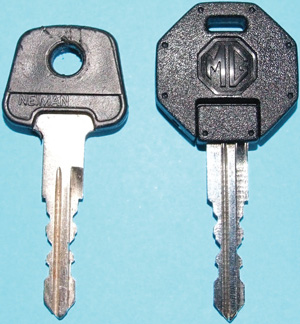
Original ‘Neiman’ MGB key on left with MGF/TF key blank on right with blade cut to the same pattern
A common thing problem relates to lost or damaged keys and unlike years gone by obtaining replacements is nowhere near as simple as it used to be, largely because the key blanks are no longer widely available to have a new one cut using an existing one as a pattern.
The Rubber Bumper cars, and some slightly earlier US export cars, are better served in this respect as the lock and key pattern is still common today. These cars original keys had the corporate style of BL with the black plastic ends with the BL logo moulding in.
Whilst there is no value in the BL logo end the key used in MGF and TF uses the same blade pattern and the plastic end has a much more appropriate Octagonal moulded end with MG moulded into it, as per the image.
These MG key blanks are a standard MG Rover based spare and listed under part number CWE 100580 listed in the Sept 2009 Xpart parts lists at £7.36 plus vat, and a stock item with MGOC Spares.
Classic MG Hydraulic Systems
An interesting condition has been noted recently relating to the operation and efficiency of braking systems on classic MGs that seems to affect a quite large number of cars when work is being done on their braking systems and clutch systems.
When it’s time to bleed the system, pumping via the pedal proves difficult or in some cases impossible to get a good fluid flow. Even pressure bleeding to evacuate all air from the lines and cylinders, is ineffective. Afterwards there is a poor pedal and very often poor operation
This condition is clearly indicates poor sealing within the master cylinder and it can apply following the fitting of a brand new cylinder, new seals to an existing cylinder or even when the master cylinder is not worked upon, just having a period of time when the fluid is drained and air is around the seals.
A simple approach can restore normal operation, usually over a period of days. Simply rapidly pump the brake or clutch, whichever has been worked on, for as long as your legs can stand it or say 10 minutes. Then leave the car and return a while later and test if the pedal has returned to normal on a single initial press. It often takes several sessions before the pedal operates properly, sometimes several days. If a week passes with no change then it’s time to consider replacing the master cylinder.
What may be occurring is that the internal master cylinder seals may not be as flexible as when new or that a previously working normally cylinders seals lose some flexibility when exposed to air. The seal’s impaired efficiency allows fluid to leak between the seal lip and the master cylinder bore wall to give the long pedal travel. Being immersed in fluid and the ‘exercising’ brings about a softening and greater flexibility within the seal and then it starts to make better contact with the bore wall.
This is not a common problem, just sufficiently frequent and found to be affecting owners and professionals alike to have been able to suggest this odd process that does seem to have been quite effective.