The Balvenie Discovered
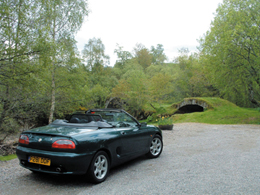
The Balvenie Mystery MG Competition that has been running for several months in Enjoying MG brought about an invitation for me to visit the distillery in Speyside where the classic whisky is produced. It has been at least twenty five years since I last drove up to Scotland and on that occasion I went up in my MGB GT but as that’s still under restoration, I borrowed the Club’s MGF for the journey. The long drive up the A1 or great north road engenders a curious mixture of adventure and tedium as you weave you way inexorably northwards passing landmarks old and new, with Anthony Gormley’s Angel of the North being new to me and surprisingly close to the road. The MGF coped well and proved to be very easy to live with despite a full day behind the wheel. Thanks to considerable hold ups on the A1 I didn’t find myself in Scotland until late afternoon, there was still a longish drive but I made Dufftown by early evening. I had forgotten just how stunningly beautiful this part of the world is with its deep green glens and dark mountains.
Packhorse Bridge
The Distillery is located near Dufftown in Speyside which is regarded as the home of proper malt whisky, so much so that the area is a centre for whisky enthusiasts, and many travel here to follow the whisky trail and tour all the eight distilleries in the district. My destination was ‘The Glenfiddich Distillery’ owned by William Grant & Sons Ltd and also home to The Balvenie, a distinct brand produced in a separate distillery on the same site. I was invited to experience the new visitor centre at The Balvenie and get an insight into what makes the product so unique. I confess that I knew absolutely nothing about whisky production and was fascinated to find out more.
William Grant and Sons remains a family owned business, which is product centred in its outlook and fiercely protective of its traditional methods of production. In these days of relentless marketing, promotion and media hype in which presentation is the overriding factor and quality a secondary issue it is rare to find an example of any business based on the singular excellence of its product. It is even rarer to find a business that strives to preserve this quality by retaining traditional methods at every possible stage.
The Balvenie distillery still grows its own barley, malts in its own traditional floor maltings and even employs its own team of coopers to tend the casks (barrels) and a coppersmith to maintain the stills. The workforce is composed of successive generations of skilled artisans and they are employed on the malting floor, in the tun room and the still house, the cooperage and the warehouses.
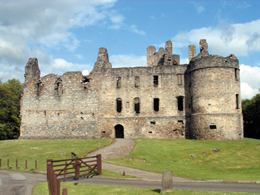
The Balvenie Castle
The distillery was founded by William Grant. Born in Dufftown in 1839. William eventually become a book-keeper and then manager for a local distillery. Finally, after learning the business thoroughly he was able to buy a field beneath The Balvenie Castle and then create his own distillery. He was a shrewd man and his business expanded and absorbed the surrounding glen to assure his supply of spring water and also enough farmland to grow the necessary barley. William Grant’s philosophy was to keep as much of the process as possible under his control in order to ensure the quality of the product, an ideal that has survived to this day.
The Balvenie Tour
The paint in the very swish visitor centre was barely dry when I joined a small party to see how single malt whisky is produced. Our guide was a young Frenchman, Ludovic Ducrocq, who spoke perfect English with a most interesting combination of Scots and French accents. We relaxed in deep leather chairs while he explained in detail how William Grant began the company and also how single malt Scotch is made from three natural ingredients: malted barley, spring water and yeast.
The barley is malted in order to cause germination, which activates enzymes enabling the starch to be converted into soluble sugars. Unusually these days, all this takes place at The Balvenie Distillery itself. Our first port of call was the traditional malting floor, the last in use in the Scottish Highlands.
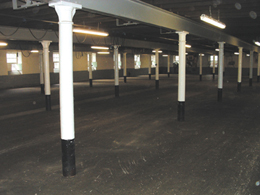
Malting floor
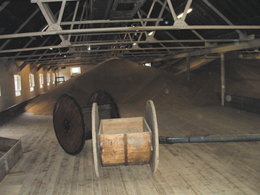
The maltings
After being soaked, or steeped, for two days in tanks of spring water, the barley is then spread out on the malting floor for between five and seven days where it starts to germinate. Four men working different shifts tend the malting floor, turning the barley three times a day by hand, seven days a week, in order to stop the roots matting and to ensure an even germination. When judged ready, the barley, now known as green malt, is moved to the kiln, a tall tower like building with a beautiful pagoda roof.
We stood in the warmth of the kiln room where the kilning, or drying, takes place, and this halts the germination process. The green malt is spread evenly across the perforated metal floor while below at the base of the tower, the furnace is started, fuelled with anthracite and some peat which spreads a steady flow of warm air up through the kiln room floor.
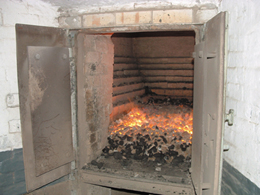
Drying furnace
The next task is to extract the sugars from the malted barley, which is first ground in a small mill into grist, a coarse wholemeal flour. It’s then time for the mashing process. In mashing the first ingredient, the barley meets the second, the crystal clear spring water, straight from the Conval Hills. The Mash Tun is loaded with the mixture of grist and water and then heated to a temperature of 64ºC. At this temperature the water re-activates the enzymes and ends the conversion of the starch in the grist into fermentable sugars. Altogether three waters are added, gradually getting hotter, to extract the sugars. The first two waters are drained off, cooled and passed on to fermentation. This butterscotch-coloured liquid is now known as wort. The last fill is used as the first water of the next mash.
Next comes fermentation. Yeast is added to the wort as it is pumped from the cooler into the fermentation vessels, or ‘washbacks’. We then entered the tun room containing ten wooden washbacks, made out of Douglas Fir. Fermentation causes the temperature to rise significantly and, as carbon dioxide gas is produced, the liquid foams up to the top of the washback and has to be kept down with revolving blades. We were invited to inhale the heady fumes which have a really powerful kick. Some two and a half to three days later the liquid in the washbacks, now called wash, with an alcoholic strength of around 7-8% alcohol by volume, is ready to be pumped through to the stillroom.
Nine copper stills sit in the stone built stillroom, four wash stills and five spirit stills. These specially built stills do not last forever and today’s stills are not the same ones that were first installed, yet they are identical in design. This because the shape of the still, its height, its girth, and the length of its neck, plays a part in developing the character of The Balvenie range of single malts. The stillman is vital to the process of distillation, who uses his skilled eye and experience to operate the stills and, also of course, the coppersmith. There is an ongoing replacement programme for still copperwork, based upon the experienced eye of the coppersmith. He dictates which part of the still is to be replaced next and ensures that it is identical in size and shape to its predecessor.
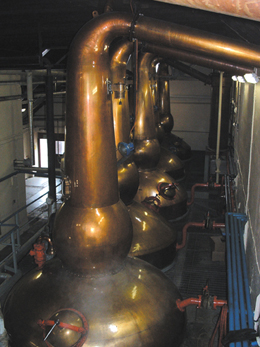
Distillery
The first distillation takes place in the wash stills, which are filled with the beer-like wash and slowly heated to boiling point. The vapour from the boiling wash rises up the neck, along the lye pipe into the condenser, where, cooled by water, it liquefies to become low wines, which are held in their own charger, ready for the second distillation. This takes roughly six hours.
The spirit stills are now charged with distillate from the wash distillation and previous spirit distillations and the process of bringing the liquid to the boil and slowly driving off the alcohol is repeated.
The spirit distillate is separated into three distinct parts. The first, called foreshots, is not deemed pure enough and is directed through the spirit safe into the feints receiver. When the alcohol runs clear after adding a few drops of water, this is the middle cut, the purest portion of the spirit run. The still man gauges when the middle cut begins, which is re-directed to flow into the spirit receiver. When the distillate becomes too low in alcoholic strength, the flow is redirected again and driven into the feints receiver for re-distillation.
The strong spirit is reduced with pure spring water to the ideal strength for maturation, ready for the longest stage of production.
The new-make spirit is still filled into oak casks maintained by a team of in-house coopers who are committed to preserving the time-honoured skills and traditions of their age-old craft. Controlling the cooperage ensures the high quality of the casks used to mature The Balvenie Single Malts.
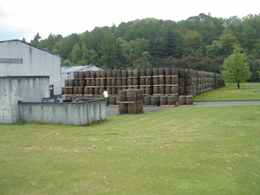
Cooperage
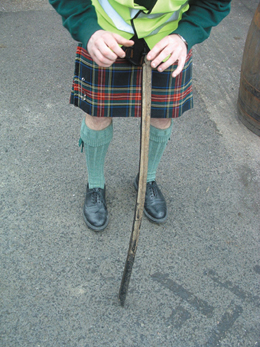
A stave from a cask showing the penetration of the whiskey into the oak
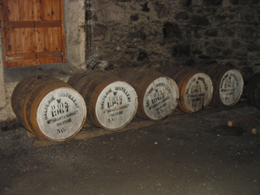
Casks in ‘Warehouse 24’
Our penultimate visit was to Warehouse 25 in the cellars of Old Balvenie House where the whisky is stored in casks to mature. The majority of the warehouses at The Balvenie Distillery are traditional dunnage warehouses. Inside there is a unique atmosphere and smell, a distinct musky aroma which is a combination of the earthen floor and the fruity maltiness of the maturing spirit. The casks are stored in this cool dark environment, racked horizontally, three or four layers high and here the final part of the process takes place.
At The Balvenie Distillery the importance of wood, and the profound effect that it has on maturing single malt, is well understood and appreciated. Over the years, stored inside the oak casks, the whisky takes up a specific taste and character from the wood itself. Casks from various parts of the world are used bourbon barrels of American oak; butts made of European oak brought from the bodegas of Spain, in which rich Oloroso sherries have matured. Also port pipes originating from Portugal, where they have spent several years holding the finest port wines. Looking around the inside of this extraordinary warehouse, casks all stamped with the year they were laid down could be seen and some have been resting there for many years indeed.
The final part of the tour is the tasting which really requires a completely new and specialised vocabulary to convey the richness and quality of the experience. It is enough to say that the product more than adequately reflects all the care and effort that goes into its creation. I was impressed with the dedication and attention to detail to ensure that The Balvenie remains ‘a good dram’. For those who really appreciate a good malt whisky, and as an excuse to tour Scotland’s delightful Speyside a trip to Dufftown and The Balvenie tour is well worth the effort.
The tours for the distillery begin again on the 12th of September. The cost of the tour is £20; it takes two and a half hours and the numbers are limited to eight people. The tour includes the final tasting. For more information and to book a place on the tour you can visit their website www.thebalvenie.com or you can call them 01340 820 373.
An excellent tour and a wonderful place to visit, it was well worth the long drive up to Scotland.
Richard Ladds