Buying an MGF
|
|
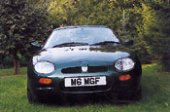
After two very successful years of production and with a great many MGFs getting onto the market, the prices of good second hand examples are now beginning to fall. To those of us who drive MGBs and Midgets, the MGF still looks like an expensive car. However, over the next few years prices of used MGFs are bound to come down to a similar level to that of a well preserved or recently restored MGB. |
| Running costs Much of the appeal of the classic MGB or Midget is the ease of maintenance and the inexpensive and abundant supply of spare parts. It is difficult to predict the costs of spares but as most components for the F come from various Rover parts bins, costs should not be too horrendous. One of the claims made for the MGF was that it would prove to be economical to run and cheap to service. It is certainly frugal in terms of fuel consumption and is quoted to give up to 33.8 mpg in urban driving conditions and therefore should not prove to be any more expensive to run than a high specification Rover saloon. At first glance the MGF does not appear to lend itself to DIY maintenance, at least to the same extent that the MGB has done. The MGF is a much more delicate proposition than the MGB particularly with regard to its body work and suspension and these will require more specialist equipment to repair. However this consideration does not preclude a high level of owner participation in the care of an MGF. The important thing will be the ability to recognise when a job requires the attention of a specialist. After the car has covered the first 6,000 miles, servicing is set for intervals of every 12,000 miles or 12 months. |
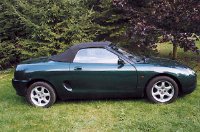 Even with the hood in place the MGF looks sleek and purposeful. |
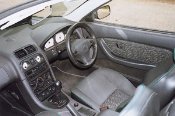 Interior is smart and functional. |
Return to sports car production Although driving the MGF is a very different experience from the traditional MGB there remains a similarity between the two models. Despite being separated by a gap of thirty three years, the two cars share a common ancestry. At its launch, the MGB was a development from a tried and tested formula as it had evolved out of a long line of competent sports cars. The MGF at its debut was in a radically different situation it had to be sufficiently innovative to gain an advantage over the opposition and traditional enough to re-awaken the desire for a British sports car. Its combination of mid-engine layout and Hydragas suspension had to work correctly from the outset and allow the MGF to break into a new market and make a name for itself immediately. Most importantly it also had to re-claim the unique MG reputation as a sports car maker that had been more or less thrown away by British Leyland in the 1980s. |
Styling
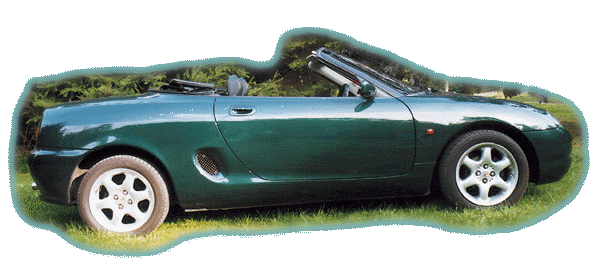
The body of the MGF marks a welcome return to shapely curves and it is very nicely proportioned. A design that will last and ‘stand the test of time’ is an essential MG quality. Even now an MGA or MGB can grace any high street without looking out of place. The MGF retains its handsome looks whether the hood is up or down. The wheels are set close to the corners of the body and give the car a solid and purposeful appearance.
Driving impressions
As a fan of traditional sports cars I was rather wary at the thought of driving the ultra modern MGF. However, I was very pleasantly surprised at the competence of this new MG. Most striking is the incredible combination of civilised comfortable ride and race car quality road holding. Driving the MGF inspires a feeling of complete confidence in the safe and predictable handling. The steering, although very light, still retains a high level of communication through the well shaped thick-rimmed steering wheel. Hydragas suspension made me think of the slightly bouncy ride of the Allegro but the ride in the MGF is very different, it manages to be both smooth and comfortable yet still remains firm and predictable.
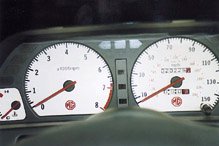
White faced instrument dials are distinctive and easy to read.
The last mid-engine car I drove was a Lotus Europa, considered to have a very high levels of road holding in its day but the MGF is in a superior class. The gear change on the mid-engine Lotus had been poor and I imagined that this was an unavoidable consequence of the central mounted engine layout. Therefore, I expected the gear change on the MGF to be equally awkward and clumsy but instead it was very precise and a pleasure to select. The ratios seemed well spaced and I enjoyed using the gearbox to the full. Some test drivers have complained that they want even more performance and I suppose you can always yearn to go faster in a sports car, but for me the acceleration was perfectly adequate and complimented the MGF’s road holding abilities. Brakes were also extremely good, providing powerful stopping power with plenty of feel
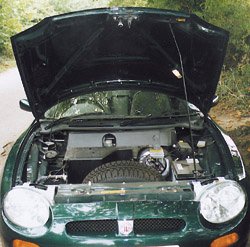 Under the bonnet available space is filled by the spare wheel, brake servo and master cylinders. |
Cockpit comfort and weather equipment The driving position is very much in the sports car style with ample seat adjustment allowing a reclining driving position. The seat itself is particularly good, offering lots of support for the lower back. Jeremy Clarkson was scathing about the interior of the MGF, describing it as bland, plastic and Japanese in style (like an MX5 perhaps) but he did approve of the instruments with their white dials which are very smart and simple to read. Switches in general are well placed, easy to use and feel as if they are well made. The only thing that caught me out when I first drove the car from cold was the gauge that I took to be indicating the oil pressure was not registering at all, this was because it turned out to be an oil temperature gauge. The MGF only has a warning light to indicate low oil pressure. |
| Storage seem to be somewhat restricted as there is nowhere behind the seats to stow anything apart from the hood recess shelf but this is shallow and completely filled when the hood is lowered. There is a small cubby hole on the transmission tunnel which is handy for small items and a similar drop lid bin between the seats. There is also a decent sized lockable glovebox in the dash. Each seat back features a storage pocket which is useful for holding maps. Carpet and trim seems to be of a very good quality and should prove to be quite durable. Electric windows add the final thoroughly modern touch to a well designed and functional cockpit. | 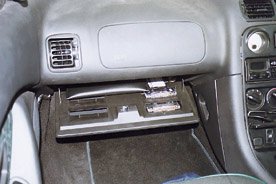 Glovebox features cassette storage. |
Luggage space
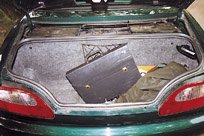 Boot is wide enough and deep enough for two sets of golf clubs. Bonnet release handle is located in the boot. |
The boot is quite good for a sports car offering 7.4 cubic feet of space which is enough to hold two full sets of golf clubs, or squashy luggage bags for two people, or even a weekly shop from Tesco’s. The close proximity of the engine does create a lot of heat which could melt you frozen foods if you have a long journey home; perhaps an MGF cool bag could solve this problem |
Weather equipment
The hood is excellent and so easy to raise and lower that only power operation could make it simpler. Those of us who have struggled with MGB and Midget hood catches and fasteners in the past could not fail to be impressed with the very good design of the folding hood. The only failing on the car I drove was that the zip fastener on the rear window had broken off and this break revealed a weakness in the design of the fastener pull tab. Trying to unzip a rear window without a tab pull is a great pain; this feature does need an urgent upgrade. With the hood erect, interior noise levels are very civilised, in fact the car feels like a fixed head coupe. Heater and demisting equipment work well and the MGF is an easy car to live with on a daily basis. I dearly love the more traditional MGs but for everyday driving and if the price was right I could be seriously tempted by the MGF.
Richard Ladds
Specification
| Engine: | All aluminium K-series engine. |
| Capacity: | 1796 cc |
| No of cylinders: | 4 cylinder |
| Valve gear: | 16 Valve Double Over Head Cam Modular Engine Management System ( MEMS) controlling all major engine functions. |
| Max Power: | 120PS @ 5500 rpm |
| Max Torque: | 165 (Nm) @ 3000 rpm |
| Performance: | 0-60mph 8.5 seconds |
| Max Speed: | 120 mph |
| Transmission: | 5 speed manual all synchromesh gearbox |
| Suspension: | Independent all round with double wishbones. Hydragas springs, interconnected front and rear. Front and rear anti-roll bars. |
| Steering: | Speed sensitive electronic power assistance standard on MGF VVC and an optional extra on MGF 1.8i |
| Turning Circle: | 10.56m (34.7Ft) |
| Brakes: | Front ventilated discs and calipers. ABS optional on MGF 1.8i standard on MGF VVC |
| Wheels: | 15in alloy spoked wheels with 6J rims |
| Tyres: | Front 185/55 VR15. Rear 205/50 VR15 |
| Fuel capacity: | 11 gallons or 50 litres |
| Fuel Grade: | Unleaded 95 RON |
| Weight: | 1060 kg (2337lb) MGF 1.8i or 1070kg (2395lb) MGF VVC Dimensions |
| Wheelbase: | 2.38m (93.5in) |
| Length: | 3.9in (154.1in) |
| Track front: | 1.40m (55.1in) |
| Track rear: | 1.41m (55.5in) |
| Height: | 1.27m (64in) hood up |
| Width: | 1.63m (64in) excluding door mirrors or 1.78m (70.1in) including door mirror |
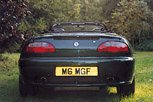 Rear end features neat rear lights, fully integrated rear bumper and twin exhausts. |
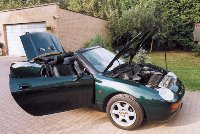 Wide doors allow easy access to the interior. |