The Cost Of Painting
The Cost Of Painting
Once you have established what your respray is going to cost – exactly what are you paying for?
Is the cost of a quality paint finish high or not? If you look through a selection of the weekly motoring press you will notice adverts that offer a complete respray for just a few hundred pounds. However, if you compare these prices against a quote for a respray from a quality bodyshop you may find a difference of at least a thousand pounds. How can this be?
Letís try to look at the reasons. The low cost route will probably involve very little or no preparation, a quick mask up and then a thin coat of primer followed by one or two coats of topcoat. It may give a good shine for a week or two but this will very soon fade and any rust or imperfections will quickly come through. The time taken to carry out this low budget spraying will not be much more than two days, if that.
The advised approach to have paintwork carried out, is to locate a number of paintshops that would be prepared to look at your car and give a written quote. Obtain at least three quotes. Do not necessarily go for the cheapest quote, but use you head to decide which paintshop might do the best job for the money. Ask to see some examples of recent work and also try to form an impression of the professionalism of the company by the way your enquiries are dealt with. Examine the cleanliness of the workshop and the quality of work in progress at the time of your visit. Personal recommendation of a paintshop should also be taken into consideration.
Make sure that both you and the paintshop know exactly what needs to be quoted for. Do you want to strip the car yourself? That is, remove all exterior chrome trim, glass and fittings from the body before they have it. If you are having a bare metal respray, do you want to remove all the old paint yourself? Always take the time to clearly establish the specification of what you expect from the paintshop, all details should be made clear to both parties involved and put in writing to save any problems later. The cost of a bare metal respray can be around £2500 if the paintshop does all of the work, however be aware in mind that this figure can go up if severe corrosion or collision damage is discovered lurking unseen beneath the paint.
Stage 1
The first stage before any respray is to ensure that the whole of the bodywork is in sound condition. The bodywork must not have any surface rust or corrosion holes anywhere. Any damage must be addressed before the process goes any further. Affected areas must be cut out and replaced with new metal because if any corrosion remains at all it will rust away beneath the surface and erupt through your new paint. Also all small dents or imperfections should be corrected using bodywork hammers and dollies. This is not always possible and so it may be necessary to make small repairs using body filler. Despite its image as a bodgerís medium, body filler when used correctly and appropriately is perfectly acceptable.
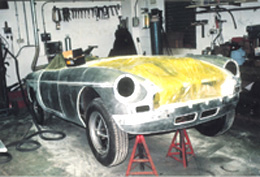
The term bare metal respray means exactly what it says. That is, all old paint is removed until the bodyshell has no trace of paint left on it and is just bare metal. You can have the car resprayed over the old paint but for the best job go the bare metal route. The problem with spraying on top of old paint is that over a period of time the new paint will shrink back and this will usually show up any small imperfections in the base surface.
| A bare metal respray means exactly that |
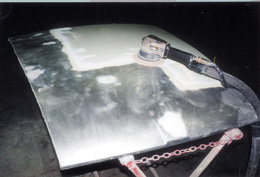 MGB bonnet being taken back to bare metal |
Stage 2
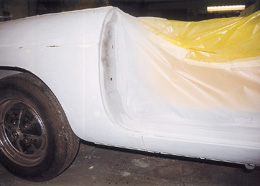 Primered wing in the process of being prepared for the next coat. Rubbing down will expose bare metal, therefore more spraying and flattening will be required
The following preparation work will be necessary if either a bare metal or over existing paint respray is carried out.
Once the surface has been made free from rust it must be checked that it is all smooth and correctly follows the body contours. This can be very time consuming but the amount time spent on this process will make a significant difference to the final quality of the work. Once happy with the contours and surface condition it is then necessary to etch prime the bare metal surface. Failing to do this can result in the paint literally falling off the car within a short period of time.
Masking up
Another very important aspect of the preparation process often overlooked is the necessity for careful masking up. Overspray is unsightly and even the dust generated by paint spraying can cause serious damage to trim and various sensitive electrical components such as CD players. Numerous problems can be caused by not masking up correctly and a considerable amount of valuable time will be wasted rectifying the resulting damage. A professional will always ensure that you car is properly masked up by making a really thorough job but all this takes time and will also add to the cost of your respray.
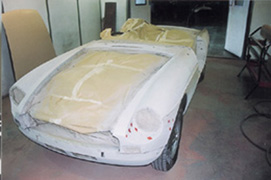 Surface imperfections are filled and smoothed untill undetectable |
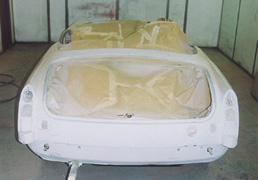 Careful masking is essential during each stage of preparation |
I hope I have given you an insight into the costs of your respray. It is not just a case of a quick spray over a quickly sanded base, but far more work is involved. The time spent in preparation of the surface for the paint, is the most important and time-consuming part of a respray. The more time spent on preparation then the better the final result.
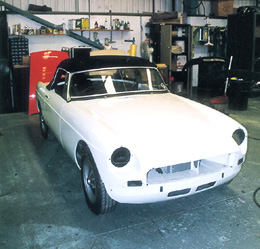 After the paintwork has been completed the process of refitting can begin |
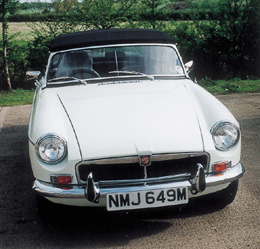 It is essential that chrome trim and detail parts, such as door handles, bumpers and lights are carefully and accurately refitted |
The preparation differs from cellulose here in that there is not quite as much work involved to achieve a really good result. Two pack paint is generally harder wearing than cellulose but is not available to the DIY sprayer, in fact there are moves afoot to control the sale of cellulose as well. This may mean that in the future the only way to get your car sprayed will be to have it done professionally.
The first coat of primer goes straight onto the etch primer base and is usually applied in three thin coats. Once dry, this coat is flattened off with 600 grit wet and dry but on a dry basis. It is then leathered down, dried, degreased and tack clothed off to ensure a dust, dirt and grease free surface. The bodyshell is now given another three coats of primer. Again, is left to dry and now flattened off with 1000 grit wet and dry but this time used wet. Leather down, dry, degrease and tack cloth again and it is ready for the topcoat.
Just a note here, the more primer that is applied and then rubbed down the better the overall result but the more money you will be charged, a general rule is to have about six layers of primer followed by four of paint.
The topcoat is now applied in about four coats and allowed to dry. At this stage, if a low bake oven has been used, all that remains is to compound, T-Cut, finish glaze and polish to achieve the final result. Although this all sounds very straightforward, the process from applied topcoat to finished result can take a number of days to complete.
The time scale for the application of cellulose paint is usually longer and therefore you would expect it to be more expensive. However, because two pack is a more expensive paint than cellulose, both finishes are usually quoted at around the same price as the lower paint cost is offset by the increase in labour.
The reason cellulose takes longer is because after every coat of primer it must be wet flatted, leathered, degreased and tack clothed before the next coat is applied. Once the primer coats have been applied you have the same process with the topcoat. It is not just one session of three coats of paint but more like four sessions with three coats each session, each time the coat has to dry and then be cut back until the final topcoat. This topcoat then has to be T-Cut and polished to achieve a high gloss finish. Cap