MG TF on the Assembly Line
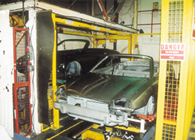
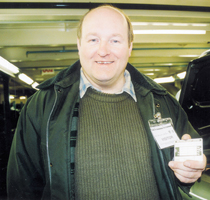
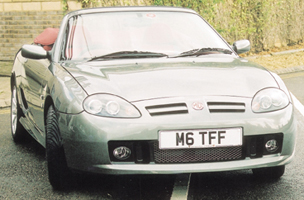
When the MGOC’s Roger Parker ordered a new MG TF we were offered the opportunity to follow his car down the assembly line at Longbridge.
Although the MG Rover Rover Longbridge factory frontage dates back to the fifties it is an impressive building covered by 600,000 square metres of glass and it has been successfully adapted to provide a very clean, bright and attractive work area. A key aspect of MG TF production is flexibility and the line has been designed and adapted to enable the skilled team to build cars in many combinations of engine and trim specification. Flexibility means that MG TFs are assembled to order and you can be sure that the latest MG sports car is not built by robots but by hard working enthusiasts. Once the order has been taken your MG TF can be assembled with particular suspension settings, engine size options and interior trim packages. Fifty people work directly on the body assembly line and each one of them has a specific part to play in the construction of every TF built.
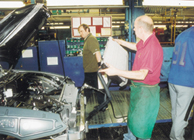
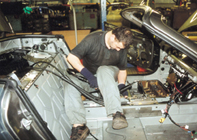
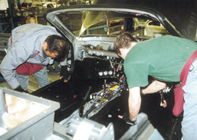
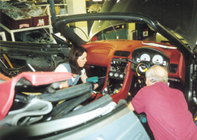
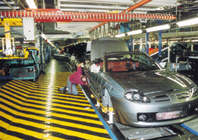
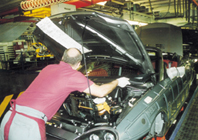
Work commences as soon as the body shell arrives at the line. Fixed on a special support jig the painted shell is lowered onto a moving track and then travels continuously right through the major assembly processes. Every work bay is numbered and while the body moves through each work station it gradually takes shape as the assembly team, working either singularly or in pairs clamber inside or reach up from underneath to fit and fettle all the components. The whole process is very brisk as the workers quickly and deftly execute each task, surprisingly they still seem to have enough time to complete each job and check their work without making any quality compromises. Those of us who have restored or even repaired our cars can only wonder at the speed and skill with which these people can operate, sliding cables through tricky pathways, threading complex looms into place and nimbly attaching the various electrical connections and components.
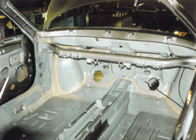
Observing the TF under construction it quickly becomes apparent how much more complicated is the design of a modern car when compared with an MGB or Midget. The TF’s monocoque bodyshell is a clever arrangement which manages to incorporate a mid engine layout with a useable boot and decent cabin space. Most striking when looking at the internals of the shell is the massive cockpit rail or large diameter tube that provides strength for the scuttle. It is also serves as location for the steering column and just like the MGB comes ready for the controls to be fitted either for either right or left hand drive.
The wiring loom in particular, is a staggering mass of brightly coloured cables to cope with the much greater complement of electrical components. Even so, it worth noting that there are different looms for different specs of TFs, for example models with or without spotlights, so make up your mind when ordering. All this cable is threaded into the tunnel and other recesses of the shell and clipped in the optimum position.
The fuel tank is a particularly neat installation, located behind the seats and in front of the engine bay in a space that is enclosed by huge bolt-on cover. Protected well away from the ravages of the weather and in an optimum position for weight distribution and crash protection.
The assembly line is designed to allow work to be carried out from both sides and also from underneath. All component parts are stored on both sides of the track and arrive at either side for fitting. Computer control of the assembly process enables the more specialized required parts such as colour matching valence/bumpers to turn up on a ‘just in time’ basis.
Each TF has its full specification sheet attached and the assembly team consults the list before starting work. Each car is different, built to order in a bespoke manner. So the line may be a procession of cars of different colours, different trim, different engines and suspension specifications and even with right or left hand drive.
Watching a shell growing into a fully fitted up car is a strangely moving experience especially as the TF in question was being built for Roger Parker. He had selected his body colour, trim specification and chosen his 160 power plant and the sport pack suspension. It was with a mixture of awe and anticipation that we watched the bare shell grow into a fully trimmed body which was now ready for dropping on to the front and rear subframes, a process which will describe next month.
|
 |
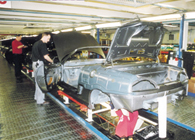 |
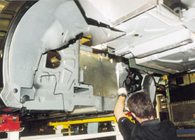
| Body shell arrives on the line | Engine bay cooling fan and heat shield being fitted | Body panel protection in place |
 |
 |
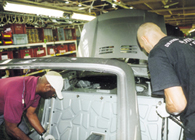 |
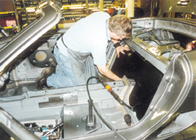
| Bare shell interior with front cross brace much in evidence | Fitting fuel tank | Dennis Broadbent and Wayne Biggs fit the large fuel tank cover panel |
 |
 |
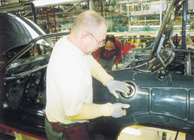 |
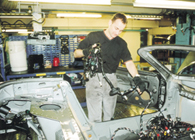
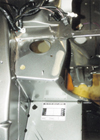
| Paul Stokes threads in the wiring loom | Chassis plate and shell ID marking chemically etched into the shell | Trevor Thorpe fits the fuel filler |
 |
 |
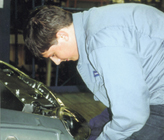 |
| Stuart Major fitting a headlight unit | Gear selector and handbrake fit | Radiator fit |
 |
 |
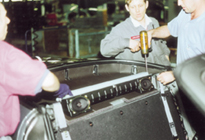 |
| Carpet fitting | Interior trim panels going in | Rear speaker assembley |
 |
 |
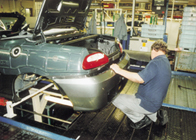 |
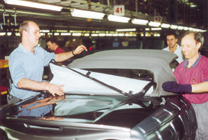
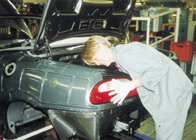
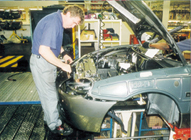
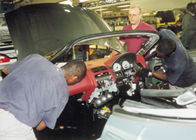
| Hood being fitted | Lisa Pointer fits rear light unit after attaching the all important TF badges | Colour co-ordinated rear valence/bumper assembly being fitted |
 |
 |
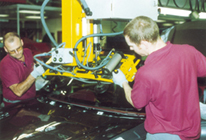 |
| Front valence | Dashboard fitting | Screen fitted |
 |
 |
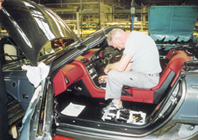 |
| After screen fit looking back down the line | Front compartment, top cover being fitted | Gear knob fitting |
 |
 |
|
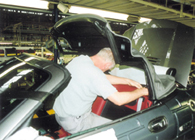
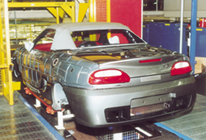
| Finishing off the interior trim | End of the body assembly line |
 |
 |