Engines excel
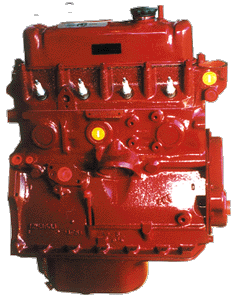
Engines EXCEL
Nowadays replacement engines are referred to as remanufactured units to correctly describe the detail with which every part has been systematically re-worked to a standard exceeding the original when new. As the performance and smooth running of the car ultimately depends on the quality of parts and skill of the engine remanufacturer, we take a look at what processes are involved and how modern standards are now popularly available for MGs.
Given that the newest core engine for reconditioning is at least twenty years old and the oldest MGB is forty years old, the quality of those core units is steadily becoming harder to re-work. Fortunately there are now many new engineering techniques which can not only compensate for this, but also improve the finished product to a higher standard than original. Here is a pictorial guide to the principal stages necessary to achieve a modern high quality unit.
Core Unit Check & Clean
Every used engine is high pressure cleaned and then stripped down to component parts. Those component parts are then chemical cleaned, checked and then stamped to provide a matching reference to re assemble the engine after each individual piece has been either reworked or replaced.
|
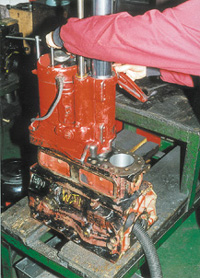
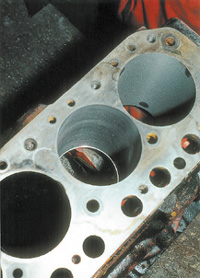
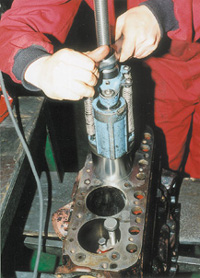
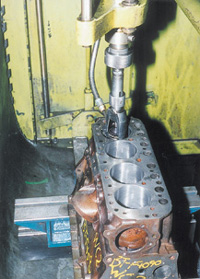
Having checked the cylinder block to make sure it is sound, the cylinder walls(known as the bores) are checked for condition and size. Given that this may well not be the first time the engine has been re-bored, a standard engine will have up to three levels of over-sizing in twenty thou. stages. If the bores are at their maximum already or if a 1950cc engine is being built requiring an overall greater size of cylinder, then the entire cylinder walls will be replaced with liners. These are steel sleeves that are fitted by radically over-boring each cylinder in turn to the outer dimension of the new liner, leaving only a seating ring at the bottom on which the liner will rest. The close tolerance engineering fit requires a four ton press to insert the sleeve, and an anaerobic retaining fluid is used to hold the sleeve fast when fully bedded. The liners can then be bored to size in the normal way ready to be honed. Honing is a two-part process, which provides the very specific pattern and grade of surface finish that will allow the piston rings on the new engine to bed in correctly. The first part is called Honing which gives the bores a cross-hatched pattern within a prescribed range of angles and to a pre determined level of finish. This is done with honing stones lubricated under flowing honing oil on a honing machine, which is a complete machine process to guarantee total accuracy. This is followed by Plateau Honing, which repeats the process but replaces the stones with a cork medium to fine tune to a final surface finish to exact size, pattern and piston ring bedding finish. |
Crankshafts
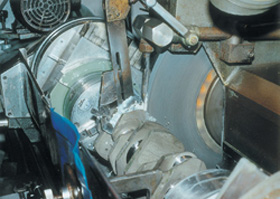
The sizing of each of the journals are measured to check if the crankshaft has been previously re-ground to determine if further reworking is possible. The journals are reground on a crank grinding machine and each journal in turn is refaced to diameter for big end bearings and then main bearings. The engine will be reassembled using new main and big end bearings oversized to match the re-ground sizing. For performance engines the faces may be nitride hardened, and for oversize engines, ie MGB 2100 and Midget 1700, the big end journals can be offset ground to elongate the bore stroke to give greater cylinder cubic capacity.
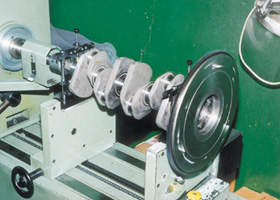
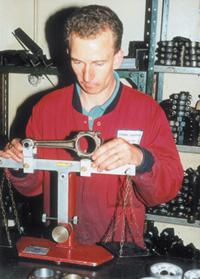
To give a smoother and more durable finished product, the crankshaft flywheel and clutch assemblies can be balanced dynamically to highlight and remove any areas where the original castings are overweight through irregular density or sizing. The con (short for connecting) rods are fitted with new gudgeon pins bushes (where fitted), reamed and then weight balanced on scales with a spirit level indicator as shown. The new complete pistons, which are already weight balanced are then fitted. By removing the vibration caused by such imbalances, the engine runs more smoothly and quietly, and by reducing vibration engine wear is also reduced. Balancing is included on all performance engines and is also available as a worthwhile extra on standard engines.
The original lift and outline shape of the camshaft is recovered using a re-profiling machine. The original faces of the cam lobes are also recovered. By varying the profiles on the machine, an infinite number of differing camshafts can be produced to suit performance engine specifications. The camshaft is re-fitted to the engine using all new cam followers and new camshaft bearings. The cam follower housings are checked for wear and honed to give the correct wall finish. The pushrods are checked for straightness and condition.
Cylinder Heads
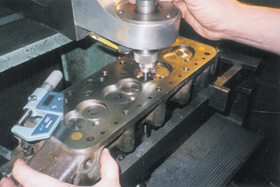
Every cylinder head job now includes replacement of the exhaust valve seats with hardened replacements to allow the use of unleaded fuels. The other significant improvement is in the machining of the valve guides, where having replaced the inlet valve guides and checked and replaced exhaust valve guides as necessary, the guides are rifled down each bore using the UTP knurling process. This encourages the valve to rotate slowly during operation to keep the wear between valve face and valve seat even, thus keeping the valve seal in good condition. The other effect is that whilst allowing sufficient oil down the valve guide to lubricate the operation, the rifling pushes back oil into the tappet chest to prevent oil burning. This process is used now on most modern cars and is highly successful. Other work on the head includes replacing exhaust valves, re-seating all valve faces and seats using the 3 angle process for improved seating. A vacuum test confirms the seal. Replacement valve springs, complete reconditioned rocker assembly with oversized rocker shaft, new reamed and honed rocker bushes, and re-profiled tappet faces are then fitted. The degree of polishing and porting (maximizing the size and smoothing the shape) of a performance cylinder head can dramatically improve the engine performance and skimming or planing the cylinder head can increase compression to create performance at higher rev ranges. For standard engines, checking, crack testing, and pressure testing the head, skim facing the head and block surfaces, together with a thorough de-coking and cleaning are all that is needed.
The cam gears are checked for wear and replaced if worn. The timing chain is replaced in all cases. For performance engines duplex (twin) gears and chains with vernier adjustable timing are used for precise gear timing. This gives smoother running and more power.
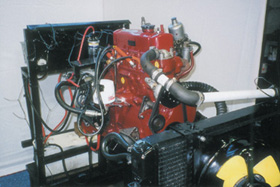
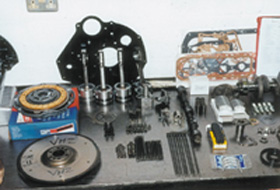
Before work commences on the engine build a complete inventory of all parts needed is compiled and checked. The engine builder assembles the complete unit and completes an engine build check schedule as he goes to form a permanent record of settings, checks and materials used. Other new components are included at this stage such as new/remanufactured oil pump, oil seals, gaskets, locktabs, and other ancillaries. The completed engine is then mounted onto a test bed and fitted with carbs, distributor, exhaust, water pump and rad. in order to carry out a hot (engine running) test. An oil pressure, cylinder compression, and cooling system pressure test are carried out. This confirms satisfactory running, that no oil leaks exist, and allows the head to be re-torqued hot and the tappets reset.
The crated and shrink wrapped engine is then ready for delivery to enthusiast or workshop. The engine fitment sequence is already well documented but remember a few essentials a) Carbs must be in first class order – if in doubt replace! b)Check for water leaks by pressurising the system before start up, c) Make sure all cooling components are working properly ie rad cap and thermostat, d) Have the CO set as soon after the vehicle is started as possible and set to 3.5%, e)Make sure the ignition timing is correct from the outset, f) Use proper running in oil g) Observe 3000 rpm limit and maximum 2/3 open throttle position during running in period.
In our September edition we will take a look at the differing effects of the many tuning possibilities and show you how to specify the state of tune to create and order the exact engine suit your own MG driving style. A complete range of performance and standard replacement engines for all MG models is available from MGOC Spares and Accessories Tel. 01954 231318
| G500 | 1840cc stage 2 MGB | £1250.00 |
| G505 | 1798cc Balanced Eng. MGB | £799.95 |
| G510 | 1950cc MGB engine | £899.95 |
| G510BE | 1950cc MGB Balanced Eng | £949.95 |
| G520 | 1950cc stage 2 MGB | £1450.00 |
| G524 | 2100 High Torque MGB | £1875.00 |
| G525 | 2,100cc stage 2 MGB | £2579.00 |
| G526 | 1798cc 3 bearing stage 2 MGB | £1720.00 |
| G527 | 948cc Midget stage 2 | £1150.00 |
| G528 | 1098cc Midget stage 2 | £1150.00 |
| G530 | 1275cc Midget stage 2 | £1150.00 |
| G535 | 1500cc Midget stage 2 | £1150.00 |
| G536 | 1600cc Midget High-Torque | £1099.95 |
| G545 | 1489cc MGA stage 2 | £1472.95 |
| G546 | 1588cc MGA stage 2 | £1472.95 |
| G547 | 1622cc MGA stage 2 | £1472.95 |
| G548 | 1950cc MGA stage 2 | £1550.00 |
| G549 | 2100cc MGA stage 2 | £2700.00 |
| G552 | 3000cc MGC stage 2 | £2682.50 |
| G555 | 3500cc V8 standard L/F | £1915.00 |
| G556 | 3500cc V8 stage 2 | £3029.00 |
| G557 | 3900cc V8 standard L/F | £2695.00 |
| G558 | 3900cc V8 stage 2 | £4117.00 |
| G559 | 4600cc V8 standard L/F | £3900.00 |
| G559A | 4600cc V8 stage 2 | £4350.00 |
(Run lead or unleaded, exchange surcharge) (engine collection or delivery from £19.95)
| Midget 1275 | £697.50 |
| Midget 1500 | £727.50 |
| MGB models | £769.95 |
| MGB 1950cc | £899.95 |
| Delivery or collection (Surcharge on Exchange unit) Castrol lube packs | £19.95 |
| Running-in Lube Packs from | £34.44 |