Daily driver on the Jewel of India 2001 (part 2)
Jewel of India Rally Part 2
The next day, on our first real rally stage, we left Dungarpur to drive to Bhopal, a distance of 425 kms. A full day’s drive we left as early as 6am. Soon we made our first mistake with the GPS navigation and we were off the rally route. Faced with the prospect of having to drive the same route back for more than an hour we decided to cut across using normal road maps to rejoin the route. The time lost we would make up by skipping lunch. These were two costly mistakes. Finding your way in India using maps and asking for directions is bad news. Not eating in 40 degrees is even worse. We did rejoin the rally but had lost a lot of time and we knew we were in for a long day. To make matters worse, as soon as we were on the route again we hit terrible roads. This is where the MG really got into trouble. Being the lowest car in the field, we had the greatest difficulty in tackling these roads. The road in fact looked more like isolated islands of tarmac, with big holes between them. In these big holes, big rocks were scattered everywhere. It was impossible to drive straight through the holes because we would smash the front of the car and damage the suspension getting out of the pothole on to the tarmac. So I developed a sort of Camel Trophy driving style. This meant driving in first gear and entering and exiting the holes at an angle to avoid head on impact. This also meant we could not drive in a straight line and we were moving at a snail’s pace driving like drunks leaving a twisting trail behind us. Sometimes the road was so bad we drove complete sections next to the road on some terrible track, until that got so bad that we opted for the road again. But even driving like that, we could not prevent the MG from taking hit after hit, and I really started to wonder whether I would be bringing my MG back to Switzerland after all this.
Then suddenly, I felt all strength just flow away and I had to stop. Up to then I had been the sole driver, and 7 hours of driving in the sun without food or sufficient drinking had taken its toll. My blood sugar level had dropped and I could hardly walk. We stopped and I drank Indian Chai with lots of sugar and I stuffed myself with grapes, mandarins and tea cookies. This was horrible, because I was feeling nauseous, but with I knew I had to eat in order to recover and feel a bit better again. My brother took over as driver and I sat in the car like a zombie for about an hour, drinking as much water as I could. This should be a warning to all those who drive long distances in the heat. Drink at least two litres of water mixed with minerals and vitamins, to replenish what you lose when you sweat and always eat fruit. Also, when you drive a rally, the co-pilot must be able to drive the car. If I had driven on, surely I would have had or caused an accident. Some of the other teams were husband and wives teams, with only the husband capable of driving the classic. This is dangerous, everyone can have a lapse and someone should be able to take over.
Having overcome my little blackout, we were continuing our snail’s pace nursing our car over and through rock and pothole. Then we hit a yet another rock and suddenly a terrible noise came from under the car. We stopped, fearing our rally was over as early as day two. Luckily Simon was almost immediately behind us and it turned out that the downpipe section of the exhaust had broken off and was hitting the engine, which caused the noise. Underbody inspection also revealed both mufflers and pipe sections to be completely flattened, and there were many big holes in exhaust. We could drive on, with what felt like a wounded car, but at least it sounded like an AC Cobra.
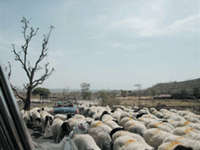
By that time we knew we would not make it in daylight, and that was not a pleasant feeling. Night driving in India is extremely dangerous, with many trucks not having lights at all and the ones that do, have them have them on full beam. They all drive at a ludicrous speeds and blind you when there coming towards you. Sitting in the MG their head lights were exactly at our eye level, so the last ten meters before an oncoming truck had passed us, we were almost completely blinded. Besides these suicide lorries, Indian motorways are home to the pedestrian, horse and carriage, Holy Cow, flock of sheep and non-motorised riksja, none of them carrying any lights. Broken down lorries are left on the road, unlit, with the driver often taking a nap under the lorry! Add to this the continuos threat of the unseen sleeping police man and pothole ruining your suspension, and one will appreciate that night driving is something all teams tried to avoid by all means.
We found ourselves driving on our own, as we had lost contact with the rally. Struggling with the intense traffic and GPS navigation in the dark, not sure whether we had a service team behind us, we started to wonder what we had gotten ourselves into. Then, after almost four hours night driving we made contact with five other cars and we drove in convoy through the Bhopal midnight traffic. Bhopal midnight traffic means ignoring every motoring rule existent. You figure out where you want to go and just drive in that direction, regardless of how many cars, bikes, riksjas and people are between you and where you’re going. And when a riksja drove into the back of the MG, l did not even get out to have a look at the damage. The only thing I wanted was to reach the hotel, which we finally did at midnight, the end of an 18 hour stage. But the MG had survived the onslaught of potholed roads, low flying lorries and a direct riskja attack, and my brother and myself had been moulded into a true rally team.
But just like in real life, things got worse before they got better. After three “normal” rally stages including a rest day we had started to believe that the second day had been the absolute worst stage of the rally. Then on day six a 256 mile stage from Bandhargrah to Varanasi was planned. Visiting Varanasi and the Ganges ghats should have been a highlight of the rally and we left camp at 5.30 am, so we would arrive early afternoon, leaving enough time to sample Varanasi. In fact, it took us more than 22 hours to finish, the first 103 miles taking 11 hours alone. The roads were so bad that at some sections my brother got out of the car to guide me through the holes and to give that extra inch of ground clearance. At one stage he was walking almost continuously. I don’t know what was more frustrating, the fact that he was walking faster than my MG was driving or being overtaken by every other car in the rally. Because the MG was the lowest, everybody else could go faster. Also, we had no idea when roads would improve, and we did not speak about it either. When you are driving like that for hour after hour, it is pointless to talk about it, you just drive on. In fact, we hardly spoke at all. It was so intense. We only stopped to change drivers every three hours. Hour after hour the roads did not improve. The area we were driving through was deserted. On the very worst section, we covered just under 6 miles in an hour. It was the toughest drive of my life.
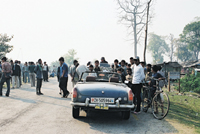
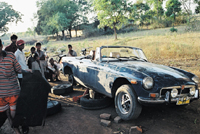
Then finally, at about 5 p.m. we hit proper roads again. But we knew we had several hours of night driving because Varanasi was still 150 miles away. And then – just a couple of minutes on the main road – finally the long expected breakdown. We heard something was broken and when we stopped we saw that the rear leaf springs were loose from the back axle. We had not noticed it on the bad sections! We could not drive on and we could not fix it ourselves. A huge crowd surrounded us, but I was in no mood for friendly chats. At that stage I thought the rally was over. Then out of the blue, Simon the mechanic arrived, and to my complete surprise told us that he would have us on the road again pretty soon. Both right U bolts that fix the leaf springs to the axle had snapped (this is the kind of beating the car had taken), and he took a bolt of his own Mahindra jeep. One hour later both MG and Mahindra were ready to go again, albeit both with a single bolt. In the night drive that followed, my brother missed a dead cow by about thirty cm, we were nearly lynched by angry lorry drivers when we jumped a traffic jam of about 100 trucks, and our GPS system failed us when we entered Varanasi. And driving with only one right U bolt, meant hitting a pot hole or sleeping police man would cause breakdown again. Unfortunately on pitch black Indian roads, you can see neither of them. But we made it and after 22 hours, at 3.30 a.m. we were the last team to come in. The next morning we were given a hero’s welcome at breakfast, several participants telling us that they had been thinking of us and the low slung MG all day. This is how close all the crews had grown together.
In the morning the MG’s suspension was “properly” repaired, which meant that all U bolts were now Mahindra parts, but we could go on. In the mean time we had learnt that about five teams had tried another route and had not made the stage at all. They were stuck at midpoint. Even worse, disaster had struck. A damaged Bentley had jumped forward on starting and knocked over two girls, seriously injuring at least one of them. The driver was jailed awaiting trial and 4 other teams had stayed, to comfort his distressed wife and arrange legal support for the jailed driver. The rally was now split into two groups, only to be re-united in Kathmandu. The Bentley driver was sent for trial and fined a relatively low sum, but still retired from the rally. A Jaguar XK150 retired because of irreparable suspension damage, the crew continuing in a Jeep. Crews and rally organisers agreed to drop the competition element of the rally, deciding that finishing was the real challenge. The two competition managers took on a new and more essential role, becoming the second service team. The rally had gotten tough. Incidentally, the last official score bulletin shows the novice long distance rally team in the blue MG leading the competition!
After the first week, we had the worst behind us, and MG and crew developed a proper rally rhythm that we maintained throughout the remaining two weeks. Every night we figured out how long we had to drive the following day, and targeting a finish time of 5 p.m., we worked out how late we had to leave which usually was around 6 am. We drove most of the day, only stopped for coke and fruit or freshly fried somozas. From our open car we saw little villages awake under the rising sun and sleepy villagers brushing their teeth with fresh branches looked in amazement at probably the first open sportscar that they had ever seen. We drove Himalayan mountain passes to reach Katmandhu and onwards to the romantic hill stations Nainital and Shimla. We followed the old camel trails taking us through the great deserts of Thar and Rajastan, to discover the rugged fortress Jaisalmer and the magical oasis Gajner.
The MG that was in its element and we were finally outpacing big 6 litre Bentleys and Mark V Jaguars. It took mountain passes and desert roads in its stride. We did not break down any more, although the rest day in Kathmandu was used to re-tamper the leaf springs gone flat, and during the Shimla rest day the front suspension was rebuilt. More Mahindra jeep parts gratefully accepted! In all these days, the MG never stalled, always had plenty of torque when needed and did not overheat. In fact, during the whole rally, the MG just inspired much needed confidence. When you’re driving alone in the desert of Thar for a whole day in 40 degrees of heat, or when you’re climbing a steep winding Himalayan mountain roads, you don’t want to worry every second if your car is going to make it!
After three weeks the rally finished in Kumbhalgarh and we had a wonderful party. The next day were invited by our patron, our friend the Maharana, at his palace for formal dinner and we enjoyed the beauty and splendour of Udaipur and its palaces for one last time. Then the cars were dropped at the customs compound and we all left India. When I collected the MG in London, a month later, I was shocked at the condition it was in. On Indian roads I did not really notice it, but driving back on smooth French and Swiss motorways, I realised that everything was rattling and loose, my suspension had gone, the steering was slack and the distinct MG exhaust rasp was replaced by a roar of illegal decibel levels. Two months and yet another £5000 of restoration the car is itself again. It is in fact driving and sounding better than it ever did.
India and its people have given me an experience that I will never forget. I am glad that was able to give India something back – I raised over £4000 for a UNICEF schooling project for little girls in Barabanki in North India. I felt it was important to do something for a country that in all it’s poverty so warmly welcomed these strange people who choose to rally their expensive cars through these remote places.
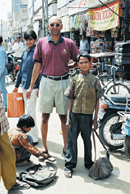
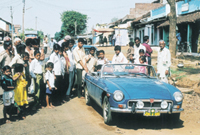
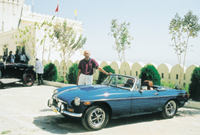
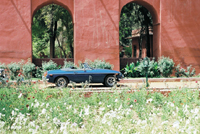
The MG is back at being my daily driver again. I could not yet bring myself to remove the rally plate from the back of the car. It will probably stay on till the next big rally. I hear there are some places left for London to Sydney in 2003. All I need is three months off, £50.000 and my wife’s permission. I already have the car. Narinder Kasi Captions MG negotiating a flock of sheep Day six, MG finally broken down Narinder having a shoeshine on a rest day MGB provokes a lot of interest wherever it goes Author and intrepid rally driver Narinder Kasi MG in Gajner Palace Day 13, MG crew come to the aid of Bentley team