Daily driver on the Jewel of India 2001
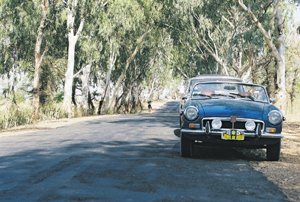
Daily driver on the Jewel of India 2001
As many owners will attest, given regular service, MGs can and should be used daily combining reliable transport with classic motoring enjoyment. You can even attempt a road rally without any special preparation. I did this last year when I drove my 1973 B Roadster from Zurich to Luxembourg for my very first rally: the “Rally Touristique des Vosges”, a three day event where the real challenge is in navigation and avoiding those penalty points in the regularity sections. But unfortunately, due to family circumstances, my wife and navigator designate, could not make it at the very last moment and I ended up as the only 1 man team in a field of about 250 cars. Not blessed with any sense of direction coupled with an inability to read a map in a car without getting nauseous, I am happy to let my wife give directions, turning left, right or straight on as ordered. So to drive a rally where good scores were dependent on finding the smallest of roads on the most detailed of Michelin maps, on my own, was never going to be easy. I adjusted my personal target to “not finish last” and developed a new “1 man team driving style”. Which entailed stopping at one waypoint, study the map, memorise the next waypoint, then drive as fast as possible to that point, stop again, imprint the next one on the brain, and repeat the whole thing. These 3 days of on continuos stop/go with very hard driving in between each of the stops did not faze the MG at all, in fact after the event, driving back to Switzerland I noticed that the car had actually become quicker and more responsive. As many teams found out, when you don’t drive your classic regularly and then suddenly drive it hard for a couple days, the strangest bits suddenly break or fall off. Many shining beauties that looked ready to compete in any concours were stranded next to the road, basking in unused glory. I on the other hand, just took my daily driver to Luxembourg, competed for three days and drove back. And by the way, I finished second from bottom!
I was ready for some more rallying and believed the MG was up for it. My dream has always been to drive long distance classic car rallies such as “Peking to Paris” or “London to Capetown”. This seemed impossible though, as family demands, combined with a career make it impossible to take a month off, just to drive around some remote part of the world in an MG. Then I saw the add for the Jewel of India rally and I knew I had to do that one.
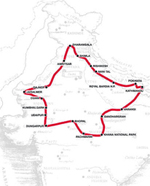
I work for Energis as Director Customer Operations and I submitted an application for the Chairman’s Award, asking Energis to sponsor the entry fee and the time off. I would be driving with my brother as co-driver. Yes, I won and me and my brother had tickets to drive the Jewel of India – a 6000 km rally for classic cars, traversing the Northern parts of India. The Rally started in Udaipur, driving east into the historic jungles of Kipling to the Holy city of Varanasi, before contesting the sweeping dusty plains of Northern India and the long climb up the Great Himalayan Range into Nepal and Kathmandu. After driving west across Nepal the rally reaches the highest of the British hill stations, Shimla, Rishikesh and Nainital. After the Himalayas have been left behind it is into Royal Rajasthan and the majestic desert cities of Gajner, Jaisalmer, Puskar that the rally visits before the final drive over the Aravalli Range back to Udaipur.
Preparing for the Rally
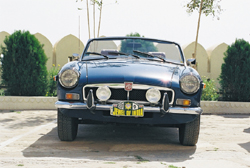
Now the question was – how do you prepare the MG for this gruelling rally? I decided to change as little as possible, for the very simple reason that because I had driven the car almost daily for 4 years, the car was well sorted and balanced. Changing something major, for example uprating the suspension, would probably have a knock on effect elsewhere. If it ain’t broke, don’t fix it! As a result the only things I added were an additional Kenlowe fan, rally fog lights, underbody protection for brake and fuel lines and a sump guard. And yes, the car got the most thorough service it ever had. Every moving part was taken off, inspected, cleaned, greased and put back. If it looked like it could break under stress of the rally it was replaced. Some of the parts that were replaced, could have easily lasted a couple of thousand more “normal” miles, so I kept them to use in future services. All in all the car spent five weeks in a Swiss workshop – I am completely useless as a mechanic. Total cost of the preparation: about £5000 of non-economical restoration. You spent the going rate of a nice roadster to prepare your own car, just to thrash it for four weeks. You hope that nothing terminal will happen to your beloved MG, but you know that it is impossible to drive such a rally without incurring some damage. My only hope was that the “essential car”, i.e. the body, engine and suspension would survive, so we could finish. All bits that were bolted on to it, like bumpers, headlights and exhaust, could break or fall off. Anyway, the car was prepared, and it is incredible how a treatment like that changes your car. My MG had never responded so well, or driven that fast. It also looked the part, with the fog lights and the headlight covers. It was ready to do battle in India.
Finally, we’re driving
The Jewel of India is a small event, with only 15 teams competing. Interestingly enough, although advertised in media with world-wide audiences, the rally seemed to have particular attraction to the English and Dutch, who made up all of the participants, bar one Australian and one Danish gentlemen (albeit the latter was married to a Dutch lady). These people had characters you’d expect crew members participating in exotic long distance rallying to have: eccentric, adventurous, interesting if perhaps not a bit spoiled. But everybody was interested in the other teams and especially in each other’s cars. Being a novice in long distance rallying, I soon discovered that what I thought was a meticulous preparation, was perhaps not so perfect. I had brought a Borsalino Panama hat, where I would probably have been better off with spare bushes. Most of the other participants had already done long distance events before and I was amazed at how they had prepared their cars and what tools and tricks they had brought with them. All these people were obviously proud of their machines (predominantly vintage Bentleys) and preparation, but at the same willing to share all their experience, and to help with advice and tools. It was nice to be surrounded by people who would certainly help in the case of breakdown or any other problem. And because the rally was going to get tough, everybody was going to need that help from the other crews.
At the rally briefing in Brooklands in November 2000, we were promised that this was going to be a sort of “gin and tonic rally”. Easy and short drives, with late afternoon arrival in splendid hotels, where our favourite cocktail would await us (which we even had to detail in one of many application forms!). In reality the rally was gruelling for both car and crew, and extremely demanding both physically as well as mentally. We drove 20 days with only 4 rest days and on average we drove between 8 and 12 hours per day. On the longest day, we were on the road for twenty-two hours. We had to drive at night on several occasions, which was the most dangerous and scary driving I had ever done. Cars broke down, cars retired, and cars had accidents. Crews got exhausted and happily married couples screamed at each other. This was no gin and tonic rally!
A good start
The rally started off well with the flagging off by His Highness the Maharana Arvind Singh of the House Mewar, from his palace at noon. The Maharana was the patron of the rally, and the crews were offered his garage and staff to have the cars cleaned, polished and little problems fixed. All crews were invited for a pre-rally cocktail party at “his place” – the City Palace and after the rally we were invited back for a formal dinner party. For the flagging off, the Maharana had organised quite a reception and all crews were introduced to the crowd and flagged off one by one. We had tulip roadblocks and maps, but in addition we had a GPS with the route loaded and waypoints entered. The first morning all crews were struggling with this little but vital device and also getting to grips with driving in India, where to survive means having to negotiate immense pot holes, enormous “sleeping policemen”, cows, camels trucks, lorries and other undefined moving objects. All this in the blazing heat of 35 to 40 degrees Celsius. On the first day our only lunch stop of the rally was planned in a beautiful palace, after that, lunch was next to the road! When all teams arrived at this fantastic palace from the days of the Raj. It was the first of many more splendid palaces turned into hotels. Everybody was just thrilled by having had a full morning of rallying, being able to navigate to the stopover and just happy that after so many months of preparation we were finally underway. The MG was performing flawlessly in the searing heat, without the need of having to use the additional Kenlowe fan. I had noticed a smell of petrol though, and Simon “Spanners” Skelton, the Chief Rally Mechanic, diagnosed overflow fuel spilling from the bottom of the carburettor in the engine bay. This could be dangerous, so he suggested to take the rubber hose from the windscreen washer bag, attach this to the carburettor overflow pipe, cut holes through the wings on both sides and lead the rubber hoses through the holes into the wheelarches. That way any excess petrol would drop into the wheelarches, rather than on or close to a hot engine. Of course I agreed and had to undergo the traumatic experience of having to witness Simon drilling two holes in the body of my beloved MG. Anyway, it fixed the problem, and I was reminded that rallying can cause serious damage to the health of your car. After a wonderful afternoon drive, we arrived in yet another marvellous palace hotel, where we were welcomed by the son of the Maharaja of Dungarpur. We had dinner in one of the most extravagant dining rooms I had been: the walls were completely covered with trophies from 100 years of hunting. I felt wonderful and thought that if this was a typical day, the rally would be fun: a bit of relaxed driving with enough time to have lunch. Arrive at five for cold beers. Of course, this was not to be.